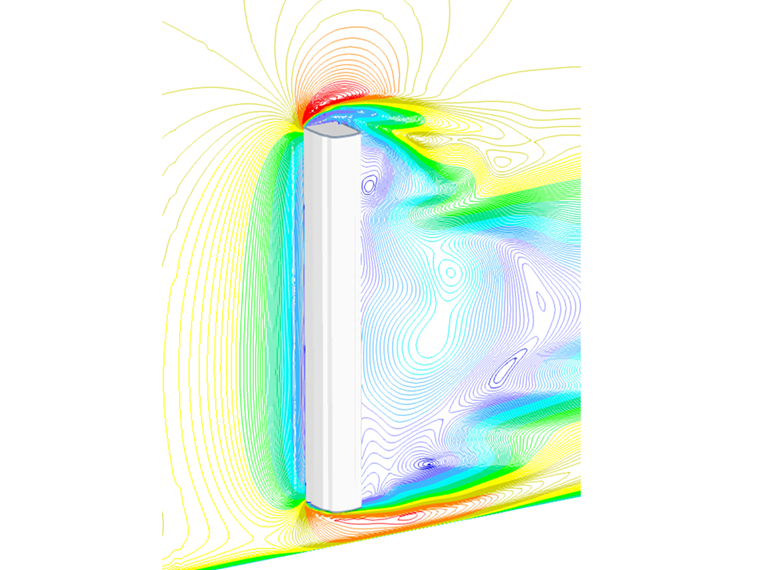
Introduction
As computational methods continue to evolve, CFD (Computational Fluid Dynamics) has become a promising alternative or supplement to wind tunnel testing in structural wind engineering. However, for CFD to gain widespread acceptance among engineers, authorities, and reviewers, its reliability must be ensured through rigorous verification and calibration procedures. This article outlines the key steps and principles behind these processes.
1. Why Verification and Calibration Are Necessary
CFD simulations are highly sensitive to numerous factors, including:
- Turbulence models
- Inflow boundary conditions
- Mesh quality and resolution
- Solver settings and numerical schemes
Without proper verification and calibration, CFD results may look visually convincing but can be misleading or non-conservative in real-world structural applications. Both EN 1991-1-4 and ASCE 7-22 acknowledge the potential of numerical methods, such as Computational Fluid Dynamics (CFD), for determining wind loads, provided that these methods are properly validated and verified. According to Section 1.5 of EN 1991-1-4, numerical simulations may be used in supplement to calculations and physical wind tunnel tests, as long as they are "proven and/or properly validated." This enables engineers to obtain reliable load and response information using accurate models of both the structure and the natural wind environment. Similarly, ASCE 7-22, through reference to ASCE 49, recognizes that while CFD is increasingly applied in wind engineering, its use must be carefully controlled. Since there is currently no dedicated standard detailing the full procedures for CFD in this context, ASCE emphasizes that any application of CFD to determine wind loads on the Main Wind Force Resisting System (MWFRS), Components and Cladding (C&C), or other structures must undergo peer review and a Verification and Validation (V&V) study to ensure the accuracy and reliability of the results.
2. Verification vs. Validation vs. Calibration: Definitions
It is essential to distinguish the commonly interchanged terms:
- Verification ensures that the CFD model is solving the equations correctly (i.e., the code and numerical setup are free from errors).
- Validation assesses whether the model accurately represents the physical behavior of the real-world system (typically through comparison with wind tunnel or full-scale data).
- Calibration involves adjusting model parameters to align CFD results with known or measured data.
3. Verification Procedure
Verification involves checking that:
- The mesh is sufficiently refined (mesh sensitivity study)
- The time step and numerical scheme are appropriate
- The boundary conditions are correctly implemented
- The solver converges consistently
This includes:
- Grid Convergence Index (GCI) analysis
- Residual monitoring and time-averaged stability checks
- Code-to-code comparison (benchmarking against trusted solvers)
4. Validation with Experimental Data
The most critical aspect of CFD acceptance is validation against physical test results, such as:
- Wind tunnel measurements
- Full-scale field monitoring (e.g., pressure taps, anemometers)
Key steps include:
Reproducing the test setup: Geometry, terrain roughness, and inflow turbulence must match the experiment.
Comparing quantities of interest: Mean and peak pressure coefficients, force/moment coefficients, or flow field characteristics.
Statistical analysis: Use of RMS error, correlation coefficients, or normalized deviation metrics.
Validation should be structure-specific, especially for unusual geometries like:
- Antennas
- Lattice towers
- Non-rectangular high-rise buildings
- Timber shells or hybrid structures
5. Calibration Strategy
If minor deviations exist after validation, calibration can be performed by adjusting:
Inflow turbulence intensity and length scales
Turbulence model constants (with caution)
Surface roughness and wall functions
However, over-calibration must be avoided, as it can lead to a model that is tailored to one case but unreliable elsewhere.
6. Documentation and Traceability
For CFD results to be accepted by building authorities or certifying engineers, the process must be:
Transparent: All input parameters, solver settings, and assumptions documented
Repeatable: Other experts should be able to reproduce the results
Traceable: Validation cases must be linked to published benchmarks or experimental references
Tools like RWIND or OpenFOAM, when used for wind load analysis, often include predefined validation examples (e.g., flow around a cylinder, pressure on prisms, comparison with wind tunnel loads from WTG examples). These serve as reference cases for acceptance.
7. Integration into Structural Design Workflow
Finally, for CFD to be accepted in structural load determination:
The CFD outputs (e.g., pressure distributions) must be transferred to FEM software (e.g., RFEM)
Load combinations must follow LRFD or EN design combinations
The pressure data must represent statistically valid wind actions (e.g., 50-year return period)
Introduction
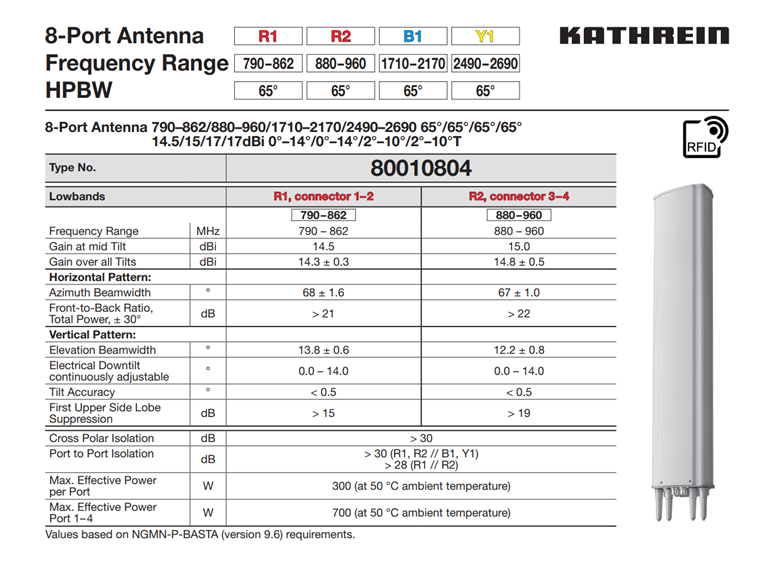
The accurate prediction of wind-induced forces on antenna structures is a critical aspect of structural and telecommunications engineering, particularly for high-frequency, slender devices like the Kathrein 80010804 antenna. In this study, a comprehensive validation of CFD-based wind simulations is carried out for the antenna’s cross-section in collaboration with RWTH Aachen University. The goal is to assess the reliability of numerical results generated by RWIND Simulation software by comparing them with wind tunnel measurements, including both in-house tests and reference data published in the Master's thesis from RWTH Aachen University [1] and technical Kathrein 产品目录 (Images 1 and 2).
One of the key challenges in the validation process is the sensitivity of aerodynamic behavior to the Reynolds number, particularly at low wind attack angles (e.g., 0° and 180°), where flow separation and reattachment phenomena dominate. The aerodynamic performance at these orientations is highly dependent on the flow regime, surface roughness, and the scale of the physical model, leading to discrepancies between CFD results and experimental findings.
This validation study not only serves to benchmark RWIND Simulation but also contributes to refining best practices for simulating complex antenna geometries under wind loading. The findings underline the importance of accounting for Reynolds effects, boundary conditions, and geometrical fidelity to achieve meaningful agreement with experimental data.
![天线结构风荷载分析的CFD模拟:风洞实验验证 [1]](/zh/webimage/057701/4702092/Image.png?mw=760&hash=ec9a55cdca40d30b4481aa04757df3b01dc1fa64)
Description
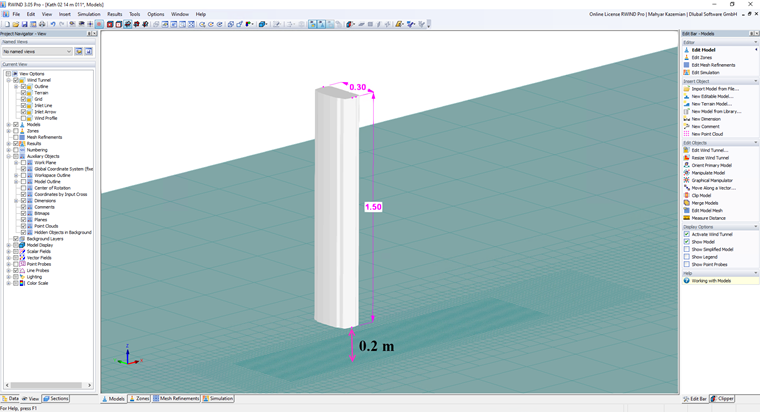
In the current validation example, the force coefficient for both the CFD simulation in RWIND and the experimental study [1] from RWTH Aachen University is investigated. The model represents Kathrein Antenna Cross-Section 80010804 in RWIND, positioned above a grid surface that serves as the ground plane or wind tunnel floor. The model includes several dimensional labels, indicating specific measurements in Image 3. The total height of the antenna is 1.50 m and the width (b) is 0.3 m; its base is elevated 0.20 m from the ground as shown in Image 3. It is important to note that the reference area is assumed to remain constant for all wind directions that is defined as following formula:
Input Data and Assumptions
The required assumption of the wind simulation is illustrated in the following table:
| Table 1: Dimensional Ratio and Input Data | |||
| Wind Velocity | V | 14 - 41 | m/s |
| Height | H | 1.5 | m |
| Bottom Gap | Gap | 0.20 | m |
| Air Density - RWIND | ρ | 1.25 | kg/m3 |
| Wind Directions | θwind | 0o to 360o with step 30o | Degree |
| Turbulence Model - RWIND | Steady RANS k-ω SST | - | - |
| Kinematic Viscosity - RWIND | ν | 1.5*10-5 | m2/s |
| Scheme Order - RWIND | Second | - | - |
| Residual Target Value - RWIND | 10-4 | - | - |
| Residual Type - RWIND | Pressure | - | - |
| Minimum Number of Iterations - RWIND | 800 | - | - |
| Boundary Layer - RWIND | NL | 10 | - |
| Type of Wall Function - RWIND | Enhanced / Blended | - | - |
| Turbulence Intensity | I | 5% | - |
Computational Mesh Study
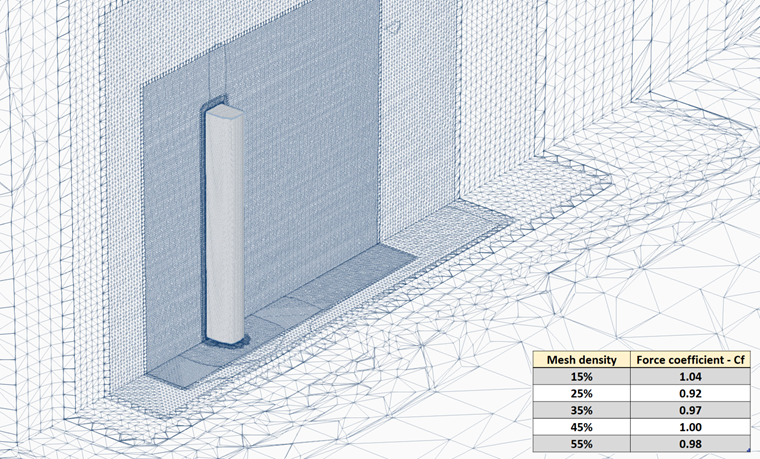
A computational mesh study is essential in CFD analysis because it directly affects the accuracy and reliability of the results. While a well-refined mesh improves precision, excessive refinement increases computational cost without much benefit. Therefore, mesh sensitivity studies help find the optimal balance between accuracy and efficiency, enabling better decision-making with practical use of resources. The table displayed in the lower right corner compares various mesh densities ranging from 15% to 55% and their corresponding force coefficients (Cf) as shown in Image 4.
For more info about computational mesh study:
Results and Discussion
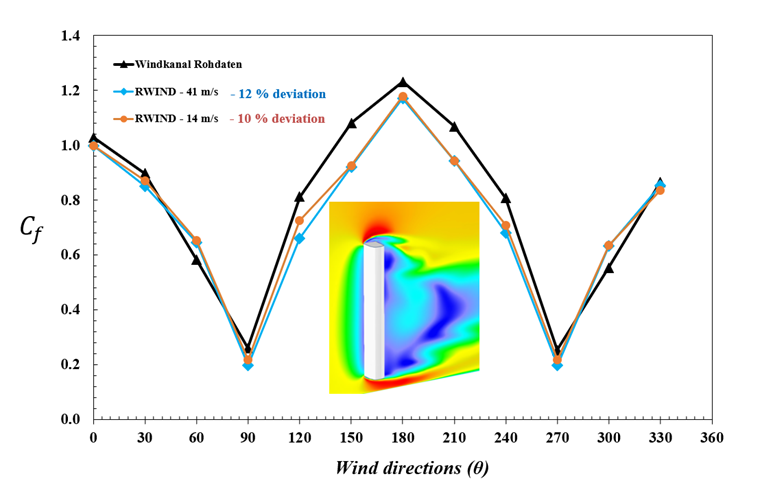
Image 5 compares the force coefficient Cf across the antenna model using wind tunnel data and RWIND at 14 m/s and 41 m/s. Both simulations (14 m/s and 41 m/s) follow the experimental trend, which confirms correct flow orientation sensitivity but slightly underpredicts peak values, with deviations of 10% and 12%, respectively. The minimum Cf occurs at 90∘ and 270∘, and the maximum at 180∘, reflecting wind exposure. The inset CFD visualization illustrates flow separation, supporting the results. The Reynolds number influences flow separation, turbulence, and vortex shedding. Even small differences in Re between CFD (at 14 m/s and 41 m/s) and the wind tunnel may cause changes in pressure distribution, especially at round corner sections. RWIND may not fully reproduce the Reynolds effects due to the physics complexity. The comparison highlights reasonable agreement, with minor deviations due to Reynolds number effects.
More info about how to calculate the wind force coefficient in RWIND:
Conclusion
Overall, the present study validates the numerical wind simulation for the Kathrein antenna cross-section 80010804 by comparing RWIND results with experimental data provided in collaboration with RWTH Aachen University. The comparison confirms that RWIND reliably captures the aerodynamic force coefficient of the rounded-cornered antenna across all wind directions, demonstrating its capability to simulate wind loads on slender, curved geometries. The reasonable agreement between simulated and measured force coefficients underlines the accuracy of the model.
In addition, here is the example from RWTH Aachen University that illustrates the single and three sharp-edge antenna models: