


Beschreibung
Dieses Beispiel untersucht den Durchstanznachweis einer Randstütze nach CSA A23.3-19 [1]. Die Geometrie und die Belastung wurden der Außenstütze D2 aus Beispiel 1 des „CAC Concrete Design Handbook – 4th Edition“, Seite 5-19, entnommen [2].
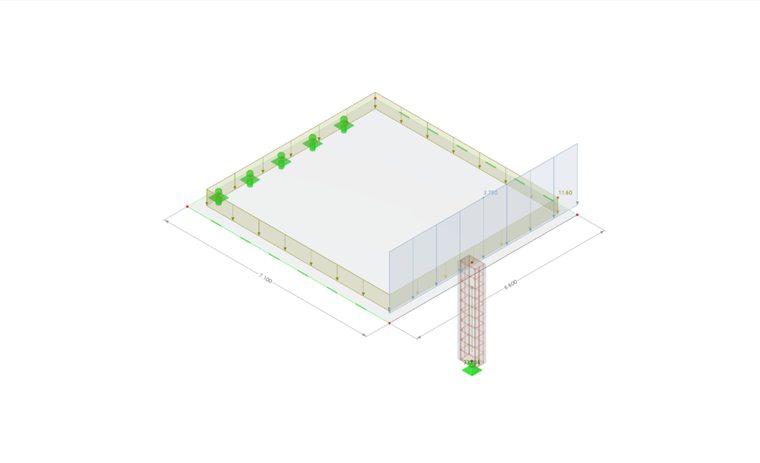
| Materialien | Beton | Bemessungswert der Betondruckfestigkeit | f'c | 25 | MPa |
| Bewehrungsstahl | Bemessungswert der Streckgrenze | fy | 400 | MPa | |
| Geometrie | Platte | Plattendicke | h | 250 | mm |
| Mittlere statische wirksame Höhe | d | 210 | mm | ||
| Stütze | Länge | lStütze | 3.000 | m | |
| Breite | b | 600 | mm | ||
| Höhe | h | 400 | mm | ||
| Lasten | Flächenlast | Stahlbetonplatte | p | 11.6 | kN/m² |
| Schnittgrößen | Kräfte | Durchstanzquerkraft der Stütze | Vf,res | 333.56 | kN |
| Momente | Plattenmoment in erster Richtung | Mf,1,sl | 129.89 | kNm |
\(
\)
\(
\)
\(
\)
Analytische Lösung:
\(
\)
1. Bestimmung der Geometrischen Größen
\(
\)
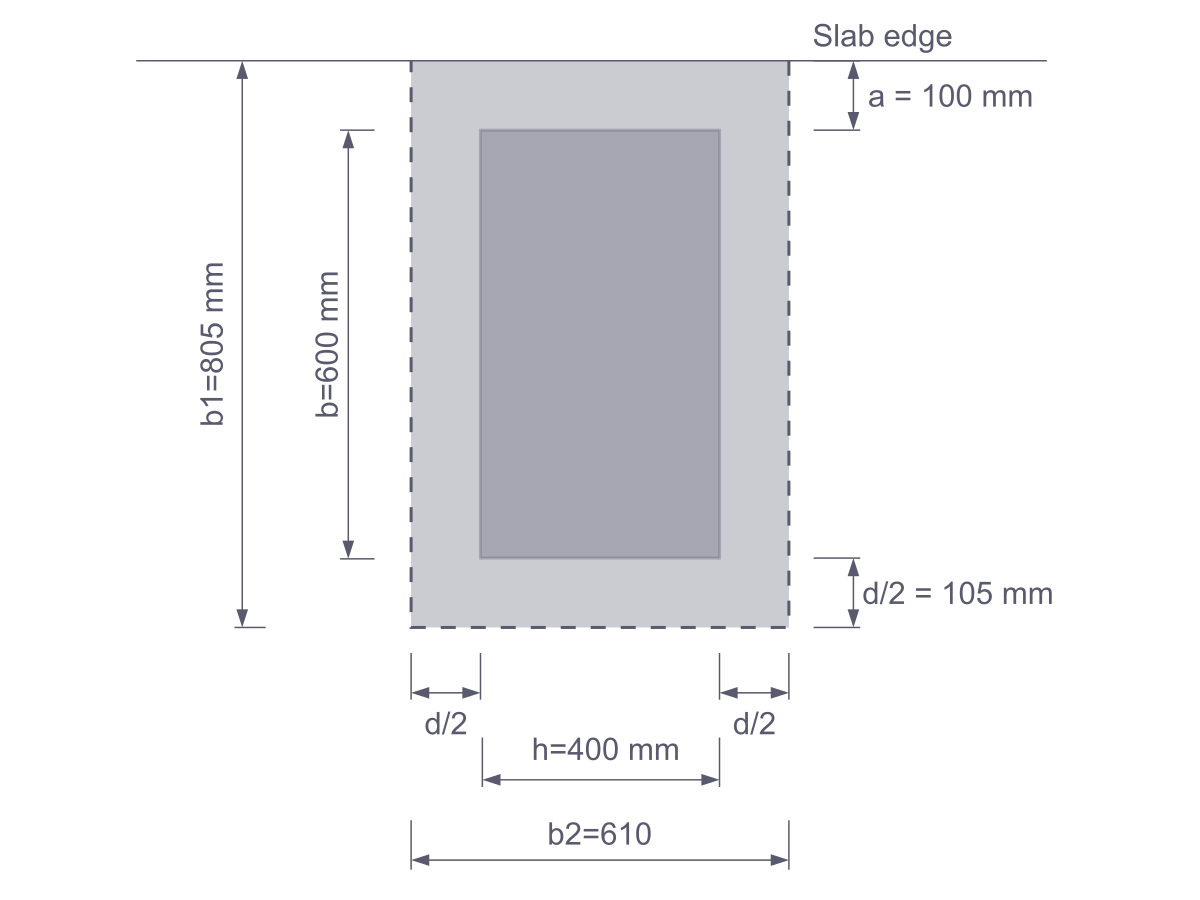
Abmessung des kritischen Rundschnitts parallel zur Exzentrizität:
\(
\begin{aligned}
\mathsf{b_{1}}
&= \mathsf{ b + \dfrac{d}{2} + a } \\
&= \mathsf{ 600 + 105 + 100 } \\
&= \mathsf{ 805\,mm }
\end{aligned}
\)
\(
\begin{aligned}
\mathsf{b_{2}}
&= \mathsf{ h + d } \\
&= \mathsf{ 400 + 210 } \\
&= \mathsf{ 610\,mm }
\end{aligned}
\)
\(
\)
Länge des kritischen Umfangs:
\(
\begin{aligned}
\mathsf{b_{o}}
&= \mathsf{ 2 \cdot \left( b + a + \dfrac{d}{2} \right) + h + d } \\
&= \mathsf{ 2 \cdot (600 + 100 + 105) + 400 + 210 } \\
&= \mathsf{ 2220\,mm }
\end{aligned}
\)
\(
\)
Exzentrizitäten des kritischen Rundschnitts
\(
\begin{aligned}
\mathsf{e_{1}}
&= \mathsf{ \dfrac{ b_{1}^{2} }{ 2\,b_{1} + b_{2} } } \\
&= \mathsf{ \dfrac{ 805^{2} }{ 2 \cdot 805 + 610 } } \\
&= \mathsf{ 292\,mm }
\end{aligned}
\)
\(
\begin{aligned}
\mathsf{e_{2}}
&= \mathsf{ \dfrac{ b_{2} }{ 2 } } \\
&= \mathsf{ \dfrac{ 610 }{ 2 } } \\
&= \mathsf{ 305\,mm }
\end{aligned}
\)
2. Berechnung der Einwirkungen:
Die Indizes „1“ und „2“ beziehen sich auf die Hauptachsen des Systems.
- Der Index „1“ bezieht sich auf die globale X-Achse.
- Der Index „2“ bezieht sich auf die globale Y-Achse. Wird im folgenden nicht weiter betrachtet da nur ein Moment um X vorhanden ist.
\(
\)
Die Reduktionsfaktoren berechnen sich wie folgt:
\(
\begin{aligned}
\mathsf{\gamma_{v,1}}
&= \mathsf{
1
-
\frac{1}{
1
+
\frac{2}{3}
\sqrt{
\frac{
b + \frac{d}{2} + a
}{
h + d
}
}
}
} \\
&= \mathsf{
1
-
\frac{1}{
1
+
\frac{2}{3}
\sqrt{
\frac{
600 + \frac{210}{2} + 100
}{
400 + 210
}
}
}
} \\
&= \mathsf{ 0.434 }
\end{aligned}
\)
\(
\)
Somit ergeben sich folgende „polare“ Flächenträgheitsmomente:
\(
\begin{aligned}
\mathsf{J_{1}}
&= \mathsf{
2 \left(
\frac{b_{1}^{3} \cdot d}{3}
+
\frac{d^{3} \cdot b_{1}}{12}
\right)
-
b_{o} d e^{2}
} \\
&= \mathsf{
2 \left(
\frac{805^{3} \cdot 210}{3}
+
\frac{210^{3} \cdot 805}{12}
\right)
-
2220 \cdot 210 \cdot 292^{2}
} \\
&= \mathsf{3.453 \cdot 10^{10}\,\mathrm{mm^{4}}}
\end{aligned}
\)
Abzumindernde Querkraft infolge der Lastumlagerung innerhalb des kritischen Umfangs:
\(
\begin{aligned}
\mathsf{\Delta V_{f}}
&= \mathsf{ p \cdot b_{1} \cdot b_{2} } \\
&= \mathsf{ 11.6\,\mathrm{kN/m^{2}} \cdot 0.805\,\mathrm{m} \cdot 0.610\,\mathrm{m} } \\
&= \mathsf{ 5.70\,\mathrm{kN} }
\end{aligned}
\)
\(
\)
Die reduzierte Querkraft wird wie folgt berechnet:
\(
\begin{aligned}
\mathsf{V_{f,\mathrm{res}}}
&= \mathsf{ V_f - \Delta V_f } \\
&= \mathsf{ 339.26\,\mathrm{kN} - 5.70\,\mathrm{kN} } \\
&= \mathsf{ 333.56\,\mathrm{kN} }
\end{aligned}
\)
\(
\)
Der Anteil des in der ersten Hauptrichtung übertragenen Moments:
\( \begin{aligned} \mathsf{M_{f,1,\mathrm{sl}}} &= \mathsf{ M_{f,1} - V_{f,\mathrm{res}} \cdot e_{1,\mathrm{sl}} } \\ &= \mathsf{ 167.62\,\mathrm{kNm} - 333.56\,\mathrm{kN} \cdot 0.1131\,\mathrm{m} } \\ &= \mathsf{ 129.89\,\mathrm{kNm} } \end{aligned} \) \( \)
Schubspannung aus der reduzierten Querkraft: \( \begin{aligned} \mathsf{\nu_{fv}} &= \mathsf{ \frac{ V_{f,\mathrm{res}} }{ b_{o} \cdot d } } \\ &= \mathsf{ \frac{ 333.56\,\mathrm{kN} }{ 2.220\,\mathrm{m} \cdot 0.210\,\mathrm{m} } } \\ &= \mathsf{ 0.715\,\mathrm{MPa} } \end{aligned} \) \( \)
Die maximal wirkende Schubspannung ergibt sich zu: \( \begin{aligned} \mathsf{\nu_{f}} &= \mathsf{\nu_{fv} + \frac{\gamma_{v,1} \cdot M_{f,1,sl} \cdot e_{1}}{J_{1}}} \\ &= \mathsf{0.715\,\mathrm{MPa} + \frac{0.434 \cdot 129.89\,\mathrm{kNm} \cdot 292\,\mathrm{mm}}{3.453 \times 10^{10}\,\mathrm{mm^{4}}}} \\ &= \mathsf{0.715 + 0.477} \\ &= \mathsf{1.192\,\mathrm{MPa}} \end{aligned} \) \( \)
3. Berechnung des Widerstands:
Verhältnis der langen zur kurzen Stützenseite:
\( \begin{aligned} \mathsf{\beta_{c}} &= \mathsf{ \dfrac{ \max\!\left( b,\, h \right) }{ \min\!\left( b,\, h \right) } } \\ &= \mathsf{ \dfrac{ \max\!\left( 0.600\,\mathrm{m},\, 0.400\,\mathrm{m} \right) }{ \min\!\left( 0.600\,\mathrm{m},\, 0.400\,\mathrm{m} \right) } } \\ &= \mathsf{ 1.500 } \end{aligned} \)
Durchstanzwiderstand der Platte ohne Querkraftbewehrung nach 13.3.4.1 (a):
\( \begin{aligned} \mathsf{\nu_{c(a)}} &= \mathsf{ \left( 1 + \dfrac{2}{\beta_{c}} \right) \cdot 0.19 \cdot \lambda \cdot \Phi_{c} \cdot \min\!\left( \sqrt{f'_{c}},\, f'_{c,\max} \right) } \\ &= \mathsf{ \left( 1 + \dfrac{2}{1.50} \right) \cdot 0.19 \cdot 1.00 \cdot 0.65 \cdot \min\!\left( \sqrt{25.00\,\mathrm{MPa}},\, 8.00\,\mathrm{MPa} \right) } \\ &= \mathsf{ 1.441\,\mathrm{MPa} } \end{aligned} \)
Durchstanzwiderstand der Platte ohne Querkraftbewehrung nach 13.3.4.1 (b): \( \begin{aligned} \mathsf{\nu_{c(b)}} &= \mathsf{ \left( \dfrac{ \alpha_{s} \cdot d }{ b_{o} } + 0.19 \right) \cdot \lambda \cdot \Phi_{c} \cdot \min\!\left( \sqrt{f'_{c}},\, f'_{c,\max} \right) } \\ &= \mathsf{ \left( \dfrac{ 3.00 \cdot 0.210\,\mathrm{m} }{ 2.220\,\mathrm{m} } + 0.19 \right) \cdot 1.00 \cdot 0.65 \cdot \min\!\left( \sqrt{25.00\,\mathrm{MPa}},\, 8.00\,\mathrm{MPa} \right) } \\ &= \mathsf{ 1.540\,\mathrm{MPa} } \end{aligned} \)
Durchstanzwiderstand der Platte ohne Querkraftbewehrung nach 13.3.4.1 (c): \( \begin{aligned} \mathsf{\nu_{c(c)}} &= \mathsf{ 0.38 \cdot \lambda \cdot \Phi_{c} \cdot \min\!\left( \sqrt{f'_{c}},\, f'_{c,\max} \right) } \\ &= \mathsf{ 0.38 \cdot 1.00 \cdot 0.65 \cdot \min\!\left( \sqrt{25.00\,\mathrm{MPa}},\, 8.00\,\mathrm{MPa} \right) } \\ &= \mathsf{ 1.235\,\mathrm{MPa} } \end{aligned} \)
Minimaler Durchstanzwiderstand der Platte ohne Querkraftbewehrung: \( \begin{aligned} \mathsf{\nu_{c}} &= \mathsf{ \min\!\left( \nu_{c(a)},\, \nu_{c(b)},\, \nu_{c(c)} \right) } \\ &= \mathsf{ \min\!\left( 1.441\,\mathrm{MPa},\, 1.540\,\mathrm{MPa},\, 1.235\,\mathrm{MPa} \right) } \\ &= \mathsf{ 1.235\,\mathrm{MPa} } \end{aligned} \)
4. Vergleich von Einwirkung und Widerstand:
\( \mathsf{\eta_{13.3.4} = \dfrac{\nu_{f}}{\nu_{r}}} \)
\( \mathsf{\eta = \dfrac{1.192\,MPa}{1.235\,MPa}} \)
\( \mathsf{\eta \approx 0,97} \)
\( \mathsf{\eta = 0,97 \;\leq\; 1 \quad \Rightarrow \quad \text{Nachweis erfüllt}} \)
Die Anordnung einer Durchstanzbewehrung ist nicht erforderlich. \( \)
Ergebnisse
Die Ergebnisse aus RFEM 6 sind nachfolgend dargestellt.
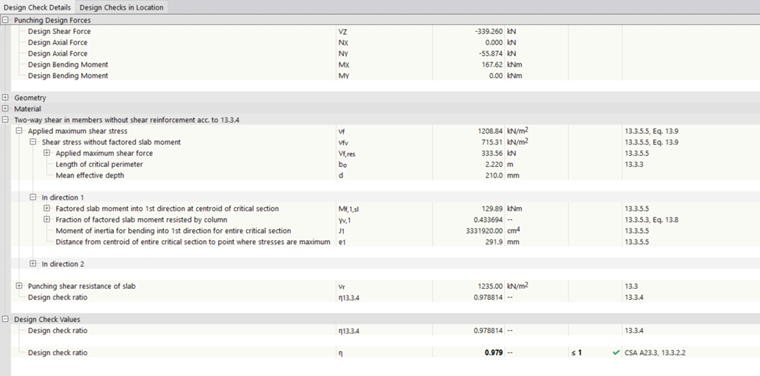
Die Ergebnisse aus RFEM 6 werden nachfolgend mit der Referenzlösung verglichen.
| Durchstanznachweis nach RFEM 6 gemäß CSA A23.3 | |||||
| Parameter | Symbol | Einheit | RFEM | Analytische Lösung | Verhältnis |
| Maximale Durchstanzquerkraft | Vf | kN | 339.26 | 339.26 | 1,000 |
| Wirksame reduzierte Durchstanzquerkraft | Vf,res | kN | 333.56 | 333.56 | 1.000 |
| Maximales Moment in erster Richtung | Mf,1,sl | kNm | 129.89 | 129.89 | 1.000 |
| Polares Flächenträgheitsmoment in erster Richtung | J1 | mm4 | 3.33 × 10¹⁰ | 3.45 × 10¹⁰ | 0.965 |
| Gesamtspannung aus Querkraft und Momenten | νf | MPa | 1.209 | 1.192 | 1.014 |
| Querkraftwiderstand | νc(a) | MPa | 1.441 | 1.441 | 1.000 |
| Querkraftwiderstand | νc(b) | MPa | 1.540 | 1.540 | 1.000 |
| Minimaler Querkraftwiderstand | νc(c) | MPa | 1.235 | 1.235 | 1.000 |
| Ausnutzungsgrad | η | [-] | 0.979 | 0.970 | 1.009 |
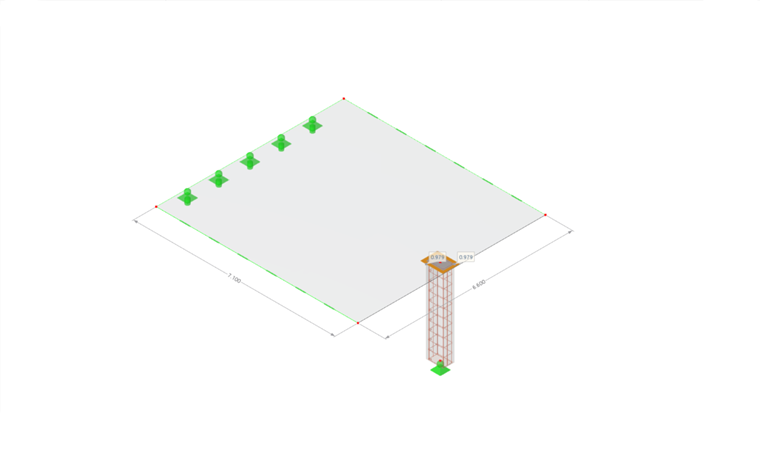
Bewertung
Die Ergebnisse aus RFEM 6 stimmen sehr gut mit der Referenzlösung überein.
RFEM 6 berechnet etwas niedrigere (ca. 3,5 %) Werte für das polare Trägheitsmoment als die manuelle Berechnung. RFEM 6 berechnet das polare Trägheitsmoment gemäß ACI 421.1R.
Der Ansatz in ACI 421.1R ist für alle Querschnittsgeometrien anwendbar und eignet sich sehr gut für eine Softwarelösung.
Im Gegensatz zur analytischen Formel, die nur auf rechteckige Querschnitte anwendbar ist, vernachlässigt ACI 421.1R die Komponente \(\mathsf{\dfrac{b\,d^{3}}{6}}\).
Das kleinere polare Trägheitsmoment nach ACI 421.1R führt zu einem konservativen Ansatz für die Durchstanzbemessung.