


Description
Cet exemple examine la vérification de la résistance au poinçonnement d’un poteau de rive selon CSA A23.3-19 [1]. La géométrie et les charges ont été reprises du poteau extérieur D2 de l’exemple 1 du « CAC Concrete Design Handbook – 4th Edition », page 5-19 [2].
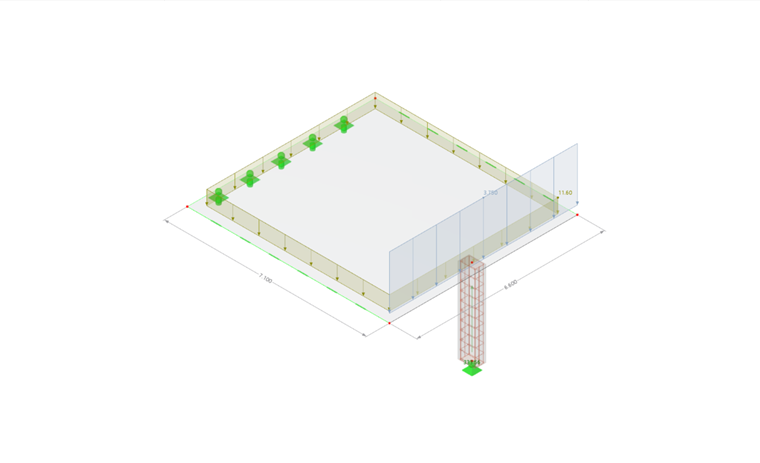
| Matériaux | Béton | Valeur de calcul de la résistance en compression du béton | f'c | 25 | MPa |
| Acier de béton armé | Valeur de calcul de la limite d’élasticité | fy | 400 | MPa | |
| Géométrie | Dalle | Épaisseur de la dalle | h | 250 | mm |
| Hauteur statique efficace moyenne | d | 210 | mm | ||
| Poteau | Longueur | lStütze | 3.000 | m | |
| Largeur | b | 600 | mm | ||
| Hauteur | h | 400 | mm | ||
| Charges | Charge surfacique | Dalle en béton armé | p | 11.6 | kN/m² |
| Efforts internes | Forces | Effort tranchant de poinçonnement du poteau | Vf,res | 333.56 | kN |
| Moments | Moment de la dalle dans la première direction | Mf,1,sl | 129.89 | kNm |
\(
\)
\(
\)
\(
\)
Solution analytique :
\(
\)
1. Détermination des dimensions géométriques
\(
\)
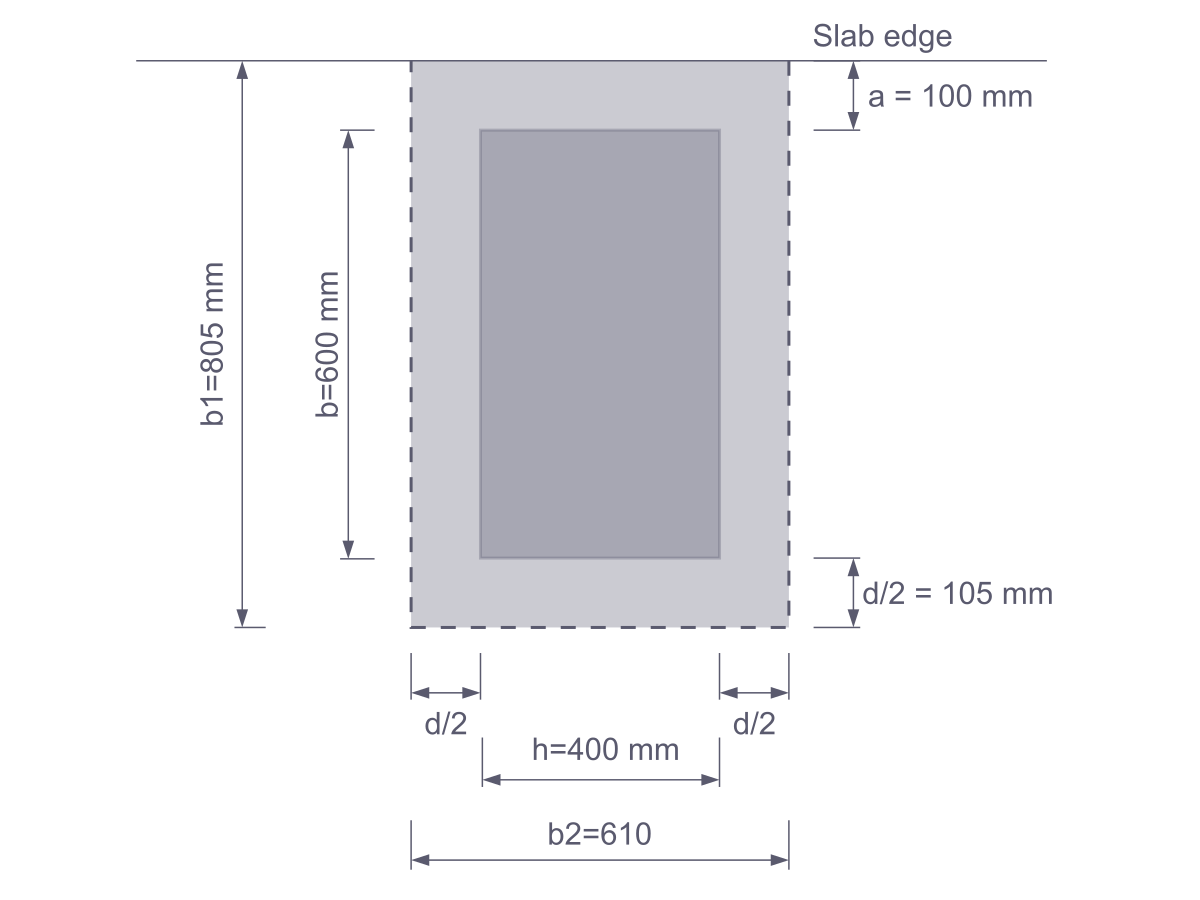
Dimension de la section circulaire critique parallèle à l’excentricité :
\(
\begin{aligned}
\mathsf{b_{1}}
&= \mathsf{ b + \dfrac{d}{2} + a } \\
&= \mathsf{ 600 + 105 + 100 } \\
&= \mathsf{ 805\,mm }
\end{aligned}
\)
\(
\begin{aligned}
\mathsf{b_{2}}
&= \mathsf{ h + d } \\
&= \mathsf{ 400 + 210 } \\
&= \mathsf{ 610\,mm }
\end{aligned}
\)
\(
\)
Longueur du périmètre critique :
\(
\begin{aligned}
\mathsf{b_{o}}
&= \mathsf{ 2 \cdot \left( b + a + \dfrac{d}{2} \right) + h + d } \\
&= \mathsf{ 2 \cdot (600 + 100 + 105) + 400 + 210 } \\
&= \mathsf{ 2220\,mm }
\end{aligned}
\)
\(
\)
Excentricités de la section circulaire critique
\(
\begin{aligned}
\mathsf{e_{1}}
&= \mathsf{ \dfrac{ b_{1}^{2} }{ 2\,b_{1} + b_{2} } } \\
&= \mathsf{ \dfrac{ 805^{2} }{ 2 \cdot 805 + 610 } } \\
&= \mathsf{ 292\,mm }
\end{aligned}
\)
\(
\begin{aligned}
\mathsf{e_{2}}
&= \mathsf{ \dfrac{ b_{2} }{ 2 } } \\
&= \mathsf{ \dfrac{ 610 }{ 2 } } \\
&= \mathsf{ 305\,mm }
\end{aligned}
\)
2. Calcul des actions :
Les indices « 1 » et « 2 » se réfèrent aux axes principaux du système.
- L’indice « 1 » se réfère à l’axe global X.
- L’indice « 2 » se réfère à l’axe global Y. Il n’est pas pris en compte ci-après, car un seul moment agit autour de X.
\(
\)
Les facteurs de réduction se calculent comme suit :
\(
\begin{aligned}
\mathsf{\gamma_{v,1}}
&= \mathsf{
1
-
\frac{1}{
1
+
\frac{2}{3}
\sqrt{
\frac{
b + \frac{d}{2} + a
}{
h + d
}
}
}
} \\
&= \mathsf{
1
-
\frac{1}{
1
+
\frac{2}{3}
\sqrt{
\frac{
600 + \frac{210}{2} + 100
}{
400 + 210
}
}
}
} \\
&= \mathsf{ 0.434 }
\end{aligned}
\)
\(
\)
Les moments d’inertie polaires « polaires » suivants en résultent :
\(
\begin{aligned}
\mathsf{J_{1}}
&= \mathsf{
2 \left(
\frac{b_{1}^{3} \cdot d}{3}
+
\frac{d^{3} \cdot b_{1}}{12}
\right)
-
b_{o} d e^{2}
} \\
&= \mathsf{
2 \left(
\frac{805^{3} \cdot 210}{3}
+
\frac{210^{3} \cdot 805}{12}
\right)
-
2220 \cdot 210 \cdot 292^{2}
} \\
&= \mathsf{3.453 \cdot 10^{10}\,\mathrm{mm^{4}}}
\end{aligned}
\)
Effort tranchant à réduire en raison de la redistribution des charges à l’intérieur du périmètre critique :
\(
\begin{aligned}
\mathsf{\Delta V_{f}}
&= \mathsf{ p \cdot b_{1} \cdot b_{2} } \\
&= \mathsf{ 11.6\,\mathrm{kN/m^{2}} \cdot 0.805\,\mathrm{m} \cdot 0.610\,\mathrm{m} } \\
&= \mathsf{ 5.70\,\mathrm{kN} }
\end{aligned}
\)
\(
\)
L’effort tranchant réduit se calcule comme suit :
\(
\begin{aligned}
\mathsf{V_{f,\mathrm{res}}}
&= \mathsf{ V_f - \Delta V_f } \\
&= \mathsf{ 339.26\,\mathrm{kN} - 5.70\,\mathrm{kN} } \\
&= \mathsf{ 333.56\,\mathrm{kN} }
\end{aligned}
\)
\(
\)
La part du moment transmis dans la première direction principale :
\(
\begin{aligned}
\mathsf{M_{f,1,\mathrm{sl}}}
&= \mathsf{ M_{f,1} - V_{f,\mathrm{res}} \cdot e_{1,\mathrm{sl}} } \\
&= \mathsf{ 167.62\,\mathrm{kNm} - 333.56\,\mathrm{kN} \cdot 0.1131\,\mathrm{m} } \\
&= \mathsf{ 129.89\,\mathrm{kNm} }
\end{aligned}
\)
\(
\)
Contrainte de cisaillement due à l’effort tranchant réduit :
\(
\begin{aligned}
\mathsf{\nu_{fv}}
&= \mathsf{ \frac{ V_{f,\mathrm{res}} }{ b_{o} \cdot d } } \\
&= \mathsf{ \frac{ 333.56\,\mathrm{kN} }{ 2.220\,\mathrm{m} \cdot 0.210\,\mathrm{m} } } \\
&= \mathsf{ 0.715\,\mathrm{MPa} }
\end{aligned}
\)
\(
\)
La contrainte de cisaillement maximale s’élève à :
\(
\begin{aligned}
\mathsf{\nu_{f}}
&= \mathsf{\nu_{fv} + \frac{\gamma_{v,1} \cdot M_{f,1,sl} \cdot e_{1}}{J_{1}}} \\
&= \mathsf{0.715\,\mathrm{MPa} + \frac{0.434 \cdot 129.89\,\mathrm{kNm} \cdot 292\,\mathrm{mm}}{3.453 \times 10^{10}\,\mathrm{mm^{4}}}} \\
&= \mathsf{0.715 + 0.477} \\
&= \mathsf{1.192\,\mathrm{MPa}}
\end{aligned}
\)
\(
\)
3. Calcul de la résistance :
Rapport entre le côté long et le côté court du poteau :
\(
\begin{aligned}
\mathsf{\beta_{c}}
&= \mathsf{ \dfrac{ \max\!\left( b,\, h \right) }{ \min\!\left( b,\, h \right) } } \\
&= \mathsf{ \dfrac{ \max\!\left( 0.600\,\mathrm{m},\, 0.400\,\mathrm{m} \right) }{ \min\!\left( 0.600\,\mathrm{m},\, 0.400\,\mathrm{m} \right) } } \\
&= \mathsf{ 1.500 }
\end{aligned}
\)
Résistance au poinçonnement de la dalle sans armature d’effort tranchant selon 13.3.4.1 (a) :
\(
\begin{aligned}
\mathsf{\nu_{c(a)}}
&= \mathsf{
\left( 1 + \dfrac{2}{\beta_{c}} \right)
\cdot 0.19
\cdot \lambda
\cdot \Phi_{c}
\cdot \min\!\left( \sqrt{f'_{c}},\, f'_{c,\max} \right)
} \\
&= \mathsf{
\left( 1 + \dfrac{2}{1.50} \right)
\cdot 0.19
\cdot 1.00
\cdot 0.65
\cdot \min\!\left( \sqrt{25.00\,\mathrm{MPa}},\, 8.00\,\mathrm{MPa} \right)
} \\
&= \mathsf{ 1.441\,\mathrm{MPa} }
\end{aligned}
\)
Résistance au poinçonnement de la dalle sans armature d’effort tranchant selon 13.3.4.1 (b) :
\(
\begin{aligned}
\mathsf{\nu_{c(b)}}
&= \mathsf{
\left(
\dfrac{ \alpha_{s} \cdot d }{ b_{o} }
+ 0.19
\right)
\cdot \lambda
\cdot \Phi_{c}
\cdot \min\!\left( \sqrt{f'_{c}},\, f'_{c,\max} \right)
} \\
&= \mathsf{
\left(
\dfrac{ 3.00 \cdot 0.210\,\mathrm{m} }{ 2.220\,\mathrm{m} }
+ 0.19
\right)
\cdot 1.00
\cdot 0.65
\cdot \min\!\left( \sqrt{25.00\,\mathrm{MPa}},\, 8.00\,\mathrm{MPa} \right)
} \\
&= \mathsf{ 1.540\,\mathrm{MPa} }
\end{aligned}
\)
Résistance au poinçonnement de la dalle sans armature d’effort tranchant selon 13.3.4.1 (c) :
\(
\begin{aligned}
\mathsf{\nu_{c(c)}}
&= \mathsf{
0.38
\cdot \lambda
\cdot \Phi_{c}
\cdot \min\!\left( \sqrt{f'_{c}},\, f'_{c,\max} \right)
} \\
&= \mathsf{
0.38
\cdot 1.00
\cdot 0.65
\cdot \min\!\left( \sqrt{25.00\,\mathrm{MPa}},\, 8.00\,\mathrm{MPa} \right)
} \\
&= \mathsf{ 1.235\,\mathrm{MPa} }
\end{aligned}
\)
Résistance minimale au poinçonnement de la dalle sans armature d’effort tranchant :
\(
\begin{aligned}
\mathsf{\nu_{c}}
&= \mathsf{ \min\!\left( \nu_{c(a)},\, \nu_{c(b)},\, \nu_{c(c)} \right) } \\
&= \mathsf{ \min\!\left( 1.441\,\mathrm{MPa},\, 1.540\,\mathrm{MPa},\, 1.235\,\mathrm{MPa} \right) } \\
&= \mathsf{ 1.235\,\mathrm{MPa} }
\end{aligned}
\)
4. Comparaison de l’action et de la résistance :
\(
\mathsf{\eta_{13.3.4} = \dfrac{\nu_{f}}{\nu_{r}}}
\)
\(
\mathsf{\eta = \dfrac{1.192\,MPa}{1.235\,MPa}}
\)
\(
\mathsf{\eta \approx 0,97}
\)
\(
\mathsf{\eta = 0,97 \;\leq\; 1 \quad \Rightarrow \quad \text{Vérification satisfaite}}
\)
La mise en place d’une armature de poinçonnement n’est pas nécessaire.
\(
\)
Résultats
Les résultats de RFEM 6 sont présentés ci-après.
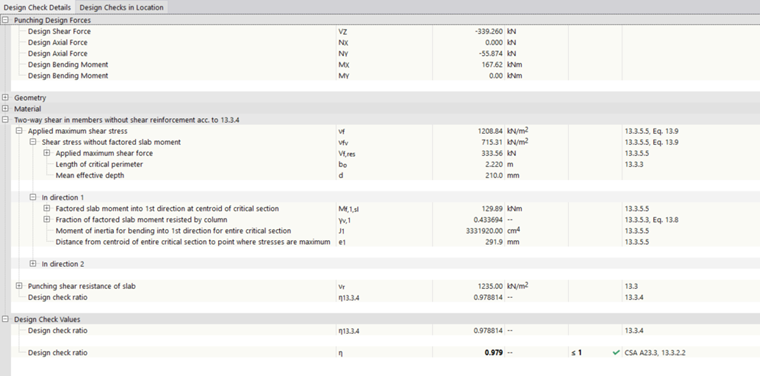
Les résultats de RFEM 6 sont comparés ci-après à la solution de référence.
| Vérification de la résistance au poinçonnement dans RFEM 6 conformément à CSA A23.3 | |||||
| Paramètre | Symbole | Unité | RFEM | Solution analytique | Rapport |
| Effort tranchant de poinçonnement maximal | Vf | kN | 339.26 | 339.26 | 1,000 |
| Effort tranchant de poinçonnement réduit effectif | Vf,res | kN | 333.56 | 333.56 | 1.000 |
| Moment maximal dans la première direction | Mf,1,sl | kNm | 129.89 | 129.89 | 1.000 |
| Moment d’inertie polaire dans la première direction | J1 | mm4 | 3.33 × 10¹⁰ | 3.45 × 10¹⁰ | 0.965 |
| Contrainte totale due à l’effort tranchant et aux moments | νf | MPa | 1.209 | 1.192 | 1.014 |
| Résistance au cisaillement | νc(a) | MPa | 1.441 | 1.441 | 1.000 |
| Résistance au cisaillement | νc(b) | MPa | 1.540 | 1.540 | 1.000 |
| Résistance minimale au cisaillement | νc(c) | MPa | 1.235 | 1.235 | 1.000 |
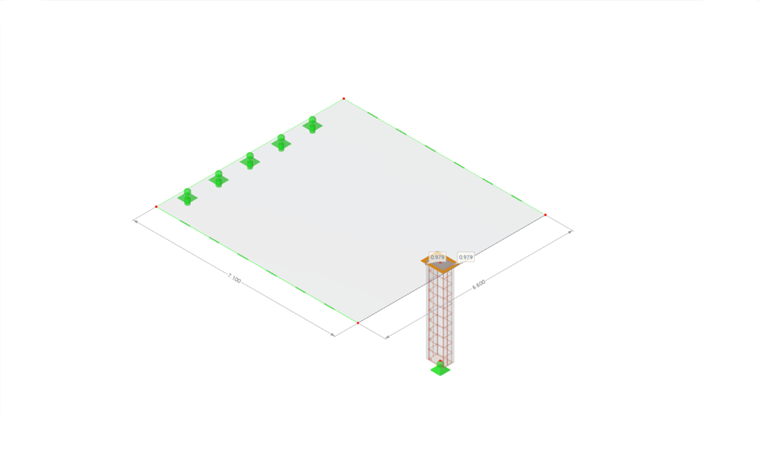
| Taux d’utilisation | η | [-] | 0.979 | 0.970 | 1.009 |
Évaluation
Les résultats de RFEM 6 concordent très bien avec la solution de référence.
RFEM 6 calcule des valeurs légèrement inférieures (env. 3,5 %) pour le moment d’inertie polaire que le calcul manuel. RFEM 6 calcule le moment d’inertie polaire conformément à ACI 421.1R.
L’approche selon ACI 421.1R est applicable à toutes les géométries de section et convient très bien à une solution logicielle.
Contrairement à la formule analytique, qui n’est applicable qu’aux sections rectangulaires, ACI 421.1R néglige la composante \(\mathsf{\dfrac{b\,d^{3}}{6}}\).
Le moment d’inertie polaire plus faible selon ACI 421.1R conduit à une approche conservatrice pour la vérification de la résistance au poinçonnement.