


In the 60s and early 70s, there was great excitement. Almost 30 years after the last Olympic Games in Germany, then still under the Nazi dictatorship, the spectacle was to take place once again in the land of poets and thinkers. The old stadium in Berlin, made of massive concrete and steel, was considered an absolute persona non grata. There was a strong desire to distance oneself from the past, to set oneself apart from the 1930s and 1940s.
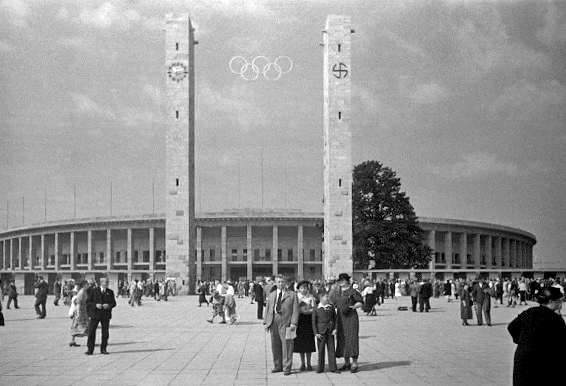
Architecture was also meant to make a global statement: for the construction of a new stadium, this was simply perfect. Germany could thus prove on the world stage that the dark times were far behind it. Something new was needed. And so the Olympic Stadium Munich came into being. No massive concrete blocks. No heavy steel roofs. Instead, transparent glass surfaces, flowing forms, and a roof that seems to float.
In this blog post, we take a closer look at how this extraordinary structure came to be. An architectural revolution and at the same time a technical masterpiece – truly engineering art. Join us as we delve into the construction industry at the end of the 20th century. Together, we set off into a new era of architecture: the Olympic Stadium Munich.
Construction industry of the 20th century: Heavy is safe
In construction, for a long time well into the 20th century, there was a very simple principle: Massive structures are very stable. Spanning large areas with a roof meant quite a lot of material. Massive steel, many thick beams, and tons of concrete. Of course, it worked. But it looked neither beautiful nor was it even remotely economical.
So why not build lighter? Lightweight structures were considered risky. What if the structure collapsed in the end? Public ridicule, damage to one's reputation in professional circles: nobody wanted to take that risk. At least until Frei Otto stepped onto the construction industry stage. By the way, in the USA there was someone who faced the same problem, only in high-rise construction.
Fazlur Rahman Khan also resolutely opposed the prevailing system: massive means safe. Thanks to him, we now have modern skyscrapers. If you are interested in his story, feel free to take a look here: Fazlur Rahman Khan: padre dei grattacieli .
The Olympic Stadium Munich: New symbol for Germany
We already mentioned it at the beginning: the 1972 Olympic Games were very important for Germany. The aim was to consciously present a different image to the outside world than under the Nazi regime. Openness, democracy, and transparency were at the top of the list. A classic monumental stadium was completely out of the question.
Günter Behnisch’s office, Behnisch & Partner, won the second architecture competition with an open, nature-oriented concept. The big challenge, however, was the stadium roof. Here, Behnisch referred to works by Frei Otto that he had seen at the World Expo in Montreal. So he brought him on board right away.
Olympic Stadium Munich: From fabric model to reality
Even then, Frei Otto enjoyed an outstanding reputation when it came to unusually lightweight-looking structures. He suggested building not a roof on massive supports, but under tension. How was that supposed to work?
Together with other planners, he developed a concept that met with skepticism in much of the public and also in professional circles. A visually floating structure made of tensioned cables and glass. Here, stability does not come from massive beams, but arises through tensile forces.
Frei Otto used his principle of letting nature do the engineering. He developed models made of soap films, fabric, and suspended nets. Because, as we sometimes forget in construction, nature already shows us which forms are the most stable and efficient. He therefore had his physical models calculate the ideal structure – a small reminder: there was no structural analysis software back then yet. Which made such models all the more important.
The Olympic roof: a technical sensation
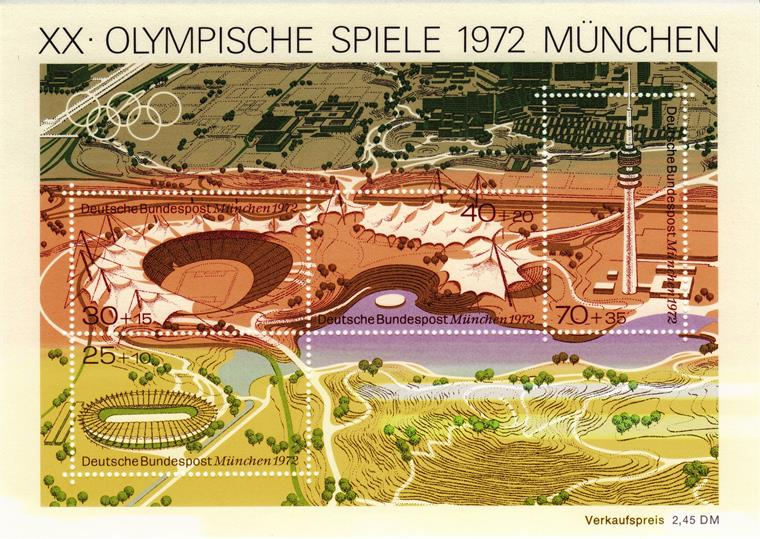
On 9 June 1969, construction began on what was undoubtedly then the most spectacular stadium in the world. In addition to the Olympic Stadium Munich, which could be used for various events, an Olympic swimming hall and the Olympiahalle were also built. The buildings are embedded in the Olympic Park. The goal was not just to create a simple venue, but a harmonious landscape, a coherent overall concept.
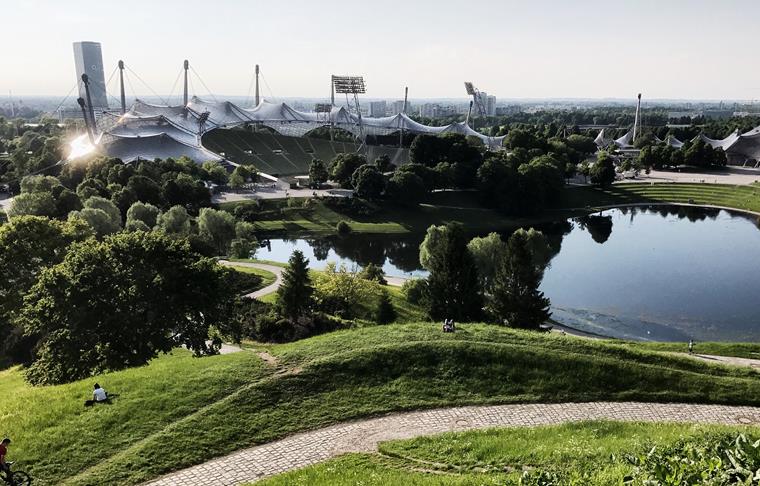
Green spaces, artificial hills, and landscaped ponds were bordered by narrow paths that deliberately did not follow rigid axes. Everything, absolutely everything, was meant to stand apart from Berlin in the 1930s. Particularly interesting in this context: many of the artificially piled-up hills are made in part of rubble from the Second World War. From the remains of old Munich, something entirely new emerged: a place of encounter.
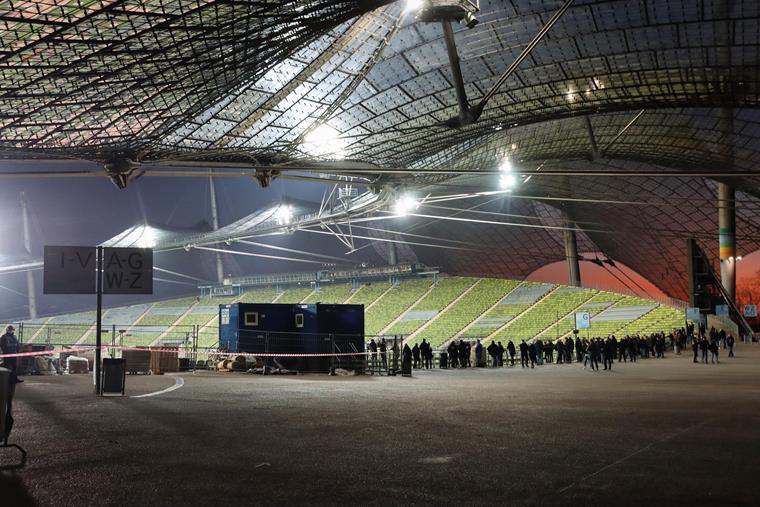
So let us turn to the most exciting part of the entire complex. The highlight of the Olympic Park is undoubtedly the transparent roof. It spans not only the Olympic Stadium Munich, but also parts of the Olympic Hall and the areas connecting the two. This creates a very special effect: everything appears as one unit. Here, the idea of democracy is reflected.
Olympic Stadium Munich: Structure of the roof construction
The structure of the roof of the Olympic Stadium Munich is absolutely brilliant from a structural engineering point of view. Tall steel masts carry the main loads. When you see them in combination with the rest of the structure, they look almost like trees. The enormous network of steel cables resembles interlocking treetops that blend excellently into the artificially created landscape. Rarely has steel looked so elegant.
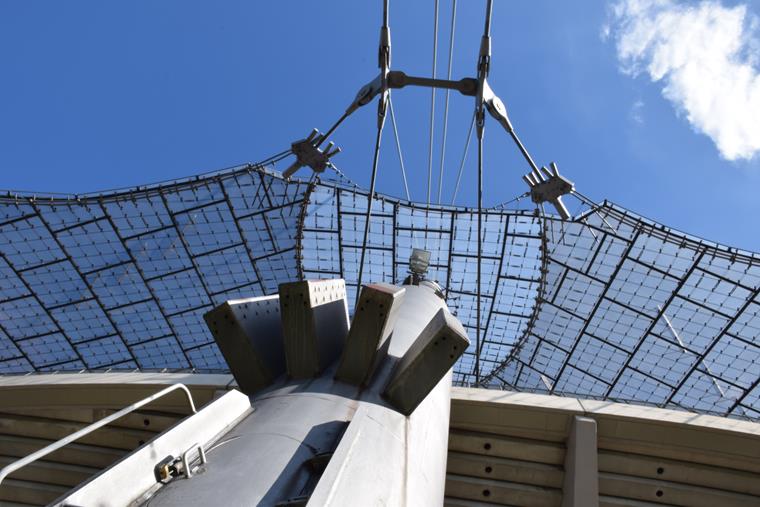
Perhaps you are now wondering: how does the stability of the roof in the Olympic Stadium in Munich come about? After all, it is just masts and cables! In conventional reinforced concrete structures, stability is created by compression acting on the load-bearing structure. In the stadium roof in Munich, however, those responsible relied on tensile rather than compressive forces.
The cables stabilize one another through this prestress. When forces occur, for example from wind or self-weight, they are distributed across the entire network. The tall masts then transfer them directly to the anchors in the ground. The method of prestressing steel cables comes, by the way, from bridge construction. More precisely, Eugène Freyssinet was the first to have the idea of working with prestressed steel to make structures more elegant and load-bearing. If you are interested in the topic, feel free to take a look:.
For the roof surfaces of the Olympic Stadium Munich, transparent acrylic glass panels were used. Unlike steel, these have hardly any self-weight and, together with the cables and masts, form an extremely lightweight structure. At the same time, and that was the point, this system is also very flexible and withstands environmental influences with ease.
Participants in the roof construction
The planning and design of the roof of the Olympic Stadium Munich was, however, a real challenge. Frei Otto supported the architectural office of Behnisch & Partner as a development consultant. But those were by no means the only well-known names working on this project.
In order to ultimately implement the roof structure, Fritz Leonhardt and Wolfhardt Andrä, who ran a joint engineering office, were among those brought into the architectural team. By the way, we have already reported on Fritz Leonhardt on our blog. Feel free to have a look there: Fritz Leonhardt: Un ingegnere fa galleggiare il calcestruzzo .
Each person in this expert team had their own specific task. The project planning was led by architect Fritz Auer, while Frei Otto developed parts of the roof. Otto used the trial-and-error principle for this. How did it all work? He made increasingly larger physical models of the roof and when the structure failed, he went one step back to start again.
Meanwhile, Andrä and Leonhardt worked on calculating sections of the roof using the first CAD programs. On 21 April 1972, the time had come. The roof of the Olympic Stadium Munich was completed, and even today this gigantic structure still seems almost weightless above the Olympic complex.
Olympic Stadium Munich: Influence on modern construction
The Olympic Stadium Munich was intended to become a symbol of Germany's new beginning – and the plan worked. Above all, the roof structure became world-famous and inspired numerous well-known buildings that were to follow. Every major city wanted such a monument of lightness. A combination of prestige and art.
Another architect who has specialized in flowing, almost floating structures is Santiago Calatrava. Why his major projects are repeatedly criticized and why he is now considered a persona non grata in his homeland, you can find out here: Tra eleganza e stravaganza: Santiago Calatrava .
Ultimately, the roof structure of the Olympic Stadium Munich changed the way engineers should think. Material efficiency and stability could be reconciled. Moreover, nature and architecture did not have to exclude each other; on the contrary – they could be combined excellently.
Conclusion: Olympic Stadium Munich
The Olympic Stadium Munich is far more than just a venue for sporting events. It became a symbol that new beginnings often require a good dose of courage. But in the end, it pays off. Innovation in such an old industry as construction has never been easy. All the more impressive are the results when a new idea finally prevails.
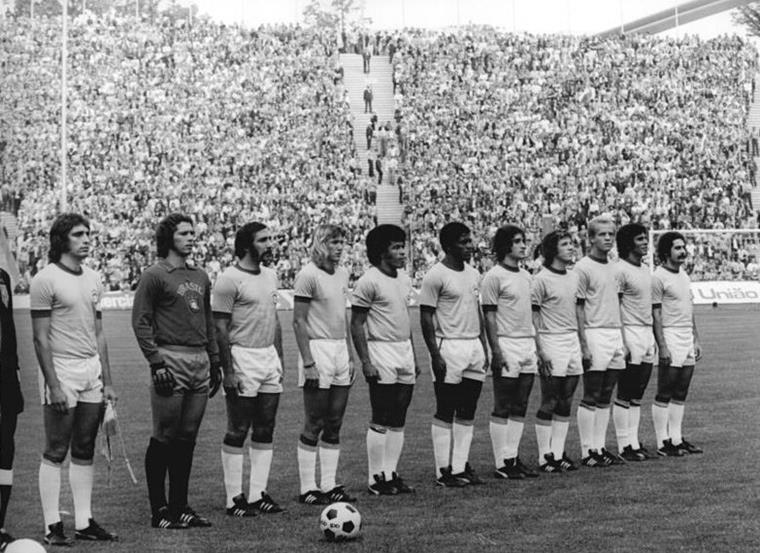
Today, the Olympic Stadium in Munich is used for all kinds of events. For example, from 1972 to 2005 it was the home stadium of FC Bayern Munich. In 1974 the FIFA World Cup was held there, and in 1988 the UEFA Euro. For decades, the Olympic Stadium Munich was one of the most important football arenas in Europe and definitely one of the most beautiful in the world.
The stadium with its spectacular roof was of course also suitable for concerts. Over the decades, international stars such as Michael Jackson, The Rolling Stones, Queen, U2, AC/DC, and Coldplay performed here. But unusual events such as Supercross, motorsport shows, winter sports events, and other extreme sports events also continue to take place there time and again to this day.
So if you ever find yourself at an event there – or even just in the city: book a stadium tour! You can even take part in guided climbing tours on the roof structure. A very special experience. It gives you a unique impression of all the engineering skill that went into this construction project.
A building complex with innovative structures: the Olympic Stadium Munich has an absolutely unique history. Built for just a few weeks of the Olympic Games, it remains one of the city's iconic buildings to this day. In any case, it is truly worth a visit.