Structural Requirements
The hole bearing capacity Fb,Rd is regulated in DIN EN 1993-1-8, Section 3.6.1, Table 3.4. The corresponding equation for the general case is:
However, if there is a single-leg joint with only one bolt row, the hole bearing capacity Fb,Rd has to be limited to:
The product of the coefficients k1 and αb is therefore subject to a limitation to a value of 1.5 in Formula 2.
This takes into account the effects of the eccentricity of the single-leg joint in a general way if the mutual support of the bolt row is not possible due to the absence of another bolt row. It is necessary for the mutual support to take place on the one hand in the bolt row and on the other hand as contact pressure between the plates involved. This means that, in addition to shear forces Fv,Ed, tensile forces Ft,Ed also arise in the bolts. The bolts are therefore subject to combined stress in the longitudinal and transverse directions.
Consideration in Steel Joints Add-on
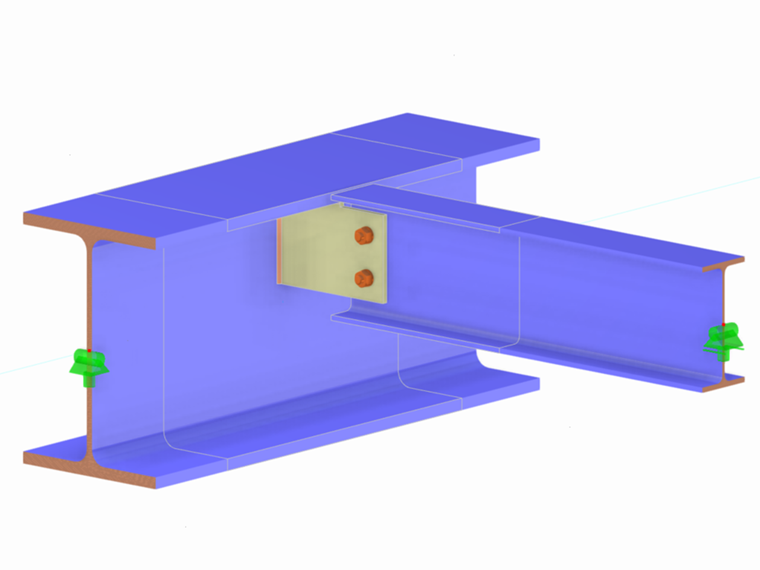
In the Steel Joints add-on, it is difficult to distinguish between single-row and multi-row connections, because the force acting on the steel joint model almost never acts in one direction. Technically speaking, these are thus not single-row connections. Even in a nearly ideal case, forces act on the bolts in both directions, mainly parallel to the member direction, but also to a small extent perpendicular to it.
Since the add-on uses an FE model of the connection with nonlinear material properties, this approach accounts for the local load distribution and the potential stress concentration at the bolt locations. The FE model can better predict the actual behavior of the connection, which may differ from the simplified approach by a factor of 1.5.
The add-on also checks that the plates involved do not experience significant plastic deformation (5%) themselves.
The conservative factor of 1.5 takes into account possible plastic deformation if the load could cause local yielding. By ensuring that no significant plastic strain occurs, we increase the reliability of our approach.
In an analytical (manual) check of this type of shear connection, the tensile forces in the bolts caused by leverage and the eccentric plate connection are not taken into account directly, but are considered using the flat rate of 1.5. In the design check, we use a combination of shear and tensile forces in the bolt to cover this behavior.
The FE method used by the add-on for modeling connections requires checks that are as general as possible. Nevertheless, the results are more accurate and reliable than conservative standard analytical equations.
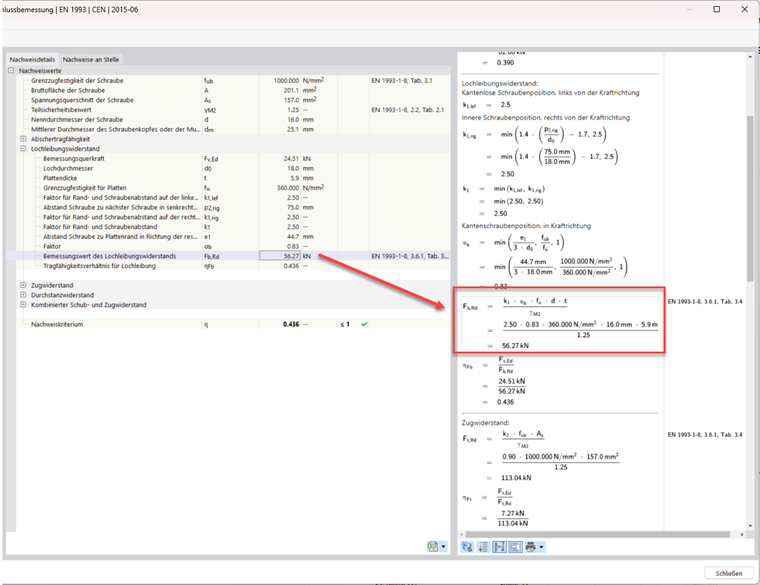
For these reasons, the design according to Formula 1 is listed in the design check details for the general case. The design according to Equation (3.2) or Formula 2 is not performed.
The following image shows the available design from the design check details in the Steel Joints add-on:
Conclusion
The analytical design according to Equation (3.2) of the standard is dispensable. The FE calculation takes into account all effects resulting from the eccentricity of a single-leg joint with only one bolt row.
Click on the following image to download an example model.