Dlubal's successful structural analysis program RFEM is the best choice for demanding structural engineers. This 3D FEA software meets all the requirements in modern civil engineering.
- Products
- Dlubal API
- Dlubal API
Discover Dlubal API
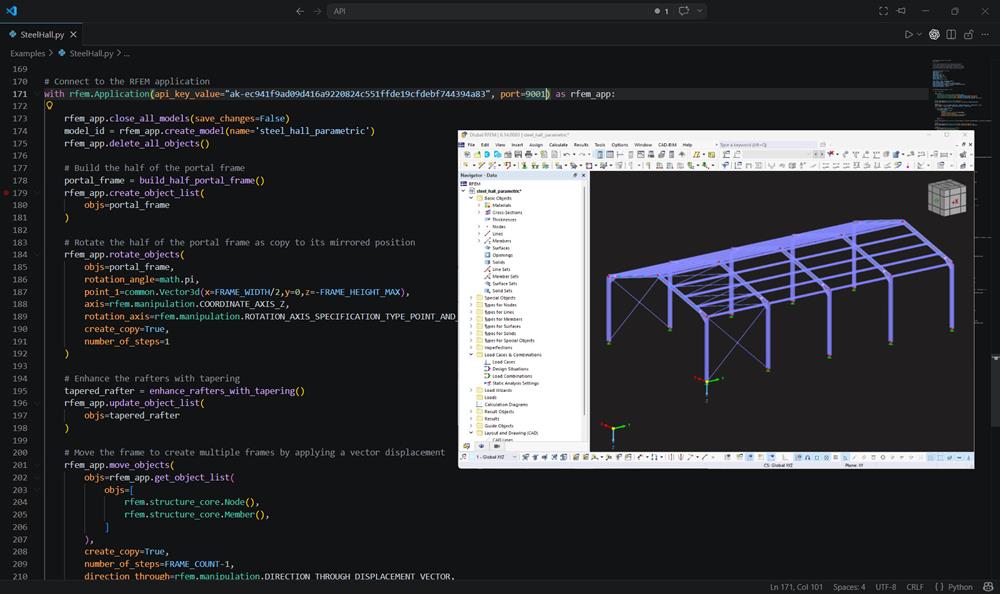
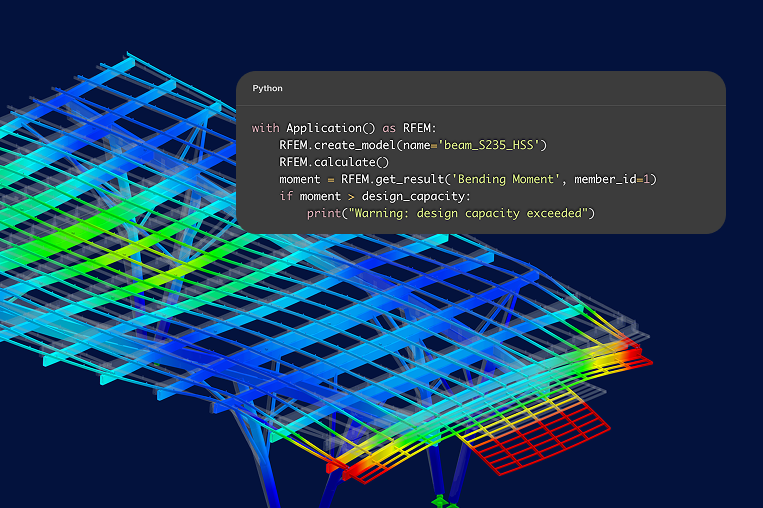
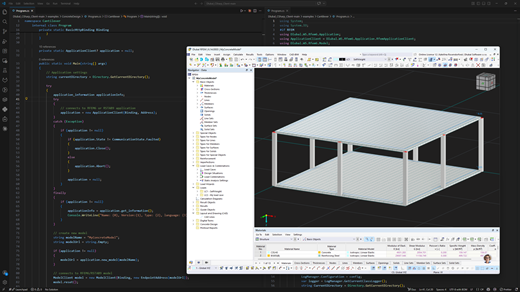
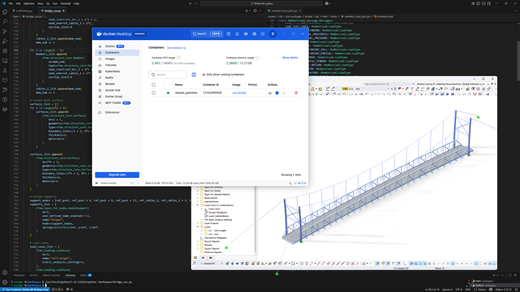
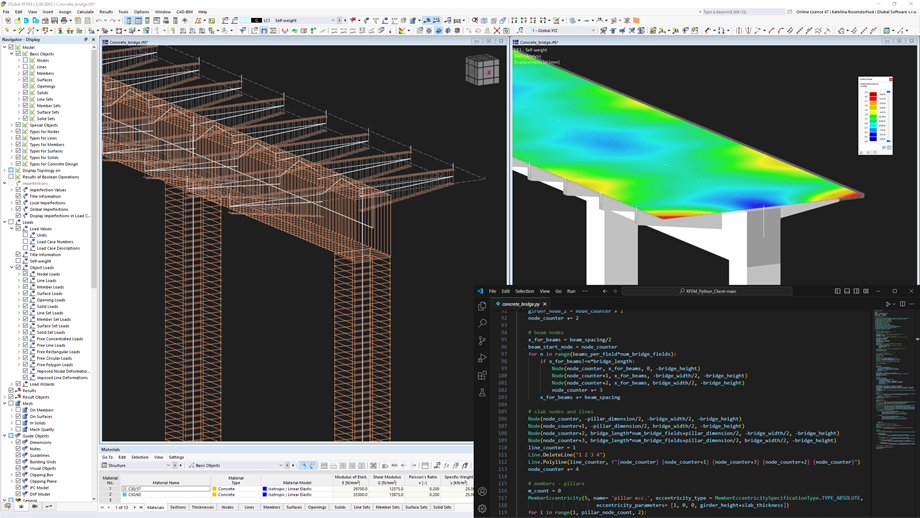
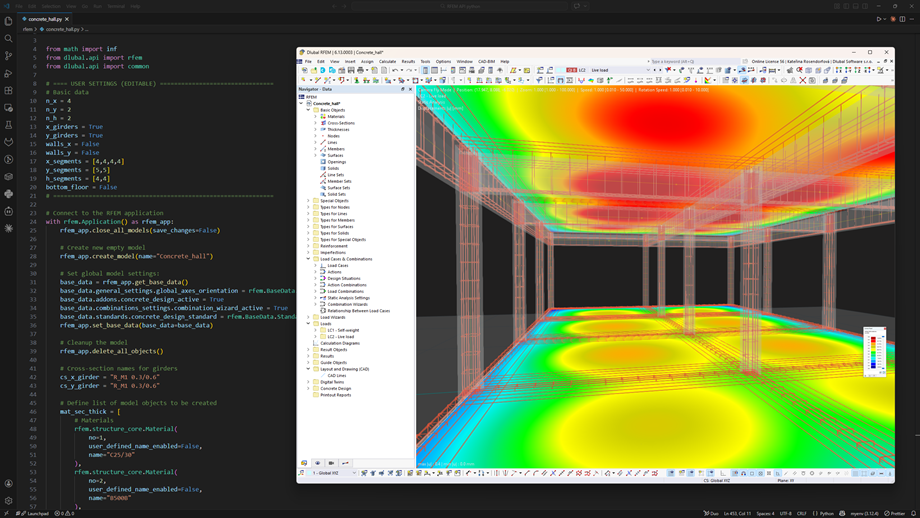
The new Dlubal API Service (gRPC) is a Python/C#-based solution that provides seamless, high-level interaction with the entire Dlubal product suite—RFEM, RSTAB, and RSECTION. Open for your innovations, it is perfectly suited for integrating your company-specific tools.
Whether you're working on parametric modeling or optimization tasks, our mission is to deliver an easily extensible library, enabling quick and effortless access to all data and functionalities across Dlubal’s main programs and their add-ons via Python or C#.
Available Dlubal API Clients
RSTAB is an advanced 3D structural analysis solution, delivering efficient analysis and design for frame or member structures in concrete, steel, timber, and more.
The RSECTION stand-alone program calculates section properties and stresses for thin-walled and massive cross-sections of all types.
What is Dlubal API?
The Dlubal API (Application Programming Interface) enables seamless integration of our software tools with external applications and systems. It allows for process automation, custom calculations, and the creation of tailored work environments based on specific needs. With the API, you can easily connect Dlubal Software to your own applications, enhancing efficiency and flexibility in your workflows.
For beginners, we provide online examples to guide you through the process step by step.
-
Monthly
-
Annually -10%
- Maximum of 1,000 API requests per month
- No additional API requests possible
- Maximum of 1 active user
- Access to all input data and results (without add-ons)
- No time limit
- Maximum 3,000 API requests per month
- 0.08 USD per additional API request
- Access to all input data and results
- Maximum 10,000 API requests per month
- 0,050 USD per additional API request
- Access to all input data and results
- Maximum 25,000 API requests per month
- 0,035 USD per additional API request
- Access to all input data and results
- Individual number of API requests
- Individual price per additional API request
- Unlimited number of active users
- Access to all input data and results
6 Reasons to Get Started with the New API
Boost your efficiency with the new Dlubal API, powered by high-performance gRPC technology. Enjoy a unified API and console syntax, optimized data serialization, and lightweight, bidirectional streaming. Experience faster development, precise result filtering, and seamless Docker deployment—all designed for scalable, high-speed applications.
Advantages of API
Cost Efficiency
Automating repetitive tasks and optimizing calculations reduce manual effort, minimizing costs for engineering firms.
Time Saving
Workflows can be streamlined by automating model generation, load application, and result evaluation, significantly speeding up the design process.
Full Customization
You can tailor calculations, reports, and processes to meet specific project or company requirements without software limitations.
Better Integration
The API enables seamless data exchange between structural analysis software and other BIM & CAD solutions.
Access to Data
Get access to all objects, results and model data of the programs to transform design processes.
Innovation
API services enable developers to build new applications, foster collaboration, and facilitate rapid prototyping by leveraging existing data and functionality.
Frequently Asked Questions About Dlubal API
The Dlubal API is a programmable interface (Application Programming Interface) that allows you to directly access the features of Dlubal programs. Currently, the API is available for RFEM 6 and RSTAB 9, and will also be available for RSECTION, RWIND, and the Geo-Zone Tool in the future.
Using the Dlubal API, you can efficiently automate repetitive and time-consuming tasks, create customized workflows, and develop individual solutions for internal processes and specific customer projects. Typical areas of application include automated modeling and data input, variant studies for optimizing structures, user-defined design checks, and interfaces to other software solutions.
Furthermore, the API allows you to design your workflows flexibly and independently of the Dlubal software user interface. You can create your own scripts and programs that exactly meet your requirements and integrate seamlessly into your existing processes.
We would be happy to advise you individually on your specific requirements and support you in integrating the API into your work process.
To use the Dlubal API, you need a valid license (full or trial version) of a supported Dlubal main program (currently RFEM 6 and RSTAB 9, in the future also RSECTION, RWIND, and Geo-Zone Tool) and a personal API key. You can easily generate this API key via your Dlubal Extranet account under “API & Cloud → API II → My API Keys”:
An API subscription is not mandatory – you can start directly with the free API subscription “Free” and get to know and use the API without obligation.
The new Dlubal API is based on modern gRPC technology and currently supports primarily Python. You can easily install the official ‘’'Python client'‘’ via PyPI. The Dlubal API documentation provides numerous code examples to help you get started.
A new addition is a ‘’'C# client'‘’, which is conveniently available via NuGet.
However, we still recommend Python for most use cases. The language is easy to learn, allows for extremely fast prototype development, provides a huge selection of libraries, and benefits from a particularly active community.
The new Dlubal API currently supports RFEM 6, RSTAB 9, and RSECTION 1. In the future, it will also be available for RWIND and the Geo-Zone Tool. Full program licenses, academic and student licenses, and trial versions are compatible. Support for demo versions is currently in preparation.
The Dlubal API is regularly updated together with the supported main programs (currently RFEM 6 and RSTAB 9, in the future RSECTION and RWIND). To ensure optimal compatibility, we recommend that you always use the API version that corresponds to the minor and patch number of your installed main program. Example: RFEM version 6.10.0007 should be used with API version 2.10.7.
The API is continuously being expanded and optimized. To stay up to date, we recommend that you regularly check the latest update reports in the “Releases” section of the official Dlubal API documentation.
The upcoming Dlubal MCP Server is currently under active development to allow for AI-supported access to all RFEM and RSTAB data and features. It acts as a service-oriented middleware between your applications and the Dlubal RFEM and RSTAB programs. Its concept consists of three central components:
1. Open API layer – Clearly documented REST and WebSocket endpoints encapsulate all model, result, and design functions. This allows you to access RFEM/RSTAB completely independently of the platform.
2. Real-time data bus – Model changes and all relevant RFEM/RSTAB data, including load cases, internal forces, and design results, are streamed in real time. This allows external systems to access them immediately, start calculations automatically, or trigger further actions.
3. AI orchestration – An integrated AI engine automatically translates natural language inputs or optimization tasks into appropriate API requests – just as if you were sending your commands to an AI chatbot, such as our assistant Mia. Examples include:
- Create a new member made of steel S235 with cross-section IPE 200 between Nodes 5 and 8.
- Give me all internal forces of Member 12 in Load Case 5.
- Give me the most critical member in the model.
- Find the most heavily utilized cross-section of the HE-A cross-section series for Member 21.
- Import the DXF file xxxxx.dxf as a background layer.
- Model a 3D hall with the following parameters: width, height, depth, roof inclination, ...
The MCP server then implements all these instructions ‘’'automatically'‘’ in your model.
In short, the upcoming Dlubal MCP Server will become the hub of a new, openly networked structural analysis world. Behind it is the Model Context Protocol (MCP), an open standard for linking AI models with external tools and data sources. In the future, RFEM or RSTAB can be connected to almost any application with just a few lines of code. Whether CAD and BIM software, individual dashboards, or company-specific microservices—with the help of MCP, you can implement such interfaces in no time. For the first time, structural analysis calculations, data analysis, and AI automation are seamlessly integrated into a single pipeline. This is not just another feature—it is a leap into a groundbreaking and limitless engineering era in which your ideas become reality faster than ever before.
API requests are all actions that actively make changes to models, trigger calculations, retrieve results, or save models. These include, for example, model modifications, calculation executions, and result queries. Administrative operations such as requests of the operation type “Service” (for example, querying the current billing data) are not counted as API requests.
The number of API requests is relevant for your API subscription, as a certain quota of requests per billing period is available depending on the subscription you have selected.
An active user is defined as any user who submits at least one request via the Dlubal API within a billing period. It does not matter how many API keys a user uses—each user is counted only once within a billing period.
To monitor API usage transparently and clearly, we recommend creating separate API keys for individual projects or users. This allows for precise and individual evaluation of API usage.
Dlubal values trust and transparency. Therefore, in your personal Dlubal Extranet account under “API & Cloud → API II,” you will find clear tables where you can easily track your API requests, API sessions, and the number of requests within defined time periods.
Comprehensive API documentation with detailed method descriptions, practical application examples, and clear installation instructions can be found on our website:
This documentation will help you quickly become familiar with the API and work productively with it. The collection of code examples is continuously expanded and optimized. In addition, we are currently developing a web community platform where Dlubal users can actively exchange experiences and share tips, questions, and solutions with each other.
Furthermore, we provide numerous webinars on the topic of API, where you can learn about practical applications and gain valuable insights.
If you have any questions regarding installation, connection, or error messages, you will find answers and assistance in the support and FAQ section of our website:
For more extensive inquiries, individual requirements, or development support, we offer customized training and consulting services.
Furthermore, the new Dlubal Community platform will soon be available. There, you can exchange ideas with other users, share experiences, and develop solutions together. The community provides the advantage of quick support through collective knowledge and direct communication.
Our AI assistant Mia is also available around the clock. She has been specially trained with knowledge of the Dlubal API and can provide suitable solutions and information quickly and easily at any time.
gRPC is a modern, open communication technology (open source) developed for particularly fast and reliable data exchange processes between applications. A key advantage of gRPC is its high efficiency—gRPC communication can be up to 15 times faster than conventional technologies, such as SOAP or REST.
As a user, you do not need any special knowledge of gRPC, as all technical details are already integrated into the clients provided by Dlubal. You automatically benefit from the speed and reliability of the gRPC technology.
The Unified API increases your efficiency because you...
- Save time – Automate model creation, load allocation, and result evaluation, significantly shortening your design process.
- Reduce costs – Fewer manual steps mean fewer engineering hours and lower project costs.
- Full adaptability – Design calculations, reports, and workflows exactly according to your project or company specifications without being limited by UI restrictions.
- Seamlessly integrated – The API links RFEM, RSTAB & Co. bidirectionally with BIM and CAD tools, prevents media breaks, and ensures consistent data.
- Comprehensive data access – Access all model objects and results, filter them specifically, and process them further to make data-based decisions.
- Unleash innovation potential – Develop new apps, prototypes, and AI workflows (for example, with AI assistant Mia) without reinventing the wheel.
- High performance – Thanks to gRPC technology, data exchange is up to 10 times faster than with classic SOAP/REST services.
Dlubal recommends Visual Studio Code as the development environment (IDE) for API programming. Visual Studio Code is versatile, free, and open source, and stands out for its comprehensive extensibility. You can install numerous extensions to make your programming even more efficient—for example, the Cline AI extension for AI-assisted, intelligent programming, which further optimizes your workflow.
Get started with the Dlubal API now and take your structural analysis workflows to the next level!
Take advantage of the full potential of the Dlubal API to connect your scripts directly to RFEM 6 – and in the future also to RSTAB 9, RSECTION 1, and RWIND. Automate repetitive workflows, save valuable time, and open up new possibilities for even more efficient, precise, and reproducible structural analysis and design checks in the Dlubal programs.