235x
005645
2024-07-12

高级

表面粗糙度参数

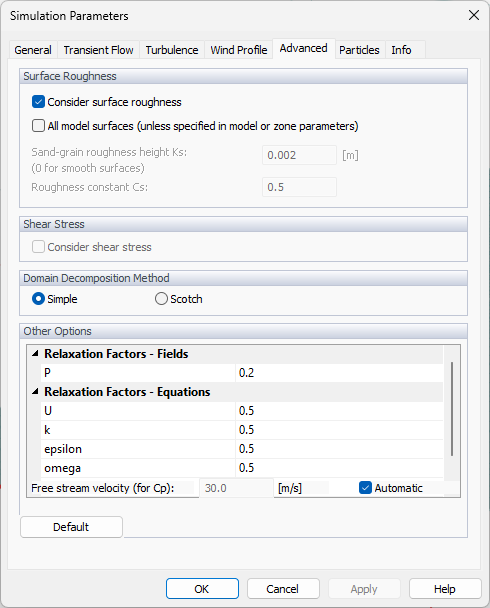
If the texture of the model surfaces has a major effect on the results, activate the "Consider surface roughness" check box. The roughness will then be taken into account for every surface of the model. Specific boundary conditions are applied to the surfaces or zones, providing surface constraints on the turbulent viscosity to account for roughness effects.

提示

CFD 模型中表面粗糙度的方法在 OpenFOAM® 用户指南 中进行了描述。粗糙度的表面函数修改在 视频 中进行了说明。

For the program to determine turbulent viscosity near the surfaces, the "Sand-grain roughness height Ks" needs to be specified. You can define the size of the sand grains in the text box. Note that the value is to be entered in meters.
The "Roughness constant Cs" controls the shape and spacing of the sand grains. This parameter is set as 0.5 by default, assuming a homogeneous distribution. If there is a non-uniform roughness, though, Cs can be increased up to 1.0.

剪应力

该部分内容暂时只计算了参数 稳态流。 剪应力的显示可以通过选择“剪应力结果”选项来启用,计算后该结果可在面数量 结果中找到。 通过选择“包括力”选项,可以将剪应力包括在Cauchy应力张量中,然后在合力中包括在拖曳力 阻力 中。 More about shear stress can be found in Chapter Surface Quantities, Surface Shear Stress.

其他选项

In RWIND 3, it is possible to set "Relaxation Factors" for the OpenFOAM® calculation. The relaxation factors are closely related to the stability and the convergence of the calculation. In general, the relaxation factors specify the amount by which a quantity changes from the previous iteration to the next one. There is no effect at all for the factor equal to 1 and the effect increases as the relaxation factor approaches zero. The limiting case of 0 represents a case where the solution does not change at all with successive iterations. Therefore, the admissible value of the relaxation factor should be greater than 0 and less than or equal to 1.
An optimum choice for the relaxation factor is the one that is small enough to ensure stable computation, but large enough to move the iterative process forward quickly.

上级章节