


|
Author
|
Sara Trinidad Quiñones
|
|
University
|
Loyola University in Seville, Spain
|
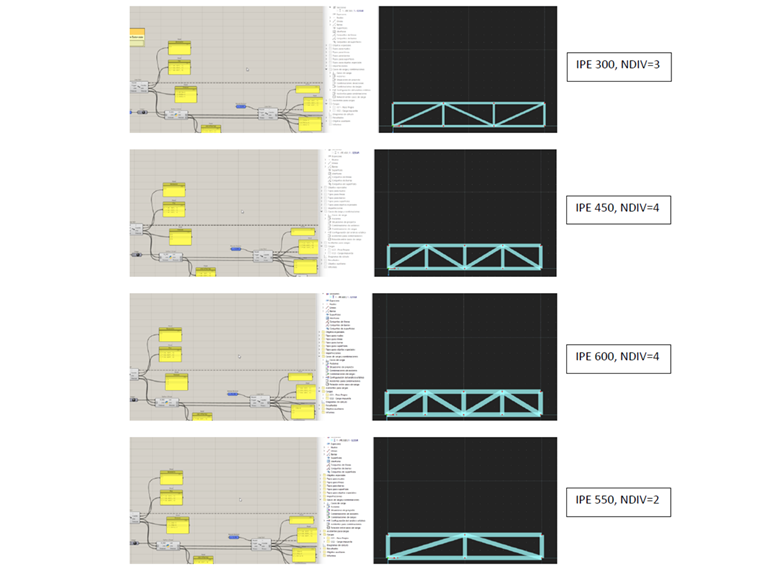
"This relevance and potential have led me to create this project, aimed at developing an application to automate the process of optimization in structural design, integrating visual programming tools and genetic algorithms. The project has focused on several detailed objectives, requiring a valuable period of prior study and familiarization with the three software programs to be integrated into this single application: RFEM, a finite element analysis tool; Python, for more complex programming tasks; and Grasshopper, which will serve as the foundation for the program's development, facilitating the interconnection with the other two software programs mentioned.
Grasshopper will provide the workspace and a multitude of elements to enable the visual programming of geometry, calculation, and optimization of two different structural cases: a simple beam and later, a two-dimensional truss. Additionally, this innovative software allows for easy API connection, making it accessible and multidisciplinary. It also has numerous plugins available for installation, allowing users to tailor the application to their specific fields. In my case, I will use RFEM Dlubal plugins, among others, to orient it towards the field of civil engineering.
The integration of RFEM Dlubal will be sought to calculate and analyze the structures designed in Grasshopper, ensuring they meet material resistance criteria. To this end, an interface will be created in Grasshopper that will allow for the generation and modification of structures, the configuration of load cases, and the correct export and import of data with RFEM. Then, genetic algorithms will be implemented through iterative loops over the different structural parameters of the model, such as the cross-sectional profiles of beams, seeking the optimal combination of these parameters through an automated process that saves both time and effort.
To facilitate the implementation and use of the application by other engineers, I will precisely detail the step-by-step creation of this project through a user guide, in a visual and explanatory manner, to reach and be understood by others. With this, I intend to showcase the great potential demonstrated by the powerful combination of these software programs, highlighting key concepts and presenting an application that would simplify daily tasks in civil engineering, motivating others to use and develop it further."