


|
Author
|
Ing. Cristóbal Reyes, Dr. Ing. Pablo Guindos
|
|
Center
|
Centro UC de Innovación en Madera (CIM UC) in collaboration with the Pontifical Catholic University Católica de Chile, sponsored by the Chilean Ministry of Housing and Urban Development (MINVU)
|
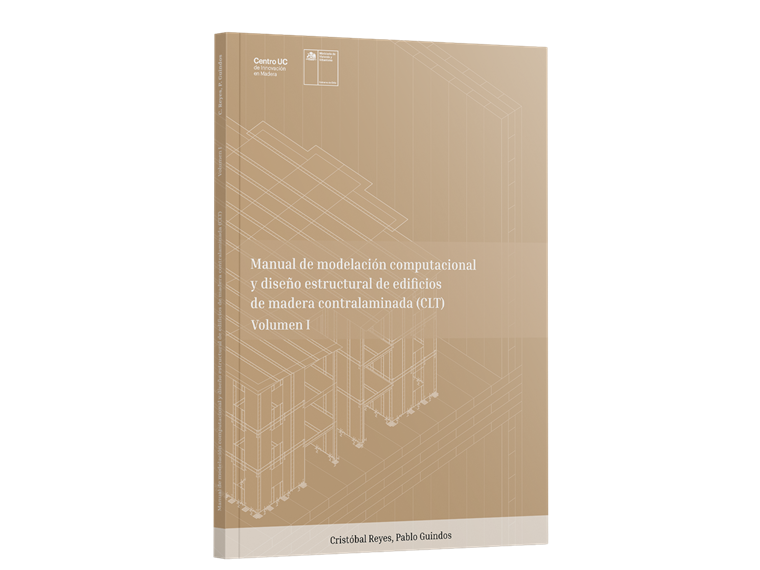
This book aims to provide a clear, practical, and detailed tool for designing gravitational and lateral structures with CLT, covering everything from physical concepts to their implementation in structural analysis software. Its approach combines theoretical fundamentals with applied examples in RFEM 6 and design recommendations.
CLT is an innovative building material composed of layers of wood boards arranged perpendicularly and joined together using structural adhesives, forming a solid panel. This configuration provides high dimensional stability and considerable mechanical strength, allowing it to be used in a wide variety of structural applications, from residential buildings to bridges and high-rise structures. The development of CLT began in Europe in the 1990s, specifically in Austria and Germany, in response to the need for a sustainable and efficient building material that could compete with reinforced concrete and steel. Since then, it has gained popularity around the world and is widely used in Europe, North America, and other regions.
One of the most notable features of CLT is that it offers a wide range of advantages in the construction sector, from its functionality to its aesthetics and sustainability. In terms of mechanical properties, its cross-laminated configuration transforms the unidirectionality of wood into a bidirectional dimension that provides high strength and rigidity both in and out of plane. This orthogonal arrangement of layers substantially improves its dimensional stability and minimizes deformation and buckling thanks to its robustness. Furthermore, the nature of its factory manufacture favors high degrees of prefabrication, industrialization, and customization of each element, achieving millimeter-level precision in production that translates into a significant reduction in waste and on-site assembly times, allowing for fast and efficient construction …