


|
Author
|
Lisa Vatterodt
|
|
University
|
Saarland University of Applied Sciences, Germany |
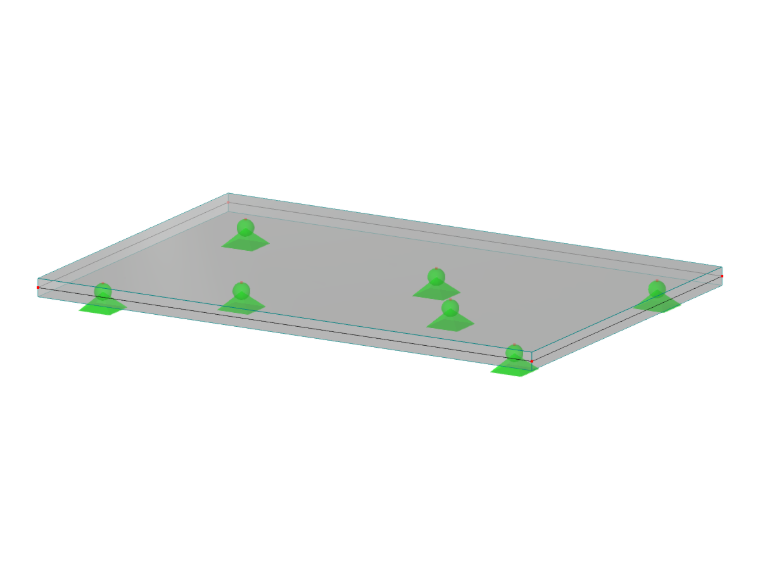
The first step involves performing a structural analysis of the plate structures using the finite element method (FEM). This utilizes the principles of Mindlin plate theory and the determination of the principal stresses and the associated principal stress directions. The values obtained in this way serve as the basis for simulating the force flow in the plate. The focus of the thesis is on implementing the Physarum polycephalum algorithm using a particle-based network model that replicates the natural pattern formation and adaptation mechanisms of the slime mold. This process uses particles that move according to chemoattractant concentrations and form self-organized networks using simple sensory rules. In the simulation, both the support points of the plate and the trajectories of the principal moments from the FEM calculation act as stimuli.
The simulation is performed iteratively, with the network being optimized by strengthening the main paths until a stable equilibrium state is reached. The results show that the particle-based model is capable of adaptively modeling the force flow lines of the plate, thereby generating a mesh structure that differs significantly from conventional orthogonal reinforcement grids. This allows for targeted reinforcement layout along the actual stress distributions, resulting in better material utilization, lower steel consumption, and increased load-bearing capacity. Furthermore, the high flexibility of the approach is highlighted, which can also robustly model complex plate structures with varying boundary conditions and load cases. This opens up prospects for resource-saving and sustainable construction in structural engineering.