The delay time is the time required for a velocity disturbance (e.g., a steady or random inlet profile) to propagate from the inlet boundary through the computational domain and reach the end of the wind tunnel. It represents the physical transport time of the flow, governed primarily by the mean streamwise velocity and the total length of the domain.
In practical CFD simulations, this delay time is essential because the flow field does not respond instantaneously to the imposed inlet conditions. Instead, the disturbance travels downstream with the flow, meaning that each location inside the domain only experiences the imposed inlet profile after this characteristic time has passed.
As a result:
🔴 Before the delay time, the flow field is still developing and influenced by initial conditions or incomplete propagation of the inlet boundary condition. Therefore, the results in this phase are not physically reliable (unrealistic).
🟢 After the delay time, the inlet condition has fully propagated through the domain, and the flow becomes representative of the intended physical scenario. Thus, the results obtained in this phase are physically meaningful and realistic.
A simple and practical estimation is based on the convection relation:
|
t |
Delay time (s) |
|
L |
Total length of the wind tunnel or distance from inlet to model (m) |
|
U |
Average flow velocity at the inlet (m/s) |
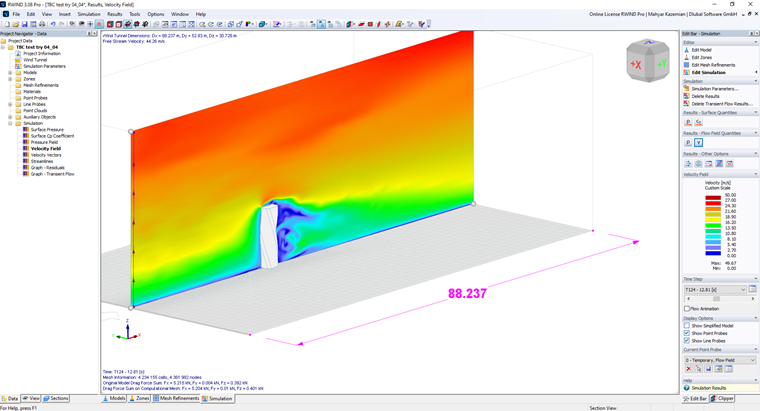
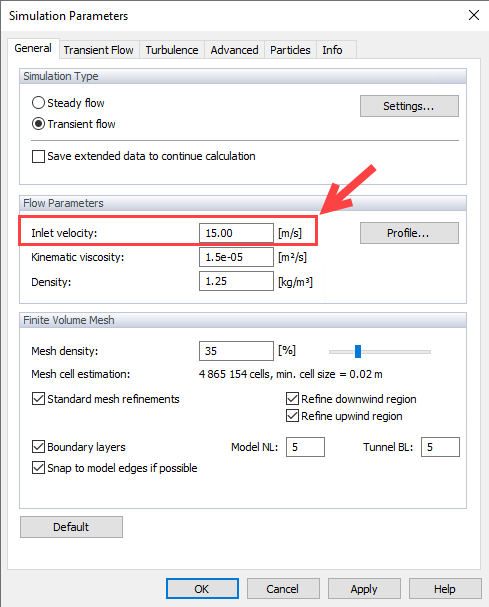
For a tunnel length of 𝐿=88 m and average velocity 𝑈=15 m/s (image 1):
|
t |
delay time (s) |
|
L |
Total length of the wind tunnel or distance from inlet to model (m) |
|
U |
Average flow velocity at the inlet (m/s) |
The inlet velocity signal requires a certain amount of time to propagate through the computational domain. Based on the given setup, it takes approximately 5.9 seconds for the wind to travel from the inlet boundary to the end of the wind tunnel.
This means:
🔴 Before 5.9 s → The flow field is not yet fully developed, and the results are not physically reliable, because the inlet condition has not reached the entire domain.
🟢 After 5.9 s → The inlet velocity is fully established throughout the tunnel, and the results become realistic and suitable for evaluation.
RWIND allows you to account for this delay automatically:
- By entering the correct average inlet velocity (Image 2), the software can estimate the physical propagation time of the flow.
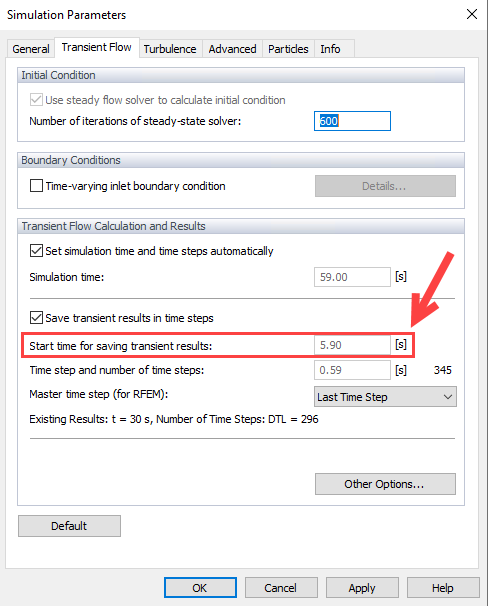
The parameter “Start time for saving transient results” can then be set (e.g., 5.9 s in Image 3) so that:
- Only the physically meaningful (stable) part of the simulation is stored
- Early, non-representative results are excluded