


In RFEM 6, the load types Ponding and Snow allow for the simulation of load distributions that adapt to changing surface geometries during the analysis. This adjustment is achieved by iteratively updating the load distribution based on the actual shape of the surface. The load may spread to the adjacent unloaded surfaces, accumulate in the lowest areas, or possibly fall from the surface.
These load types are designed to enhance the accuracy of load application and structural behavior simulation. By incorporating the actual geometry of the surface during each iteration, RFEM 6 ensures that load distributions are as realistic as possible for complex structural conditions, such as rain accumulation on roofs or snow accumulation on surfaces with varying slopes. Since the Snow load type as a surface load is not yet available in customer versions, it will be covered in a future Knowledge Base article; this article will focus exclusively on the Ponding load type.
Ponding Load Type
The Ponding load type (available as a Surface Load in RFEM 6) simulates the effect of rain on surfaces, taking into account the displacements according to the large deformation analysis. This feature is especially useful for modeling rainwater accumulation on membrane-like roofs, other multi-curved surfaces, and flat roofs. The algorithm evaluates the surface geometry and determines which portions of the rainfall will drain away and which will accumulate in ponds (water pockets) on the surface. The size of these ponds is then used to calculate the corresponding load for the structure.
The ponding effect considers the following:
Catchment Area Detection
The first step in applying this load type is to detect catchment areas on the surface. This process begins with the identification of local minimums, which are the lowest points in the mesh (illustrated by the orange node in Image 1).
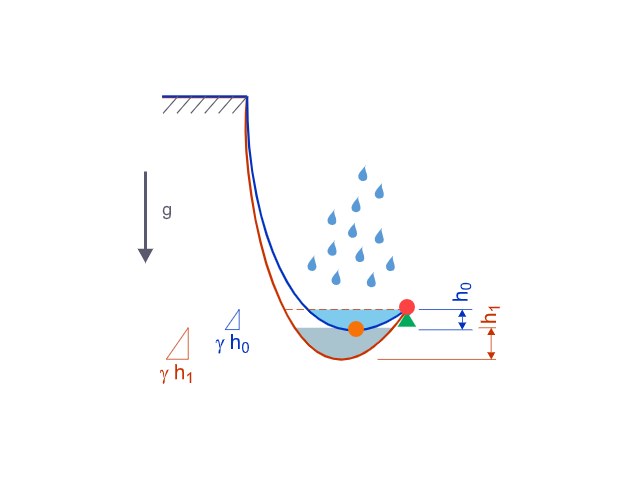
Once the lowest points are identified, the algorithm defines the convex surrounding area that includes all finite elements that will be affected by the load, regardless of their original surface level. A boundary layer is then determined, and the drainage point (red node in Image 1), being the lowest point of the boundary layer, is identified. This is the point where water will flow off the surface, setting the horizontal surface level of the detected pond (orange dashed line in Image 1). Hence, only the elements under this level are flooded.
The catchment area is iteratively updated, and ponds may merge or disappear as the deformation of the surface is calculated. This process ensures that the load distribution remains accurate as the surface geometry changes throughout the analysis.
Ponding Effect
The ponding effect simulates the accumulation of liquid in the detected catchment areas. The only input required for this load type is the specific weight of the liquid, which can be defined in the dialog box shown in Image 2. The algorithm then fills the catchment area up to the drainage point, ensuring the surface level remains horizontal.

Once the catchment area is filled, the corresponding hydrostatic load is calculated for each finite element based on the volume of liquid in the catchment area. This ensures that the load distribution reflects the accurate amount of liquid accumulation and its effect on the structure.
Precipitation
An optional parameter—precipitation—can be activated by checking the “Amount of Precipitation” checkbox in the dialog box mentioned above (also shown in Image 3). Once activated, the liquid volume to be applied on the loaded surface is accurately defined based on the surfaces explicitly loaded by the user. The algorithm then iteratively detects the corresponding water level in the catchment area. The volume in the detected pond, bounded by a horizontal surface, corresponds to the specified amount of liquid defined as the input parameter. After the volume is calculated on the loaded surfaces, the water spreads onto the adjacent surfaces, ensuring the distribution is dynamically adjusted based on the surface geometry.

Calculation
To achieve accurate results with this load type, large deformation analysis is highly recommended. This type of analysis allows the load distribution to be updated in each iteration based on the actual, deformed geometry of the structure, ensuring that the effects of surface changes are accurately captured throughout the calculation process.
Alternatively, other calculation orders are available for cases where small deformations of the structure are expected. However, if only the 1st order of calculation is used, the load is applied to the original, undeformed geometry of the structure. This may introduce inaccuracies into the calculation, as it does not account for the deformations that occur during the analysis.
Conclusion
The Ponding load type in RFEM 6 provides a powerful tool for simulating the effects of water accumulation on surfaces such as roofs. By accounting for surface deformations and iteratively adjusting load distributions, it ensures accurate modeling of rainwater accumulation and its impact on structural integrity. The catchment area detection algorithm, combined with the option to define precipitation, enhances the flexibility and precision of simulations. Hence, this feature offers essential insights for structural engineers designing buildings and roofs subject to water accumulation from rainfall, helping optimize safety and performance under varying conditions.