


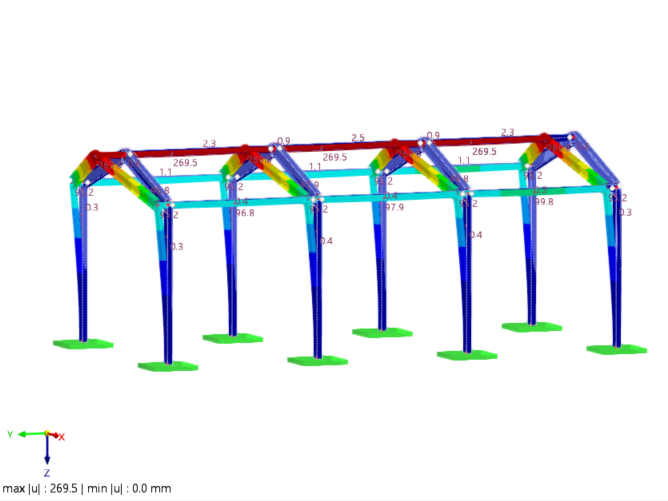
Due to the interconnection of add-ons, RFEM 6 allows for the consideration of some interaction phenomena that are often only modeled by simplifying assumptions. The basis and reference is a small metal building with a ridge height of just under 6 m and a floor area of 6 m x 12 m. It is subjected to the self-weight, snow, and wind loads. The supports of the column bases are assumed to be fixed, and the connection between the purlins and the frame is assumed to be hinged. Therefore, neither interaction with the ground nor the influence of joint stiffness is taken into account. Under these circumstances, the columns are loaded to 97% of their capacity. The global deformation of the gable is just under 270 mm.
Joint-Structure Interaction
To determine the joint stiffnesses, all joints are modeled in their exact design, the joint-structure interaction is activated, and the stiffness analysis is performed for the axial displacement under the axial force and the rotation due to a bending moment around the major or minor axis. The initial stiffnesses should be sufficient.
Although the joint of the purlins is classified as hinged, confirming the simplified assumption of the reference model, the rotational stiffness considered is 0.2 MNm/rad, which is not equal to 0. Similarly, although the column base stiffness around the minor axis is classified as rigid, at 5.2 MNm/rad it is not equivalent to a fixed support. In contrast, the rotational stiffness around the major axis is classified as flexible according to the analysis. Corresponding joint stiffnesses are generated in the structural model.
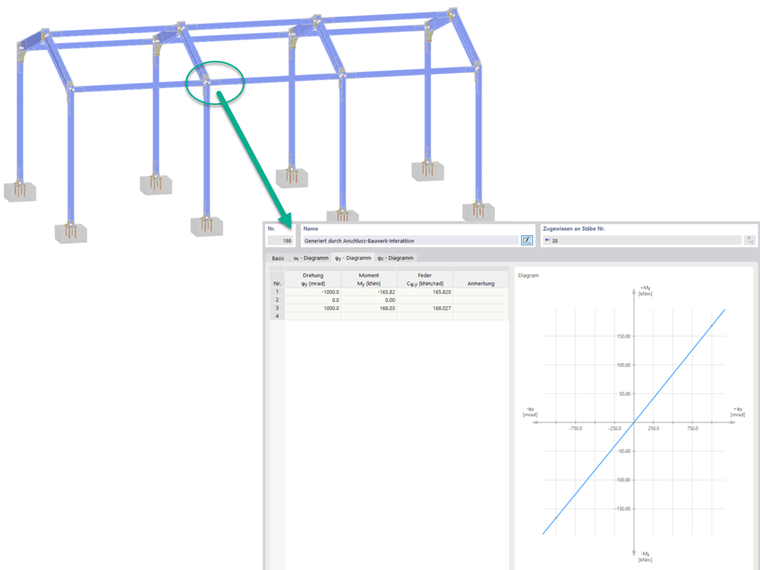
The influence on the design values is significant. The load on the columns is reduced to 82%, while the maximum deformation of the gable is reduced to 66 mm.
Soil-Structure Interaction
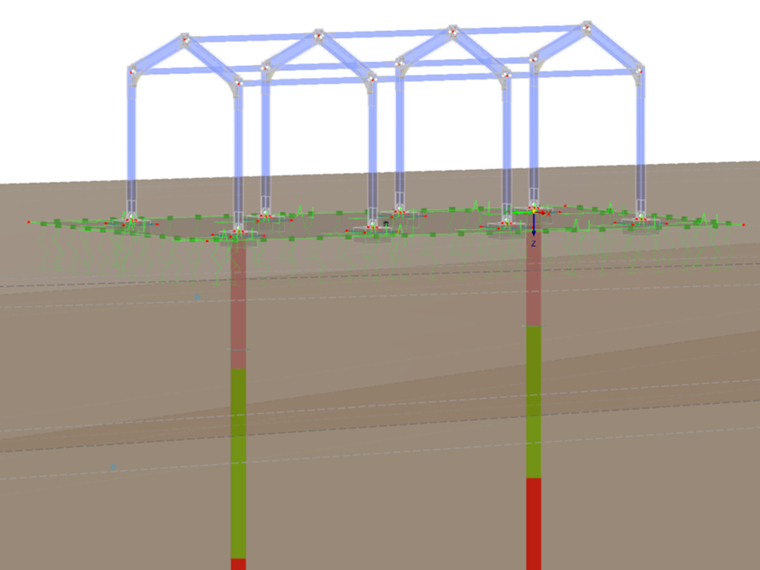
In a further step, the soil beneath the building is modeled and taken into account in the structural analysis using the constrained modulus method. This calculates the coefficients of the elastic foundation resulting from the soil structure. As an example, a soil profile consisting of sand and two layers of gravel is modeled. These vary in thickness in the foundation area, resulting in different elastic foundations for the column bases.
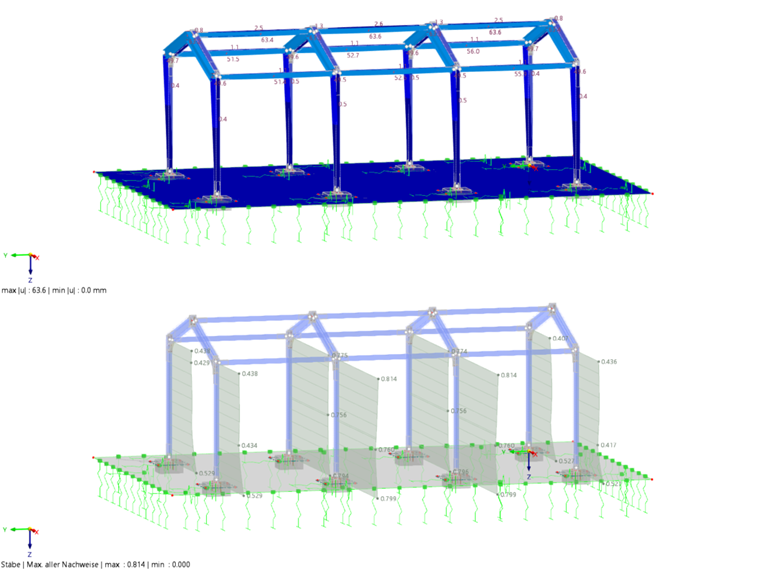
Since it can be assumed that the modified support has an influence on the entire structure, the same properties are compared: This results in a global utilization of the columns of 81.4% and a maximum gable deformation of 63 mm. Here, the influence is not so significant, although this naturally depends on the respective soil profile. The design ratio at the base points can be reduced by a value between 1.3 and 3% (depending on the considered column).
Conclusion
In summary, it should be noted that considering interaction phenomena always improves the accuracy of the calculation. Depending on the quality of the other assumptions, the economic aspect is also decisive. However, it is often necessary to decide on a case-by-case basis which modeling and calculation effort is the most efficient.