


The design of cold-formed steel products is regulated by the EN 1993-1-3 standard [1]. Typical shapes of cold-formed cross-sections include U, C, Z, hat, and sigma sections. These sections are manufactured from thin-walled plates using roll-forming or bending processes.
In the ultimate limit state design of load capacity, it is necessary to ensure that local load introductions do not cause undesirable effects, such as compression, web crippling, or local buckling in the web of the cross-sections. Such effects can arise both from the load introduction along the flange into the web and from support forces at the support points. Section 6.1.7 of EN 1993-1-3 describes how to determine the resistance of the web, Rw,Rd, under local load introduction.
The Steel Design add-on allows for an analysis of local load introduction for webs without stiffening according to Section 6.1.7 [1]. In the case of combined bending and local load introduction, the software also analyzes whether the conditions specified in [1] Section 6.1.11 are satisfied.
An example of the corresponding design checks is presented below using a bending beam made of a cold-formed C-section. The beam is subjected to a concentrated load.
Structural System and Load
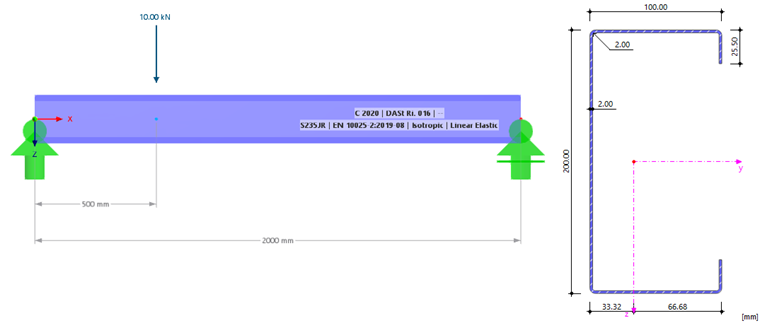
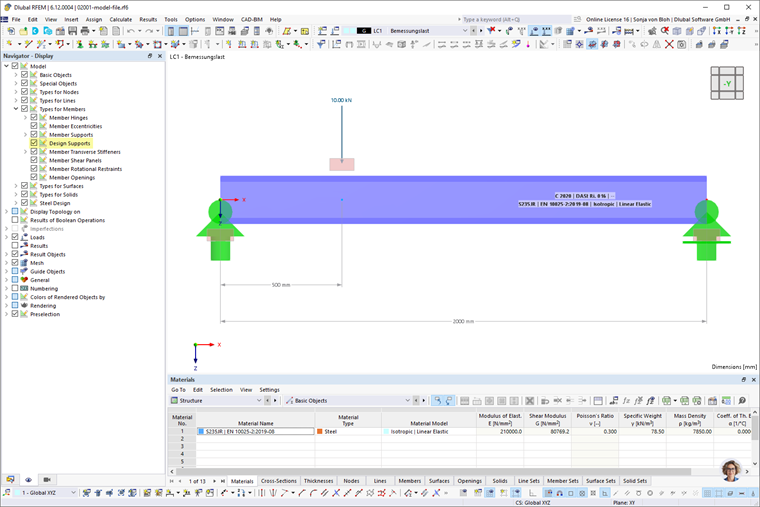
The beam under consideration is 2 meters long and consists of a cold-formed C-section (C 2020) made of S235JR steel according to EN 10025-2. The support width is 110 mm on each side, and the beam does not extend beyond the supports. The beam is subjected to a concentrated load of 10 kN at a distance of 50 cm from the support. The concentrated load is applied to the flange over a length of 100 mm and acts at the shear center. The self-weight of the beam is not taken into account in this calculation.
Data Input
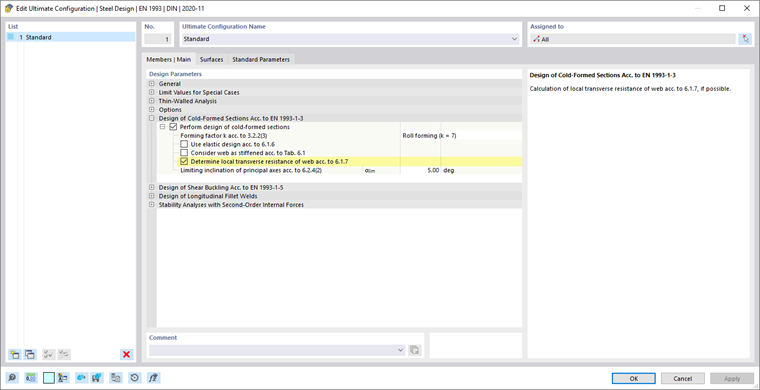
In the ultimate configuration, it is necessary to activate the “Determine web resistance under localized load introduction according to 6.1.7” check box in order to perform the design of localized load introduction.
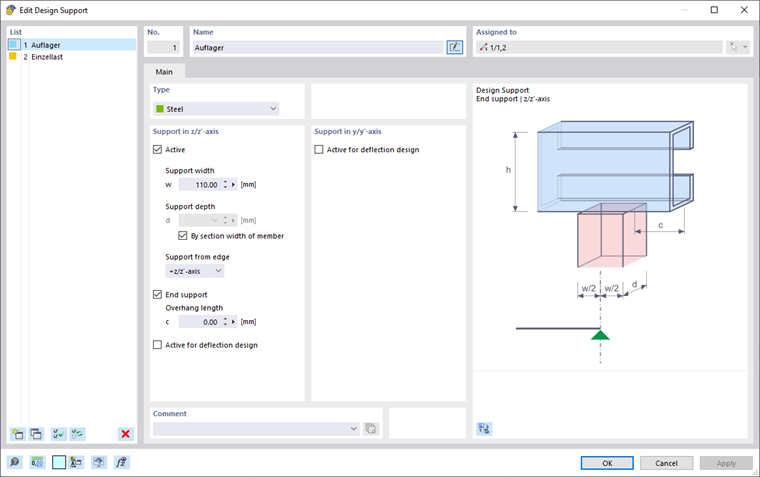
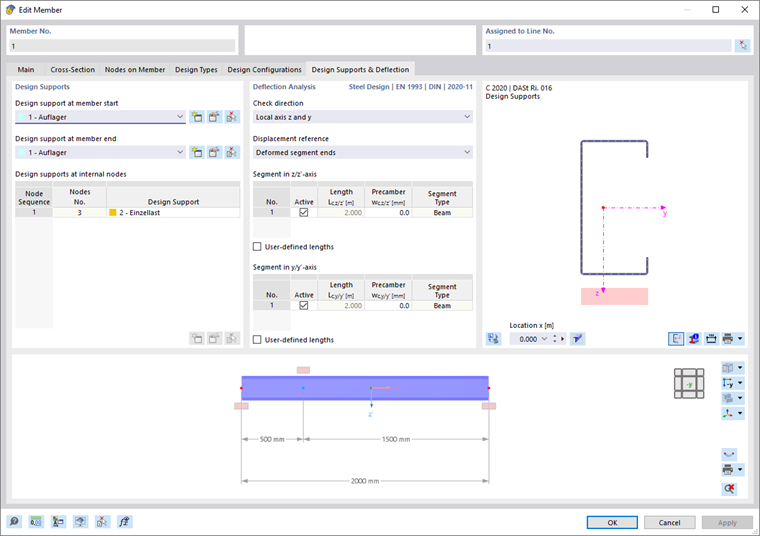
The required boundary conditions should be defined in the “Design Supports and Deflection” tab. At each location where the design of local load introduction is to be performed, you need to define a design support of the “Steel” type. The length of the stiffener for the load introduction ss is entered in the “Support width w” text box. On the other hand, the “Support depth d” has no influence on the design.
The local load introduction is analyzed when the support is defined at the edge opposite the applied force. The directions “+z/z'-axis” and “-z/z'-axis” refer to the orientation of the member's local z/z'-axis. If the concentrated load acts in the +z direction, it is necessary to select the “-z/z’ axis” edge for the support.
For the supports, a design support with a stiffener load introduction length of 110 mm is defined at the edge of the “+z/z’ axis” as an end support with a cantilever length of 0 mm.
For the concentrated load, a design support with a stiffener load introduction length of 100 mm is defined at the edge of the “-z/z’ axis.”
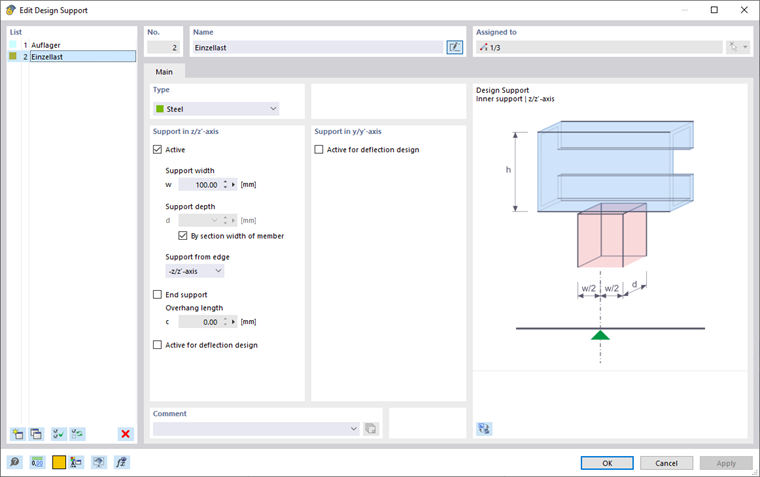
The support type for the support is assigned to the member’s start and end, while the support type for the concentrated load is defined at the intermediate node at the location of the concentrated load.
The design supports can also be displayed graphically. In the Navigator – Display, you can activate or deactivate the display of design supports under the Types for Members → Design Supports.
Results
The design for the local load introduction is performed at the defined design support points—both at the supports and at the load introduction locations. The greatest design ratio occurs at the location x = 0.00 m. For illustrative purposes, the design is performed at this location in the following.
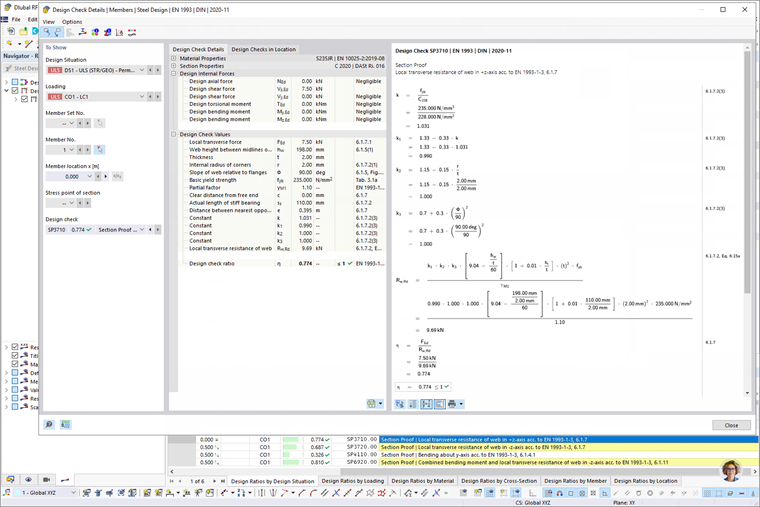
There is a support reaction at a cross-section that has only one web. The C-section with a plate thickness of t = 2.0 mm has stiffened flanges due to its lips. The distance from the support to the free end is 0.00 m, which is less than 1.5 times the web height hw = 198 mm. Therefore, Equation (6.15a) is governing for determining the web resistance Rw,Rd.
According to [1], 6.1.7.2 (3), the following coefficients are to be applied:
This results in the following web resistance under local load introduction:
The design condition according to [1] Equation (6.13) is fulfilled:
For the remaining two design points, the design is performed in the same manner. In addition, a check is performed to ensure that the conditions specified in [1], 6.1.11 are met.
Summary
The Steel Design add-on allows you to perform design checks for local load introduction according to [1] Section 6.1.7. To do this, it is necessary to define design supports at the locations relevant to the design. The design for local load introduction is performed according to [1] 6.1.7.2 for cross-sections with a web without stiffening or according to [1] 6.1.7.3 for cross-sections with two or more webs without stiffening. Moreover, the program checks whether the conditions specified in [1], 6.1.11 are met.