


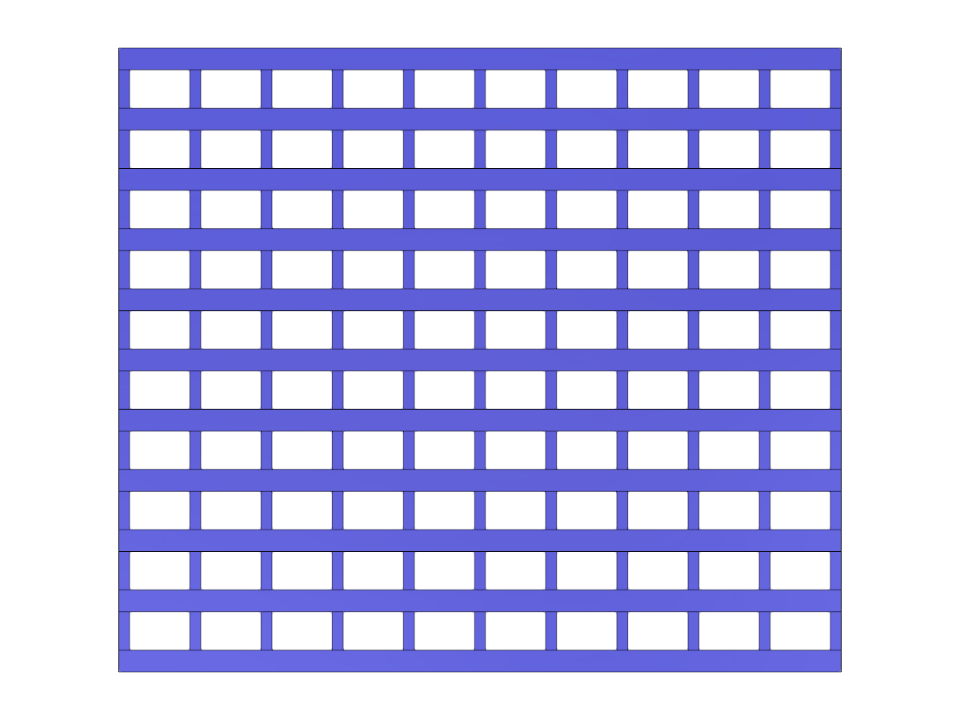
Windbreak fabric panels are widely used to reduce wind velocity while allowing controlled airflow through the structure. They are commonly employed in stadiums, construction sites, industrial facilities, agricultural applications, and other environments where wind protection is required without creating excessive aerodynamic loads.
Modeling these structures in Computational Fluid Dynamics (CFD) presents a significant challenge due to their highly permeable geometry. Explicitly resolving every opening in the fabric requires an extremely fine computational mesh, resulting in high computational costs and long simulation times. Instead, windbreak fabrics are typically represented as porous media, where the overall aerodynamic resistance of the material is characterized by its permeability and pressure-loss properties rather than by modeling each individual opening.
This example demonstrates the numerical modeling of a windbreak fabric panel using a porous media approach in RWIND. The model illustrates how porous surfaces can efficiently capture the aerodynamic behavior of permeable structures, enabling accurate prediction of wind velocity reduction, pressure distribution, and wake development while maintaining practical computational efficiency.
Windbreak Fabric Panel Design
| Block parameters editable dynamically | |
| Number of Nodes | 444 |
| Number of Lines | 484 |
| Number of Members | 0 |
| Number of Surfaces | 121 |
| Number of Solids | 0 |
| Number of Load Cases | 1 |
| Number of Load Combinations | 0 |
| Number of Result Combinations | 0 |
| Total Weight | 0.061 tons |
| Dimensions (Metric) | 26.400 x 22.800 x 0.000 m |
| Dimensions (Imperial) | 86.61 x 74.8 x 0 feet |
You can download this structural model to use it for training purposes or for your projects. However, we do not assume any guarantee or liability for the accuracy or completeness of the model.