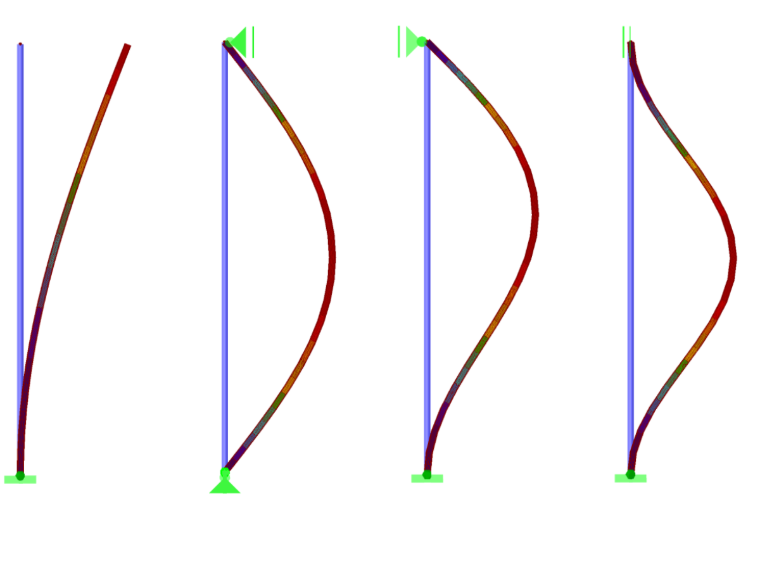
Description
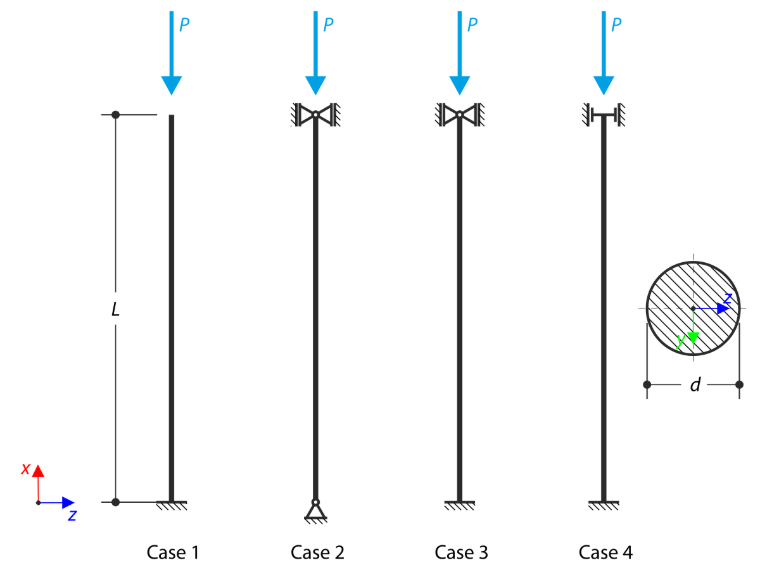
A strut with circular cross-section is supported according to four basic cases of Euler buckling and it is subjected to pressure force P according to the following figure. Determine the critical load Pcr. The problem is described by the following parameters.
| Material | Steel | Modulus of Elasticity | E | 210000.000 | MPa |
| Poisson's Ratio | ν | 0.300 | - | ||
| Geometry | Strut | Length | L | 2.000 | m |
| Diameter | d | 30.000 | mm | ||
| Load | Force | Force | P | 10.000 | kN |
Analytical Solution
The governing differential equation for all buckling cases is following:
|
y |
Coordinate in buckling direction |
|
M |
Bending moment related to the cross-section |
|
I |
Moment of inertia |
Buckling Case 1
The strut is fixed on one end and free on the other one. The governing equation can then be rewritten as:
Using the substitution
the solution of the equation above reads as
Integration constants C1 and C2 can be obtained from the following boundary conditions
The resulting deflection then reads
For nonzero δ and for the tip of the strut, the following condition has to hold
The minimum value corresponds to k = 1 and the critical force Pcr is then, by substituting into the α relation,
Buckling Case 2
The strut is supported by means of pinned joints, where one is, furthermore, sliding. The governing equation reads as
the solution of this differential equation is of the form
Integration constants C1 and C2 can be obtained from the following boundary conditions
From the boundary conditions follows
For nonzero constant C2 it can be written
The minimum value corresponds to k = 1 and the critical force Pcr is then
Buckling Case 3
The strut is fixed on one end and supported by means of a sliding pinned joint on the other one. The governing equation can then be rewritten as follows
where H is the horizontal reaction force in the pinned joint. The solution of this differential equation reads as
Integration constants C1 and C2 can be obtained from the same boundary conditions as in Case 1. The resulting deflection is then
This equation must also satisfy the boundary condition for the second end of the strut, after substitution
For nonzero horizontal reaction force H, the following equation has to hold
This transcendental equation can be solved numerically or graphically, with approximate solution
Buckling Case 4
The strut is fixed on both ends and one end is sliding. The governing equation takes the form
where M1 is the reaction moment in the fixed support. The solution of this differential equation reads as
Integration constants C1 and C2 can be obtained from the boundary conditions of Case 1. The general solution then reads
This equation must also satisfy the boundary condition for the second end of the strut, after substitution
For nonzero reaction moment M1, the following equation
yields a minimum value for k = 1 and the critical force Pcr is
RFEM and RSTAB Settings
- Modeled in RFEM 6.13, RSTAB 9.12 and RFEM 5.16 and RSTAB 8.16
- Element size lFE = 0.1 m
- Isotropic linear elastic material is used
- Lanczos method is used for eigenvalue analysis
Results
| Buckling Case | Analytical Solution Pcr [kN] |
RFEM 6 Pcr [kN] |
Ratio [-] |
RSTAB 9 Pcr [kN] |
Ratio [-] |
RFEM 5 – RF-STABILITY Pcr [kN] |
Ratio [-] |
RSTAB 8 – RSBUCK Pcr [kN] |
Ratio [-] |
| Case 1 | 5.151 | 5.150 | 1.000 | 5.150 | 1.000 | 5.150 | 1.000 | 5.153 | 1.000 |
| Case 2 | 20.602 | 20.594 | 1.000 | 20.594 | 1.000 | 20.596 | 1.000 | 20.749 | 1.007 |
| Case 3 | 42.147 | 42.109 | 0.999 | 42.109 | 0.999 | 42.107 | 0.999 | 43.190 | 1.025 |
| Case 4 | 82.409 | 82.289 | 0.999 | 82.285 | 0.998 | 82.270 | 0.998 | 83.324 | 1.011 |