Description
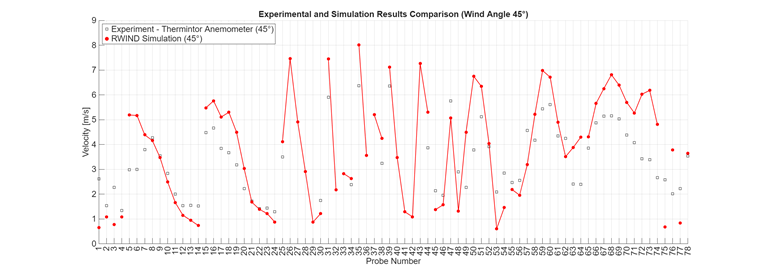
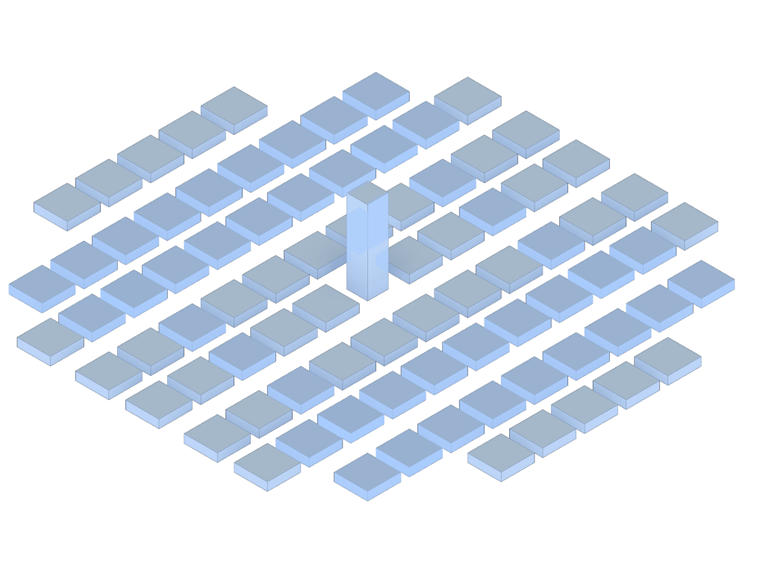
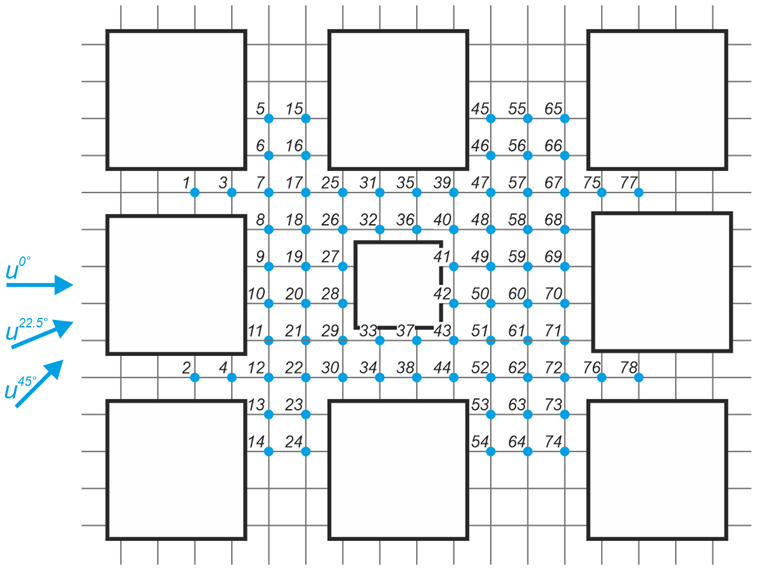
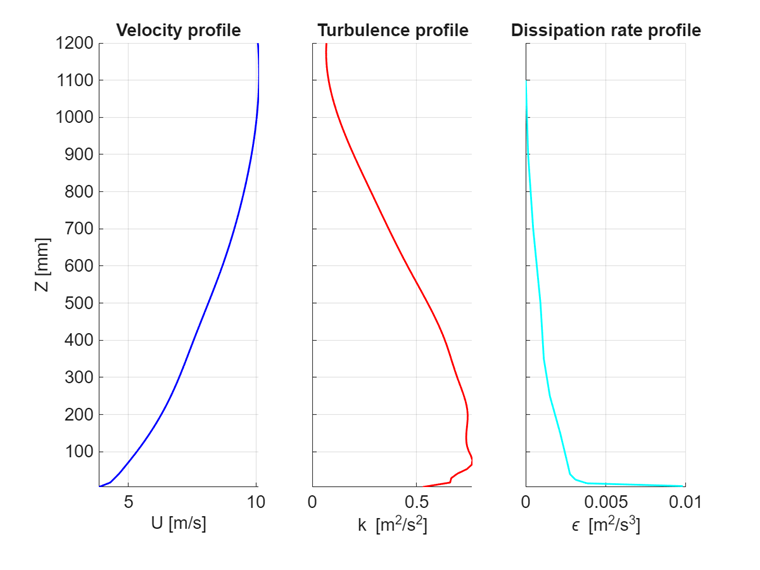
The verification example describes the steady-state flow around a high-rise building in city blocks. The example is given by the Architectural Institute of Japan (AIJ). The target model consisted of uniformly arranged city blocks with a plane shape of 40 m × 40 m and 10 m height and a 25 m × 25 m × 100 m (1:1:4) high-rise building in the central block. Each block was composed of two 10-meter-wide roads and roads of 20 m and 30 m. The scale of the model is 1:400. The result velocity field is compared in given probes with available wind tunnel experimental data. The problem is described by the following table and the inflow velocity and turbulence profile. Three wind angles are tested and compared - 0°, 22.5° and 45°.
| Fluid Properties | Kinematic Viscosity | ν | 1.500e-5 | m2/s |
| Density | ρ | 1.250 | kg/m3 | |
| Geometry | Given by the CAD model | |||
Analytical Solution
An analytical solution is not available. The example provides a comparison of RWIND CFD simulation results and experimental data (AIJ).
RWIND Simulation Settings
- Modeled in RWIND 3.05
- Steady flow simulation type
- Mesh density is 20% with refinement in the probed area (more than 2,000,000 cells for all simulations)
- Inlet boundary condition - velocity profile and turbulence intensity profile
- Tunnel bottom - no-slip boundary condition
- Tunnel walls and top - slip boundary condition
- Outlet boundary condition - zero pressure; zero velocity gradient
Results
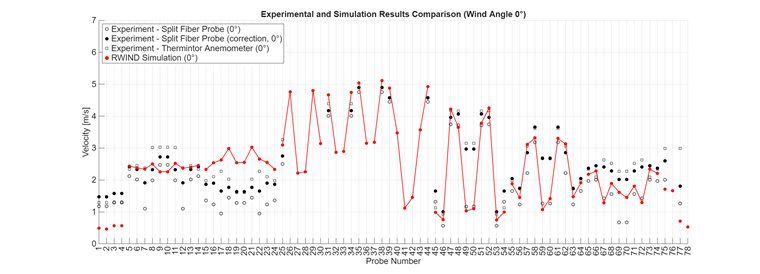
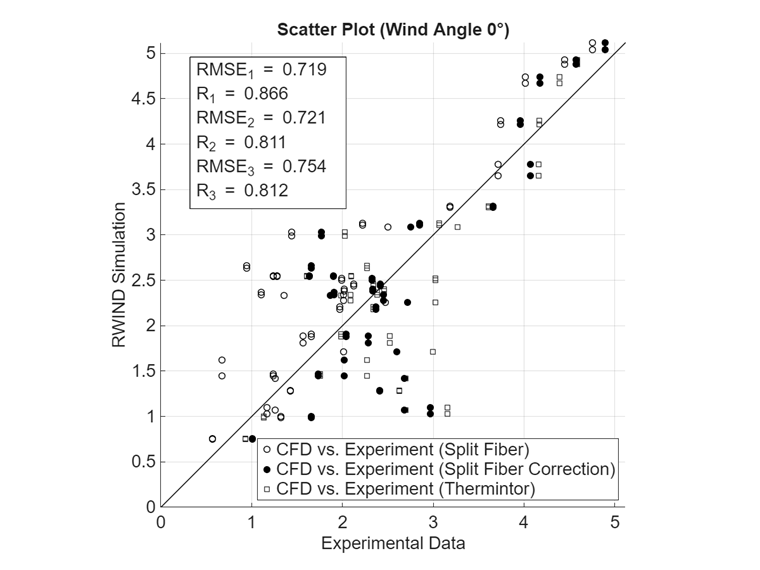
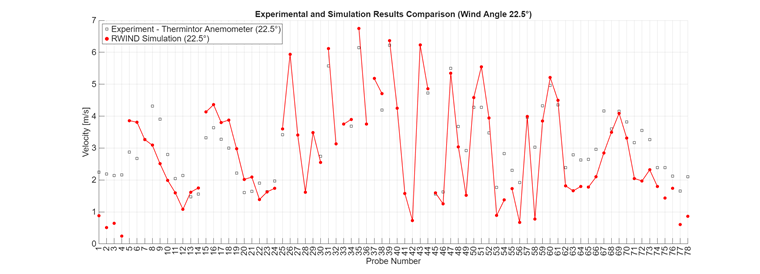
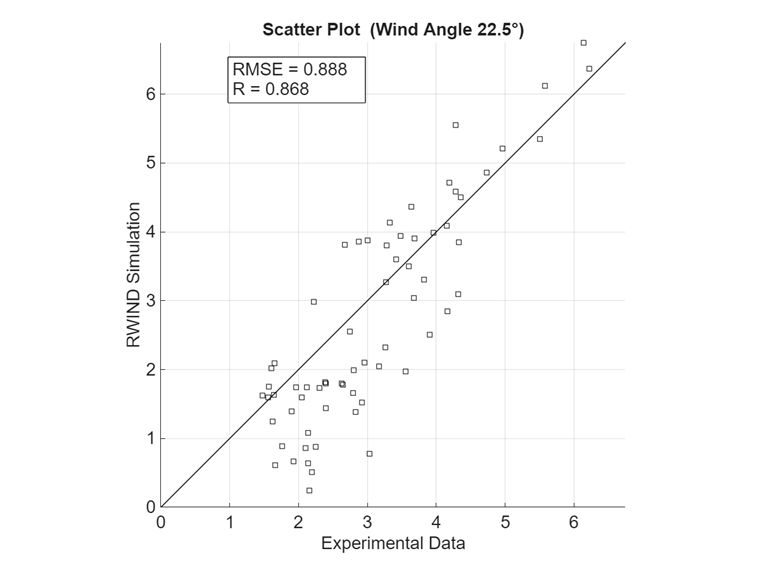
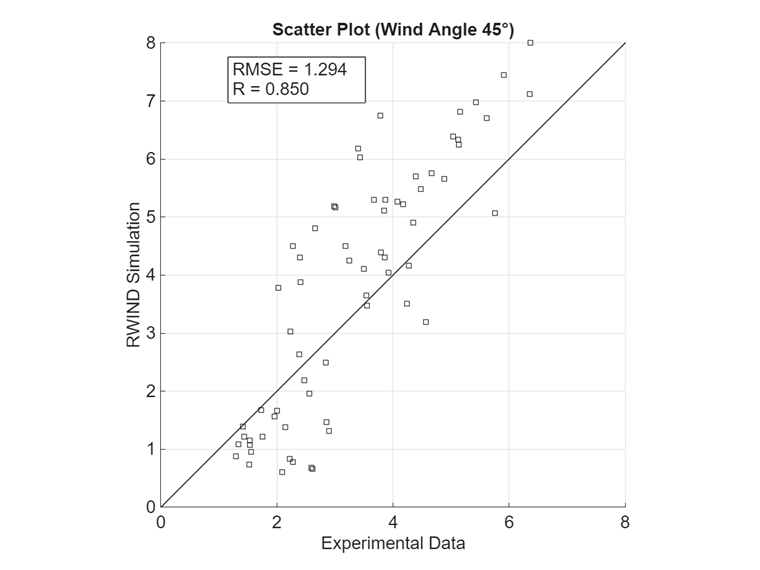
In the following graphs, experimentally obtained data from the wind tunnel (AIJ) and data from the CFD simulation in RWIND are compared. A direct comparison of the wind velocity and the scatter plot is shown. The Root Mean Square Error (RMSE) and Correlation Coefficient (R) are also calculated inside the scatter plot. The graphs show good agreement between the simulation and the experiment. Please note that experimental results in close proximity to the high-rise building are not available; however, simulation results are plotted here.