|
Author
|
Giacomo Fantacci, relatori: Prof.ssa Arch. F. Bazzocchi, Prof. Ing. V. di Naso, Prof. Ing. M. P. Lauriola
|
|
University
|
University of Florence, Italy
|
This thesis presents the architectural and structural design of a new building to house the laboratories of the Department of Civil and Environmental Engineering (DICEA) of the University of Florence, located in the Science and Technology Park in Sesto Fiorentino. Given the need to develop a project that would fulfill the specific functions required, and in the absence of reference manuals, the current state of the laboratories at the Santa Marta site was analyzed via surveys and interviews with technical and scientific managers. This provided a complete overview of requirements, which was condensed through the analysis and processing of environmental units for each individual laboratory.
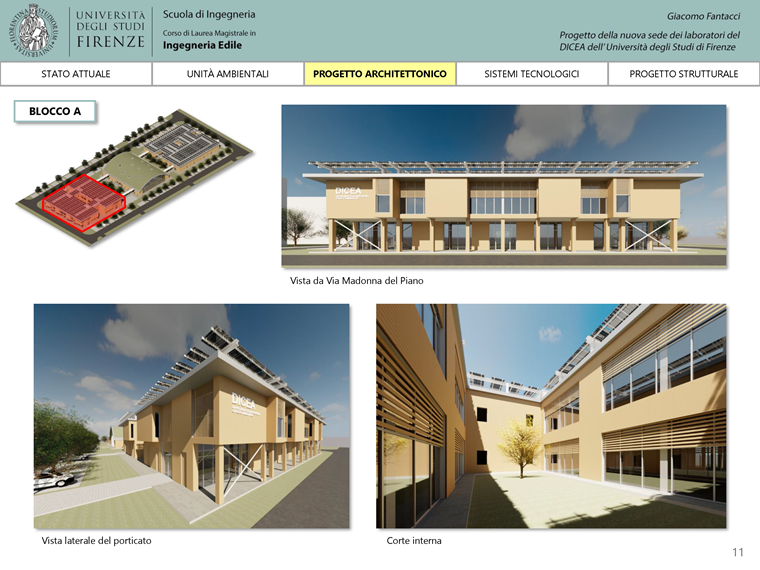
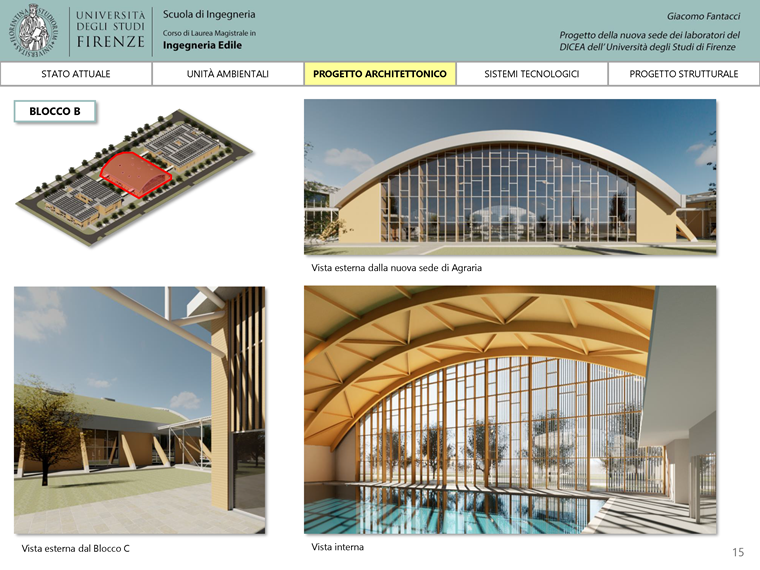
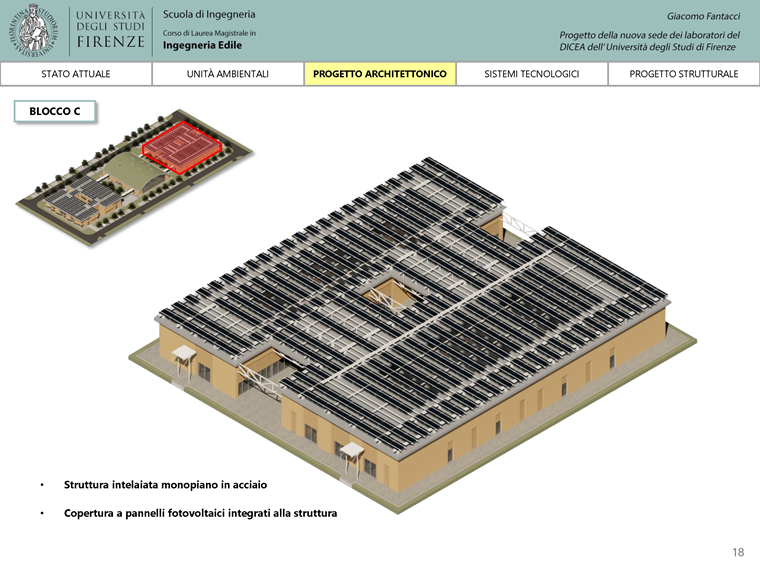
The next step was the actual architectural design, which involved dividing the space into three separate blocks (A, B, and C). This decision was made in compliance with the restrictions set out in the Detailed Plan, without compromising on the proximity and environmental compatibility required by the various laboratories. The design of Blocks A and C was carried out at the final design stage, while Block B reached the executive design stage from both an architectural and structural point of view.
The technological solutions adopted, in addition to meeting the required performance requirements, have also been designed with sustainable construction in mind, using materials such as timber, glass, and aluminum. These materials (in addition to having advantages in terms of environmental impact and recyclability) are also well suited to dry construction, further promoting sustainability. Above all, timber was favored both as a structural material, used in the roof and curtain wall of Block B (as well as for the floors and external infill panels of all blocks), and as a finishing material, used in the advanced screen facades that characterize the entire project.
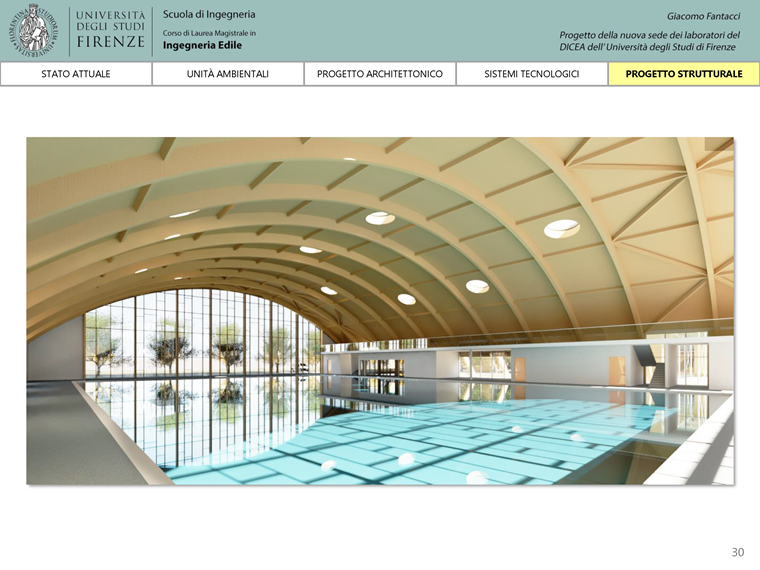
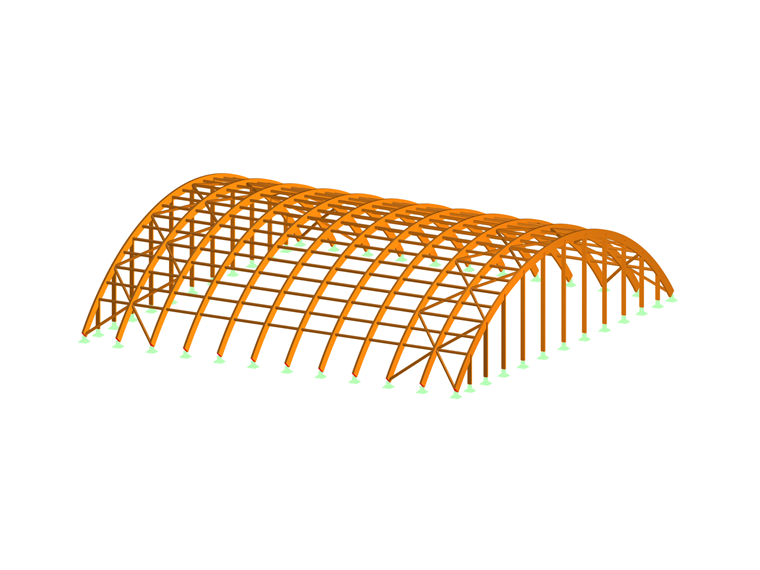
The thesis continues with the study and structural design of the laminated timber arch roof, which spans a single large span (47 m) to meet the requirements of Block B, necessitated by the need for a large tank for maritime engineering simulations. This study was conducted by implementing finite element models and taking into account all the specific characteristics of timber, paying particular attention to its hygroscopic and viscous behavior and the deformability of mechanical joints.