|
Author
|
Malika Urinova
|
|
University
|
CTU | Faculty of Civil Engineering, Czech Republic
|
Basic Information
Purpose: Pedestrian and Bicycle Bridge
Span: 18 meters (between the supports)
Material: Supporting arches made of glued-laminated timber, other elements made of structural solid wood
Supporting Structure
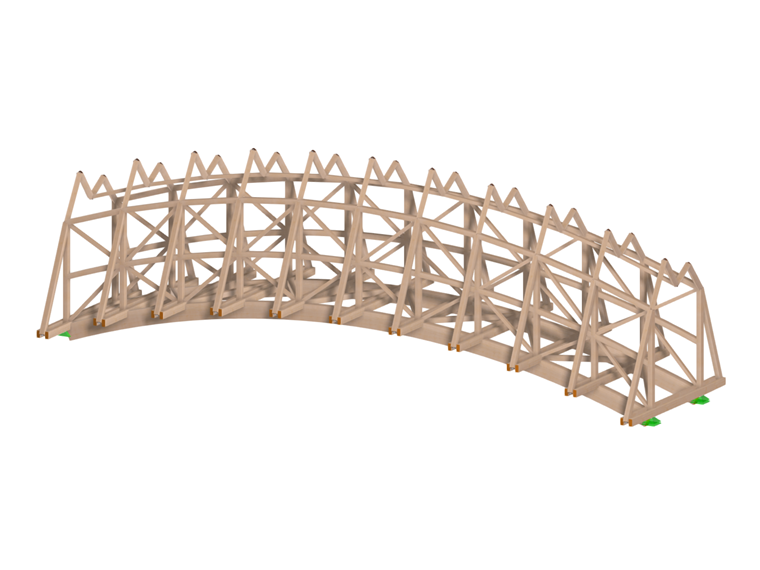
The main supporting system consists of two curved arches made of glued-laminated timber (e.g. GL24h), with a rectangular cross-section. The arches are anchored to reinforced concrete footings, which transfer both vertical and horizontal load components into the foundation. A spatial bracing structure made of structural solid wood, consisting of slanted and horizontal elements, is placed between the arches.
Deck (Sidewalk)
The sidewalk is supported on the bottom part of the arches, across transverse beams made of structural wood. The walking surface is made of longitudinally placed wooden planks, fixed with screws or nails.
Fill and Guardrail
The top part of the structure consists of a spatial bracing fill, which also serves as a protective guardrail. This fill is made from structural solid wood in the form of diagonal and horizontal reinforcements.
Foundations
The structure is mounted on reinforced concrete footings, which ensure:
The transfer of loads into the foundation soil, anchoring the arches to prevent displacement and overturning, and protection of the wood from direct contact with moisture.
Material Solution
Supporting arches: Glued-laminated timber (e.g. GL24h)
Other elements (trusses, fills, deck): Structural solid wood
All wooden elements are coated with a protective finish against weathering, UV radiation, and biological attack.
The designed wooden pedestrian and bicycle bridge was subjected to static assessment with regard to the basic load combinations according to applicable standards. The calculation was performed using a numerical model in the RFEM 6 program, utilizing the Finite Element Method (FEM).


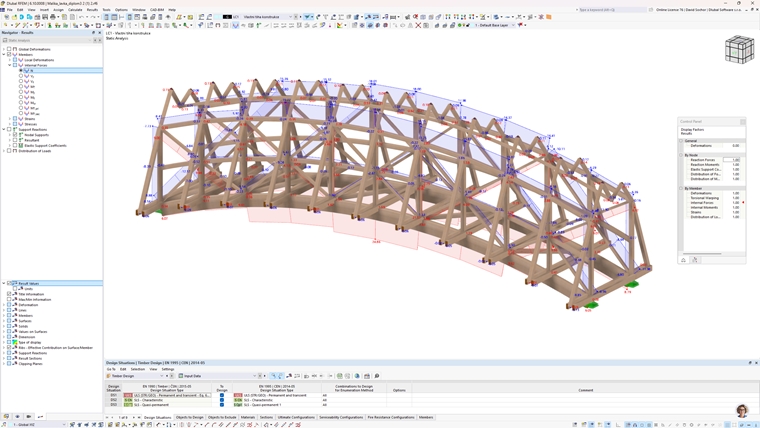
Axial Load and Bending Moment My
The bridge was designed considering the design load from the live load (pedestrians and cyclists) according to ČSN EN 1991-1-1. Additionally, the self-weight of the structure and supplementary permanent loads were taken into account. The resulting axial forces in the main load-bearing elements were analyzed and compared with the bearing capacity of the cross-sections.
In areas of maximum bending, the bending moment along the y-axis (My) was monitored, and the resulting values were compared with the design bending moment for wood. It was verified that the maximum values do not exceed the material's ultimate bearing capacity.
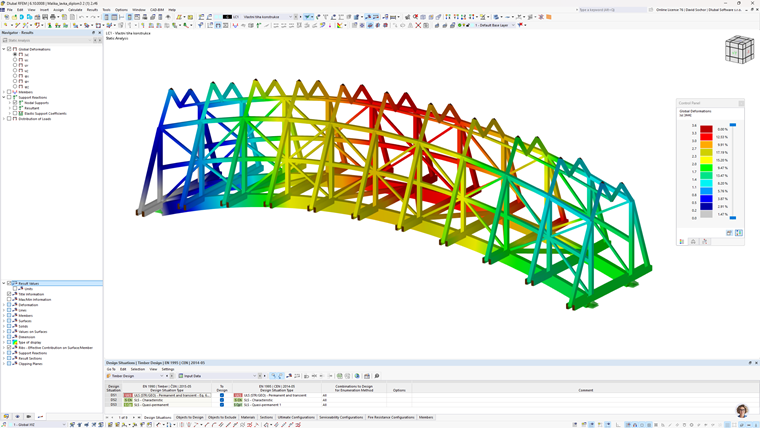
The global deformations of the entire structure were monitored for a load representing a fully occupied bridge. The maximum deflection of the structure corresponds to the prescribed limiting ratio l/300. Therefore, the bridge meets the requirements for the serviceability limit state (SLS).
Equivalent Elastic Stress
For a comprehensive assessment of the stress in the structure, the stress state was evaluated using the equivalent elastic stress according to the von Mises hypothesis. The resulting values were compared to the characteristic strength values of the wood used, and it was verified that no critical point of the structure exceeds the ultimate stress limit. Therefore, the structure is safe with regard to the ultimate limit state (ULS).
Wind Analysis
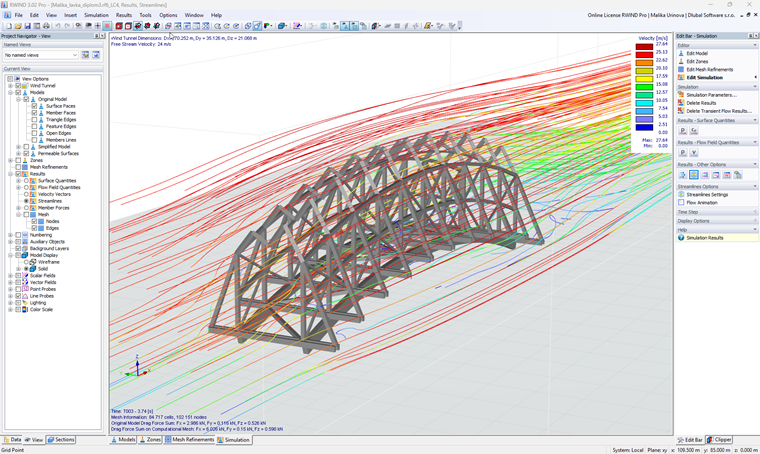
For the aerodynamic assessment of the wooden pedestrian and bicycle bridge, a simulation in the RWIND 3 program was used. The results show the wind speed distribution around the structure and the flow pattern behavior. The color map clearly indicates a significant acceleration of the flow above the structure and the formation of a vortex area behind it. The highest wind load concentrates on the windward edge of the arch.
The flow lines demonstrate that the airflow partially penetrates through the truss structure, confirming its favorable permeability. The shape of the arch contributes to smooth flow and minimizes the formation of turbulent vortices. The structure thus exhibits good aerodynamic properties and a uniform distribution of wind loads.