


|
Author
|
Piotr Piekarski
|
|
University
|
Wrocław University of Science and Technology, Poland
|
The master's thesis presents a procedure for determining normal stresses in strongly curved steel frame joints and compares the results obtained from analytical calculations, experimental testing, and numerical FEM results calculated in the RFEM 6 software.
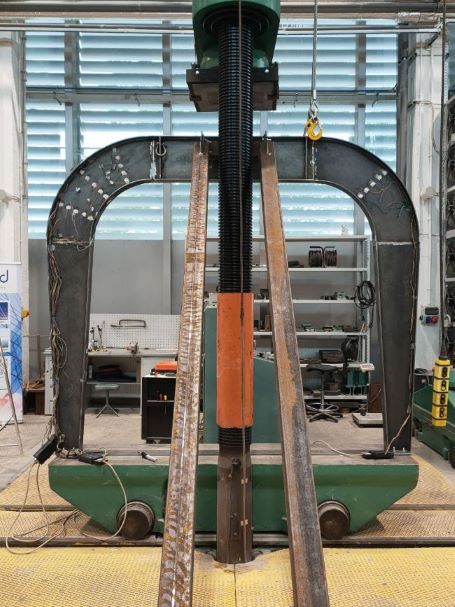
The first part of the master's thesis focuses on presenting the theoretical basis for frame joints made of strongly curved members and determining the normal stresses occurring in them, taking into account the radial load. An analysis of the influence of the radius of curvature and the width of the flanges of I-sections on the distribution of normal stresses was also carried out.
The second part presents a report on an experimental study, the aim of which was to:
- Check and verify the consistency of the results obtained from the application of the theory of strongly curved members with the results obtained analytically, numerically, and experimentally.
- Compare the experimental results with the stress results, taking into account the effective and actual cross-section properties, which proved the validity of using the effective cross-section properties.
As part of the thesis, RFEM 6 software was used for the numerical analysis of a steel frame with strongly curved joints. Two calculation models were created: a member model and a shell model.
The member model was used to determine the internal forces and the critical load factor, as well as the form of instability of the analyzed structure.
The shell model was used to determine stress distribution and normal stresses in the cross-sections corresponding to the designed cross-sections from the research experiment. The panel model was also used to read the forms of instability and critical load factors.
The results were obtained from a second-order analysis using the add-ons Structure Stability and Torsional Warping (7 DOF).
Furthermore, the results obtained from models with two different FEM mesh densities were compared. Finally, the tested frame structure was dimensioned.