


For strong economic growth, we need good infrastructure. There is global consensus on this. How major infrastructure projects are implemented, however, could not be more different. For example, while Germany and China both invest in modern infrastructure, the pace of progress varies greatly.
Major German projects are known internationally primarily because endlessly long periods of design and construction go hand in hand with design and construction setbacks. On top of that, construction costs often exceed the original budgets by a factor of several times. Good examples of this are the Berlin-Brandenburg Airport and the Elbphilharmonie in Hamburg .
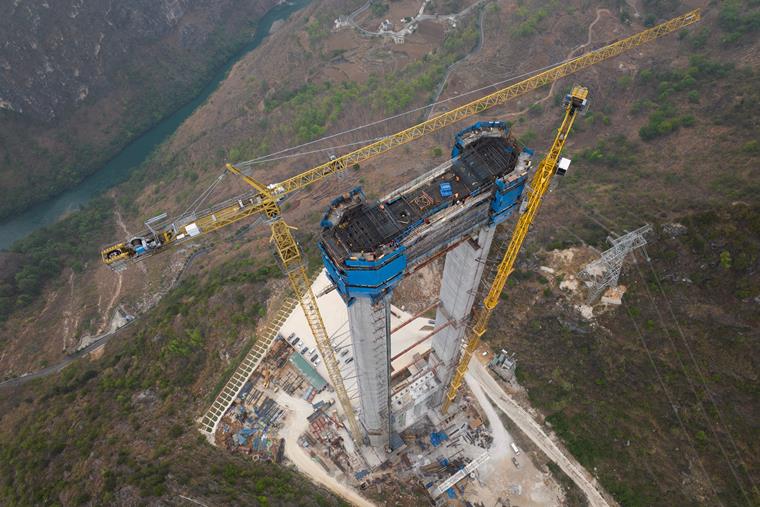
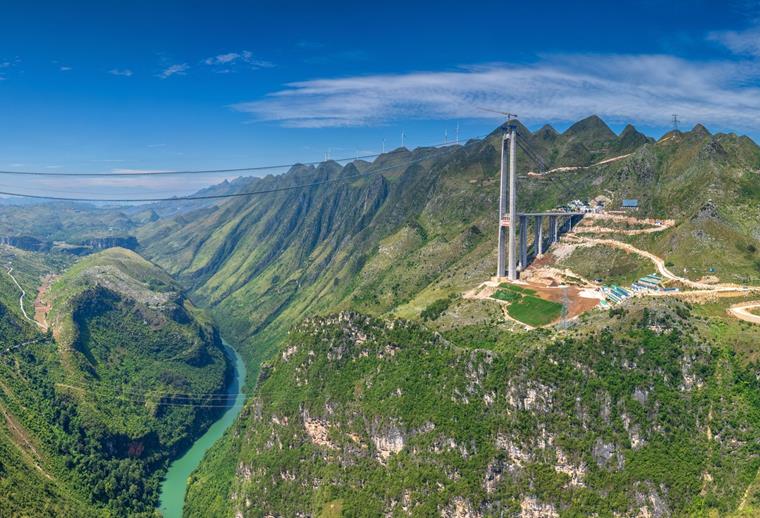
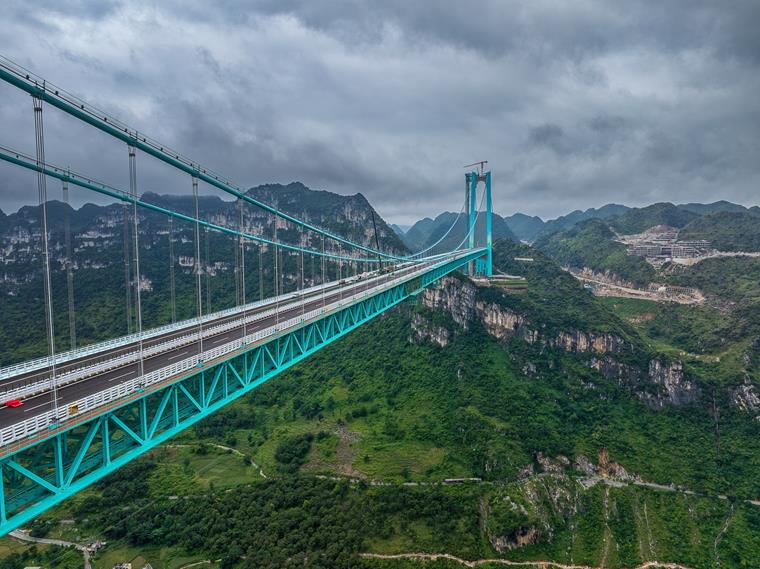
Meanwhile, in China, massive train stations, high-speed rail lines, and bridges are being built within just a few years, each one breaking records set by the last. For example, we’ve already told you about the Beipanjiang Bridge and the Huajiang Bridge. Let’s be honest: Has Germany simply fallen completely behind China when it comes to construction? Why does Chinese construction move so fast—and what is the cost of that? Let’s take a closer look!
Two Countries: Two Speeds
It doesn’t get much more current than this: In Germany, construction is underway on a major project that’s older than many of us. Stuttgart 21 was unveiled in 1995 and is still not finished. Although construction already began in 2010, it’s currently scheduled to go into operation only in 2031. And that’s after numerous delays and problems. The result: Stuttgart 21 will likely end up costing around €14.5 billion, barring any further setbacks.
And in China? There, too, a historic train station has been completely rebuilt in recent years. At Beijing Fengtai Station, this resulted in a building area of 400,000 m², with over 32 tracks and 32 platforms. 14,000 passengers per hour can board, disembark, and transfer here. And all of this was accomplished in just four years, from 2018 to 2022.
At first glance, of course, this makes a huge difference. While Stuttgart 21 kept construction companies and the media busy for decades, a massive rail hub in Beijing was renovated and expanded within about four years. Of course, the two projects are not directly comparable. After all, Stuttgart 21 is more than just a through station; it also involves the relocation and construction of new tunnels, access lines, and the further development of digital rail technology.
Beijing Fengtai has remained virtually trouble-free in terms of construction speed and project organization, but even that is no proof that China could complete a technically similar project in four years. So let’s get to the central question: Why is China able to build infrastructure at this pace? And why can’t we do the same here?
Why China Can Build Faster
These enormous differences are, of course, no coincidence. However, to make a blanket statement that China builds better and Germany is simply far too slow would be too simplistic. There are several reasons why construction in China proceeds so much faster, which we will now examine closer.
Political Decisions and Government Control
In China, democracy as we know it in our daily lives doesn’t really exist. The government consists of a single party, which makes it an autocracy. There is no opposition that could exercise a veto. Whatever is mandated by law is carried out exactly as prescribed.
When it comes to infrastructure, this has a major advantage: The political leadership sets priorities—for example, for major infrastructure projects—and everyone else takes care of implementation. Financing, land use, and construction are ‘’'coordinated and decided upon'‘’ and then carried out.
When a decision is made in Germany to implement a major infrastructure project, multiple planes and stakeholders are involved. These include the federal government, the states, local governments, agencies, project sponsors, property owners, and, of course, the public. Everyone has their own interests that it is necessary to reconcile with one another. Added to this are legal reviews, public participation processes, and, from time to time, legal disputes. All of this takes an enormous amount of time—and in the construction industry, too, time is money.
Even the OECD has already spoken out clearly about Germany. The OECD is an international organization headquartered in Paris. Its goal is to promote policies that sustainably improve economic growth, living standards, and prosperity worldwide. It is often regarded as a “think tank” for developed nations.
The OECD cites complex and inconsistent administrative procedures, limitations in local governments, and lengthy approval processes in Germany as factors that can hinder public investment in infrastructure. We note that in China, it is often simply easier to translate political decisions into actual construction projects. Already getting to that point can lead to problems in Germany.
Standardization and Parallel Construction Processes
From design, we move directly to the implementation of construction projects. Here, it shows that China has large construction companies, extensive manufacturing capacities, and many years of experience when it comes to implementing large-scale projects. Construction tasks that are carried out repeatedly are standardized. Added to this are prefabricated structural components, coordinated workflows—often involving shift systems—and a large fleet of machinery.

Thanks to this immense capacity and standardization, construction timelines are possible that one could only dream of in Germany. A fitting example of this is the Longyan train station renovation in January 2018. Around 1,500 workers were involved in connecting a new rail line to three existing lines. And what happened there already bordered on magic: Within about eight and a half hours, old tracks were removed, new tracks were laid, and switches were installed. Seven trains and 23 excavators were used in the process. You’ve probably never seen that many in one place in Germany—especially not on a construction site.
The key factor here, however, was not just the deployment of a large workforce and machinery, but the coordination. Different teams worked simultaneously on various tasks. This made it possible to completely rebuild the existing track layout in such a short time. Could this also be done in Germany?
Actually, yes. The problem here is more a question of to what extent we would consistently utilize standardized solutions, prefabricated parts, and parallel workflows in the end. Presumably—and this is an indisputable fact—we would already fail at such a project at the “labor” stage. The shortage of skilled workers on German construction sites is, after all, no longer a secret. If you’d like to read more about the problems on Germany’s major construction sites, you’ll find a relevant article here: Large-Scale Construction Projects in Germany .

China’s Construction Industry: Fast Pace, High Cost?
1. Public Participation and Political Power
In Germany, all citizens can influence major infrastructure projects themselves. The means for doing so include public participation procedures, objections, political debates, and, under certain conditions, legal action. In the case of Stuttgart 21, for example, there was a public debate surrounding the start of construction. It was resolved through a public mediation process.
A year later, a referendum was held in Baden-Württemberg on the financing of the state’s share. After all, the state’s tax revenue was yielding funds for the project. On the one hand, such procedures can delay large projects, but they also give those affected the opportunity to voice their interests, discuss alternatives, and have decisions reviewed.
Despite its autocratic nature, China also has participation and consultation procedures, for example in connection with environmental impact assessments. However, there is a limitation to their scope, and regulations are inconsistent. The public can exert only limited influence, particularly in the early phases of a project. The opportunities to challenge fundamental government decisions—such as those regarding infrastructure projects—are significantly more limited.

For people in China whose homes or land are affected by infrastructure projects, this can have significant consequences. While in Germany lawsuits and construction halts due to unsuitable flight paths for a new airport are often entirely possible, in China this often results in relocations and compensation. In the end, the state prevails. The large-scale infrastructure project takes priority over the rights and opinions of citizens.
2. Performance Pressure and Low Wages
On many construction sites in China, it’s not just about getting the work done, but also how quickly. Workers are confronted with tight schedules and intense performance pressure. Numerous reports paint an unsettling image of the Chinese construction industry: It is necessary for anyone who does not fulfill expectations to expect consequences. From the loss of a follow-up contract for a subcontractor to career setbacks for individual employees, everything is not only possible but a sad reality of everyday life with existential consequences.
Of course, this does not mean, as a general rule, that every employee is immediately fired for a mistake. But it shows the often weak position of workers vis-à-vis their employers—in contrast to Germany. Another factor here is labor costs. Compared to Germany, construction companies in China can employ large teams at lower labor costs.
In China, there are millions of so-called migrant workers who perform manual labor on construction sites for comparatively low wages. They are often paid late or receive far worse employment contracts than their permanently employed colleagues. As a result, there is always a large labor pool available for temporary structural projects, and the workers performing the labor are easily replaceable.
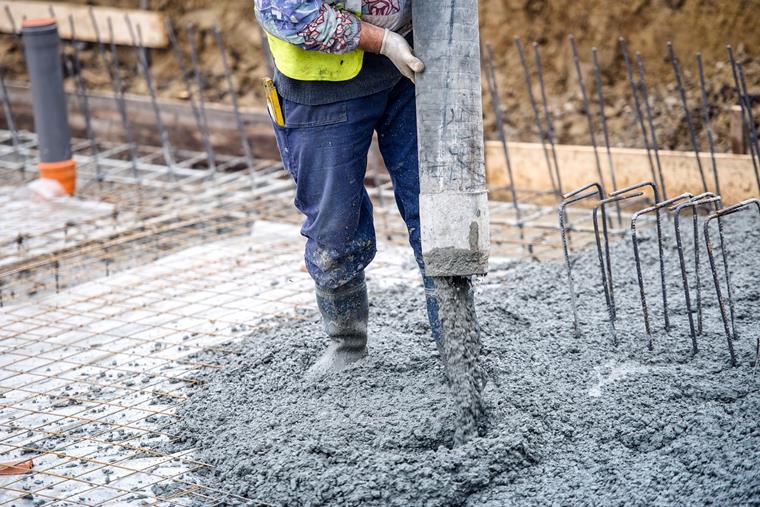
It shows that this rapid pace is also linked to a labor market in which many workers have relatively little job security. So when we ask ourselves why China is able to complete certain structural projects in such a short time, we should look not only at machinery, design, and organization, but also at the conditions under which people work on these projects.
3. Who Pays for China’s Construction Boom?
China’s infrastructure boom is not financed solely by the central government. Provinces, cities, and other local government agencies also play an important role. A key role is played by Local Government Financing Vehicles (LGFVs). These are state-controlled financing companies that, among other things, absorb loans for infrastructure and urban development. This debt is not fully reflected in the official national debt.
Let’s say the central government is pushing for the construction of a new record-breaking bridge. However, the city in charge does not have enough money in its budget to contribute its share. So it uses its own government-controlled financing company (LGFV), which absorbs loans from banks or issues bonds. This money is used to finance such structural projects.
It is necessary for the corporation itself to later repay the debt, including interest. The problem: In the end, even with revenue from the structure, not enough money comes in. For many years, local governments were able to finance structural projects even though their current revenues were insufficient for that purpose. This also increases the economic pressure to complete structural projects quickly. After all, as long as loans are outstanding, interest accrues. Delays can cause additional costs and further increase the financial burden.
And all of this has far-reaching consequences for many regions: they are heavily indebted. The International Monetary Fund even describes these financing structures as a key factor behind the high debt levels of local governments and their financing companies.
Conclusion: Building Like China?
One thing is clear: China’s construction boom shows what is possible when infrastructure is a political priority and projects are driven forward with great effort. But the rapid pace also comes at a price: for workers, for public finances, and in some cases also for the long-term efficiency of the construction projects. Would we be willing to pay that price?
And should we really build more like China—or simply a little less like Germany? What is actually slowing down our structural projects so drastically? Let’s summarize: Important infrastructure should be completed faster here as well. But without compromising on issues such as (workplace) safety, quality, and public participation. How can this be achieved?
The fact is: We haven’t found the perfect way to build yet. Perhaps it doesn’t even exist. Our social priorities are deliberately different from those in China. But what we can do is learn from Chinese construction practices to see what could be implemented here. This includes:
- Standardizing projects more extensively where it makes technical sense
- Designing thoroughly first, then building, instead of trying to solve problems only during implementation
- Simplifying design and permitting procedures: Which standards, design checks, and bureaucratic steps are truly necessary?
- Better coordinate construction processes, especially between the various trades
- Clearly define responsibilities so that decisions do not take unnecessarily long
- Improve design and risk management to identify delays and cost overruns early on
- Realistically assess financing and long-term benefits before a project turns out to be an expensive failure
However, there are certain things we should continue to preserve. These include enhanced legal protection for all parties involved, the public’s right to have a say, and high standards for the safety and durability of the structure to be built. There should also be timely and transparent reporting on costs, risks, and decisions made, before a single sensational insider headline sparks further schadenfreude.
Of course, what works in one political system cannot simply be transferred to another. The crucial question is not: How can we finally build as fast as China? But rather: How can we build faster and more efficiently without sacrificing important values such as safety, public participation and long-term responsibility?