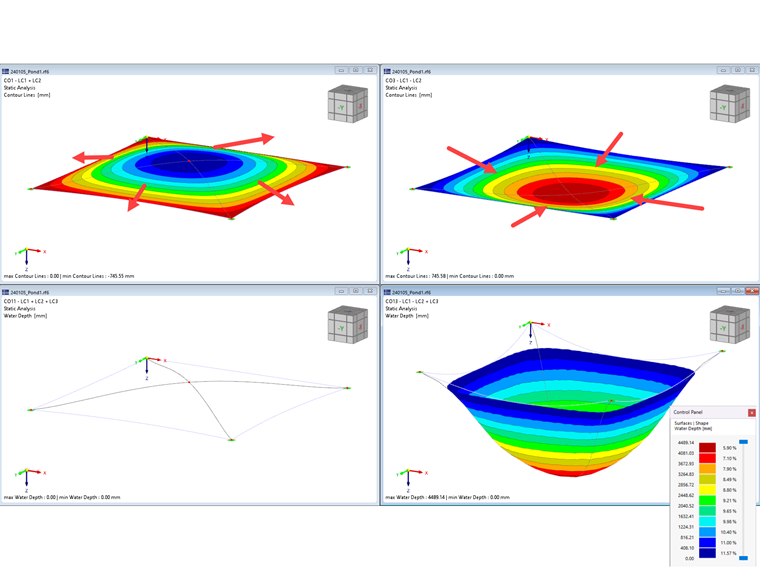
The risk of ponding can be recognized as early as when designing roof surfaces. To model the water runoff on a free-form roof surface, you can draw fall lines (contour lines / inclination) on the curved surface. They show the directions and the water amount that occur on the roof surface for a certain amount of rain. It is possible to change the geometry and the orientation of cables or a membrane, as well as the prestress, in order to exclude ponding water in the roof surfaces built.
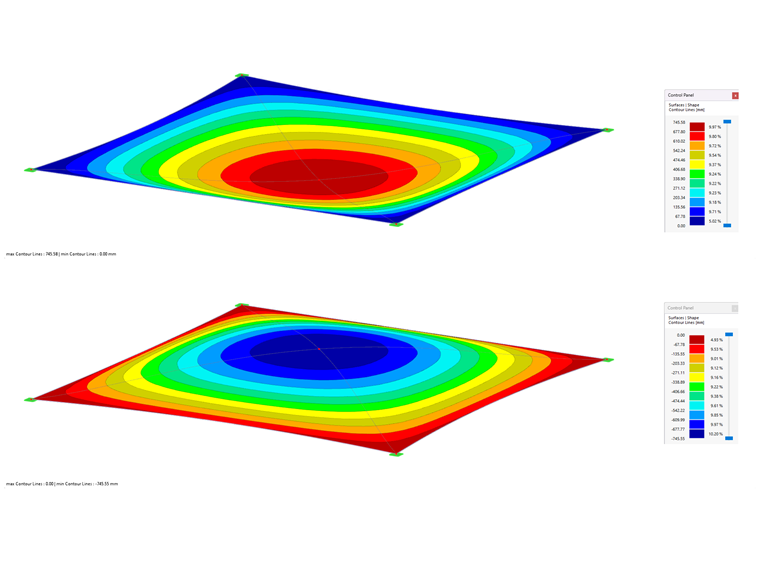
As an alternative, you can consider a water load in the structural design checks. For this, you can use the Ponding load type. The Ponding load type allows you to simulate rain actions on multi-curved surfaces, taking into account the displacements according to the geometrically linear, second-order, and large deformation analysis. This numerical rainfall process examines the assigned surface geometry and determines which rainfall portions drain away and which rainfall portions accumulate in puddles (water pockets) on the surface. The puddle size then results in corresponding vertical and horizontal loads for the structural analysis.
To use the load type, you need to generate the shape of your membrane structure first. In our example, Shape 1 is created in CO1, which causes water to run off. In CO3, Shape 2 is created, which causes water to accumulate. To combine these shapes with the Ponding load type, we simply create two more load combinations where the load is added and consider the shapes as the initial state. As expected, there is no ponding water in Shape 1. However, Shape 2 favors the accumulation of water and determines the results accordingly.