


📝1. Introduction
Timber structures are increasingly used for modern buildings and infrastructure projects due to their sustainability, lightweight properties, and architectural flexibility. However, these same characteristics make timber structures particularly sensitive to wind actions. Accurate consideration of wind loads is, therefore, essential to ensure structural safety, serviceability, and long-term performance. This article provides an overview of the influence of wind loads on timber structures, key design considerations, and analysis methods in accordance with EN 1991-1-4 (Eurocode 1) and related national annexes.
🌪️ 2. Wind Load Characteristics
Wind loading on structures is governed by a combination of mean wind action and fluctuating (turbulent) components. Timber structures, especially lightweight and flexible systems, are more responsive to dynamic effects compared to massive reinforced concrete or steel structures.
2.1. Main Components
- External Wind Pressure: Acts on walls, roofs, and other surfaces.
- Internal Wind Pressure: Generated by openings or leakage; relevant for light timber buildings with large glazed areas.
- Net Wind Pressure: Difference between external and internal pressures, determining actual load effects on structural members.
- Turbulence Effects: Can lead to significant load fluctuations, especially on slender or tall timber elements.
2.2. Typical Wind Actions on Timber Structures
Table 1: Typical Wind Actions and Structural Considerations for Timber Structures
| Structural Element | Typical Wind Action | Special Considerations |
|---|---|---|
| Roof panels & purlins | Uplift suction on windward & leeward | Check fasteners & diaphragm action |
| Wall studs & frames | Horizontal pressure + suction | Bracing against racking required |
| Columns & posts | Bending due to lateral loads | Consider buckling in both axes |
| Glulam/CLT shear walls | Racking and overturning loads | Requires ductile anchorage & diaphragm connections |
| Facade cladding | Local suctions at edges/corners | Requires high pull-out resistance of fixings |
🏗️ 3. Design Considerations
3.1. Load Transfer & Structural System
Timber structures rely on bracing systems, shear walls, and diaphragms to transfer wind loads to the foundations. Common load-bearing systems include:
- CLT shear wall systems
- Timber frame structures with diagonal bracing
- Hybrid systems with steel or concrete cores
3.2. Connection Detailing
Connections are often the critical components under wind loading:
- Fasteners must resist uplift forces on roof elements.
- Ductility and load redistribution are crucial to avoid brittle failure.
- Special attention to edge distances, nail/screw pull-out, and embedment strength per EN 1995-1-1.
3.3. Dynamic Response
Due to their low mass, timber buildings can exhibit larger accelerations under fluctuating wind loads:
- Comfort criteria (EN 1991-1-4 Annex B) often govern design for mid-rise timber buildings.
- Serviceability limit states (e.g., deflection, vibration) can be more critical than ultimate limit states.
📌Note: The implementation of aeroelastic instability and Vortex-Induced Vibration (VIV) analysis in RWIND is planned as a key future enhancement. This development aims to extend the software’s capabilities toward comprehensive dynamic wind–structure interaction studies, enabling more accurate prediction and assessment of wind-induced responses on flexible and slender structures.
🌬️ 4. CFD-Based Wind Simulation
For complex timber structures, Computational Fluid Dynamics (CFD) tools such as RWIND offer several advantages:
- Realistic pressure distribution on irregular roofs and facades
- Consideration of terrain, topography, and turbulence
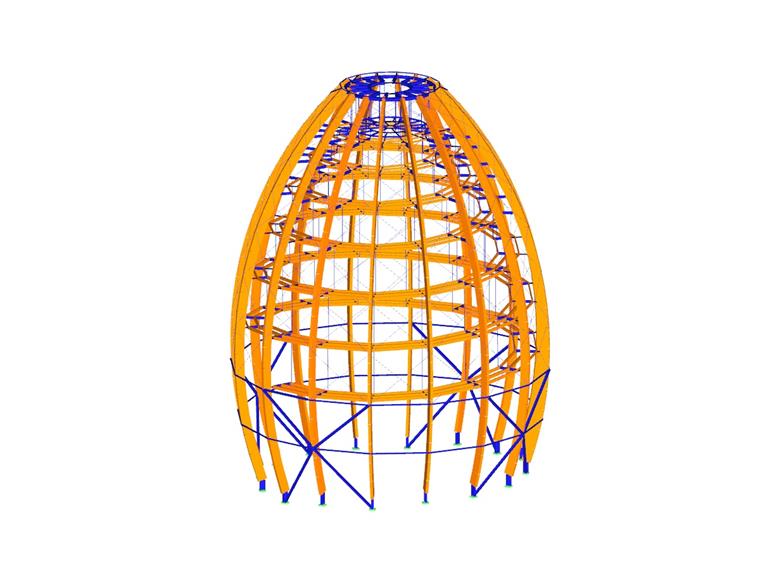
- Applicable to tall timber buildings, atriums, or free-form geometries
- Generation of distributed surface loads transferable to RFEM for structural analysis
CFD simulations are particularly useful when:
- The structure is located in complex terrain (e.g., forest edges, hills)
- The building shape deviates significantly from code-defined cases
- Dynamic effects (gust response, vortex shedding) are relevant
🪵 5. Special Challenges for Timber Structures
| Challenge | Description | Typical Mitigation Measures |
|---|---|---|
| Uplift on light roofs | High suctions on windward/leeward edges | Strong anchorage, purlin blocking, diaphragm continuity |
| Lateral bracing | Low in-plane stiffness of timber frames | Use of CLT shear walls, diagonal bracing, or hybrid cores |
| Connections under cyclic load | Timber fasteners can lose capacity after repeated loading | Design for fatigue, use ductile steel fasteners, adequate spacing |
| Moisture & wind | Wind-driven rain & pressure differentials affect durability | Proper detailing, membranes, drainage paths |
| Vibrations in tall timber | Lightweight → higher accelerations under gusts | Tuning masses, damping systems, stiffer diaphragms |
💡 6. Practical Tips for Engineers
- Always check uplift forces carefully; they often govern connection design
- Consider serviceability criteria early in design to avoid costly retrofits
- Use CFD simulations for irregular geometries or tall structures to capture realistic pressure patterns
- Ensure a continuous load path from cladding → framing → bracing → foundation
- Document all wind load assumptions, terrain categories, and coefficients clearly for structural approval
🧠 7. Summary
Wind loads play a decisive role in the design of timber structures. Their lightweight and flexible nature demands careful attention to uplift, bracing, connection detailing, and dynamic effects. Combining code-based methods for regular structures with CFD simulations for complex geometries allows engineers to achieve both safety and efficiency in modern timber architecture.
 Knowledge Base