Architecture and Structural Analysis
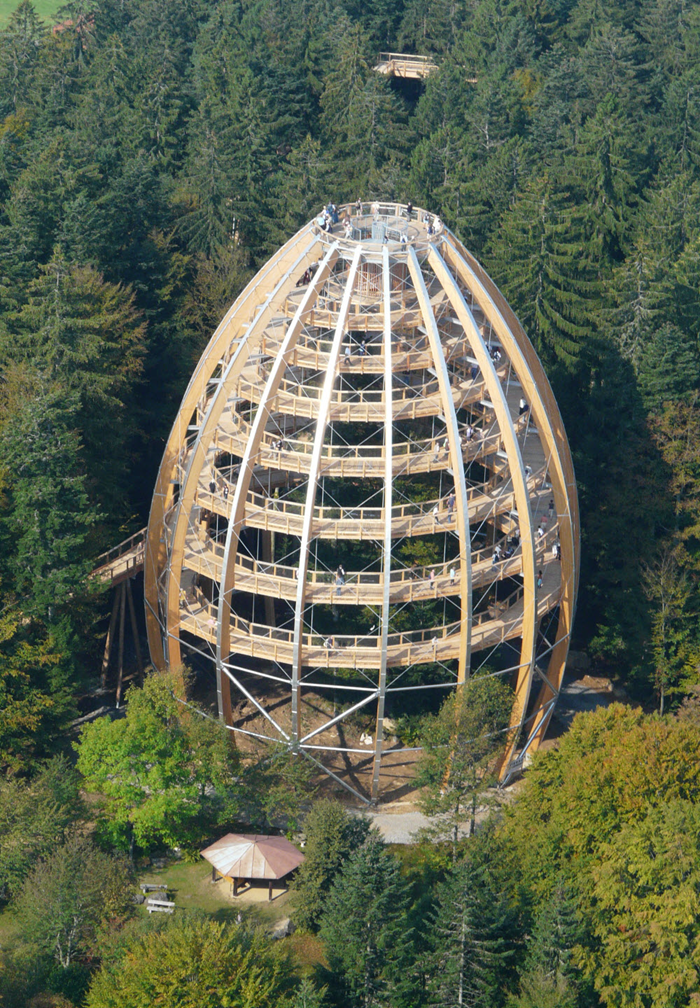
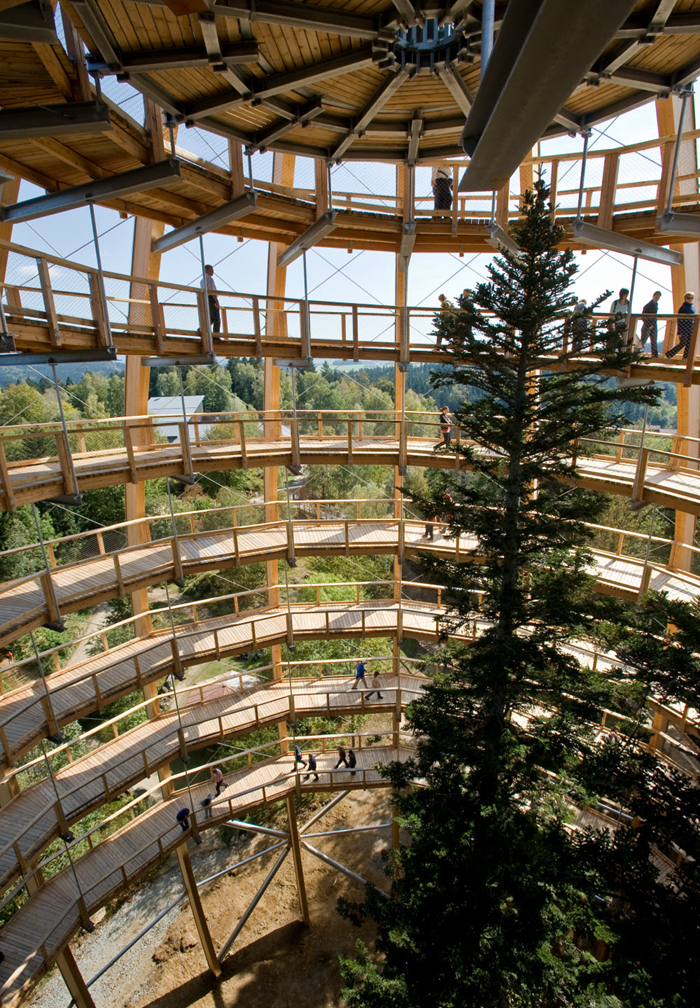
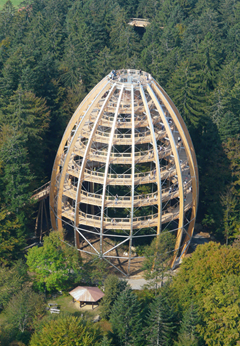
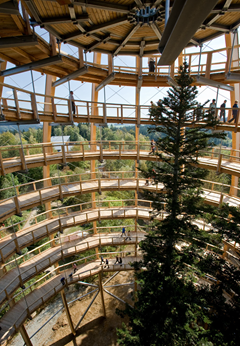
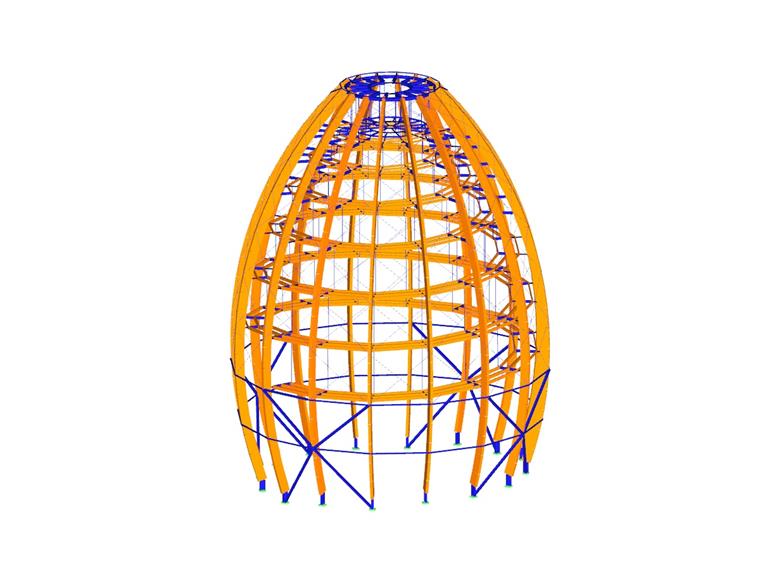
The egg-shaped tree tower was built around three trees with a height of up to 38 m (124.6 ft), growing on a rock formation.
In this way, visitors are able to follow the trees' individual steps of growth. Reaching the two-story steel platform at the tower top, they can enjoy the view across the national park.
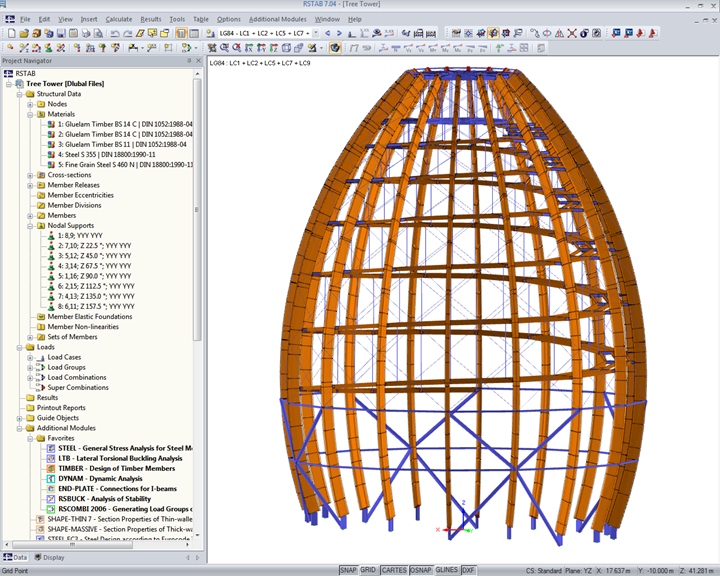
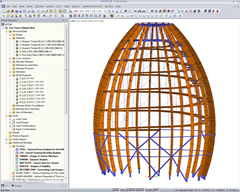
The tower's principal supporting structure, built mainly of timber, consists of 16 larch glulam beams, which are curved and arranged in rotational symmetry. Stiffening is provided in the upper area by a tight mesh of diagonal steel members and in the lower area by four compression- and tension-resistant hollow steel section crosses, which were anchored to the timber arches.
The timber spiral structure is attached to the timber arches by steel suspensions and secondary steel beams. The structural system was calculated according to the second-order analysis.
The calculation resulted in a compression force of 1,160 kN (260.79 kips) within the timber arches and a maximum horizontal tower deformation of 15.7 cm (61.8 in).
“The egg shape of the structure required the use of a program that is able to calculate spatial frameworks. We decided to work with the Dlubal program RSTAB, which is best suited for such a challenge,” says Dipl.-Ing. (FH) Ralf Kolm, the engineer at the WIEHAG company who was responsible for the structural analysis.
| Location | Baumwipfelpfad Bayerischer Wald Böhmstraße 43, 94556 Neuschönau, Germany www.baumwipfelpfade.de/bayerischer-wald |
| Structural Engineering | Project, Structural Analysis and Construction WIEHAG GmbH Altheim, Austria www.wiehag.com |
| Architect | Josef Stöger, Schoenberg, Germany stoeger-koelbl.de |
| Investor | Erlebnis Akademie AG, Bad Kötzting, Germany www.eak-ag.de/eakag |