


Introduction
Traditional joint solutions are widely used in steel construction, with the EN 1993-1-8 standard prescribing the component method for design. This method can be challenging, especially for complex designs, but resources like Standardized Joints in Steel Structures to DIN EN 1993-1-8 provide predefined joint geometries with resistance and stiffness values, simplifying the process.
This paper compares results from conventional design methods with those generated by the advanced CBFEM approach in the Steel Joints add-on for RFEM 6, using two representative joint configurations to highlight the differences.
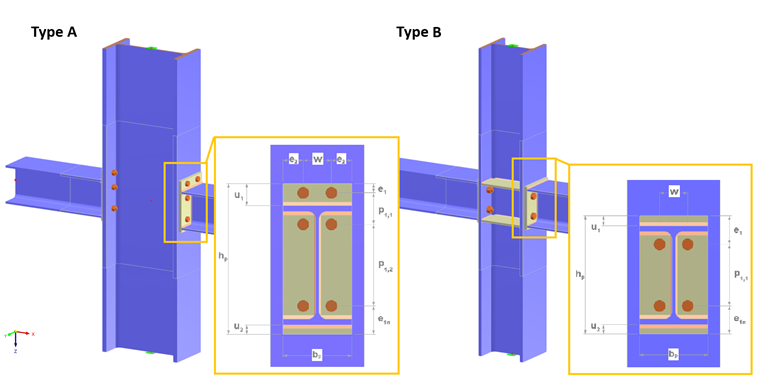
The joint analyzed is a moment-resistant connection for beams with I- or H-shaped cross-sections and end plates, assembled with vertical rows of high-strength bolts for reliable load resistance.
End plate connections have several setup variants. This article covers two options: the extended end plate, which extends above the beam and is connected to the column, and the flush end plate, which covers only the area of the beam cross-section and is connected to the column.
The extended end plate geometry, Type A, is taken from the tables for IH moment-resistant joints [1], while the flush end plate geometry, Type B, is derived from the tables for IM moment-resistant joints [3].
The selected joint geometries are presented in the table below, along with their setup.
| Joint | Type A.1 | Type A.2 | Type B.1 | Type B.2 | |
| Reference | IH ex. 444 [1] | IH ex. 141 [1] | IM ex. 10781 [3] | IM ex. 10743 [3] | |
| Steel grade | S235 | S235 | S235 | S235 | |
| Beam cross-section | HEA 260 | IPE 600 | HEA 260 | HEA 200 | |
| Column cross-section | HEB 550 | HEB 600 | HEB 320 + st.1 12.5 mm | HEB 320 + st.1 10 mm | |
| End plate dimensions, mm | |||||
|
20 | 20 | 20 | 15 | |
|
260 | 220 | 260 | 200 | |
|
340 | 700 | 280 | 210 | |
| Bolt dispositions, mm | |||||
|
30 | 30 | 75 | 60 | |
|
95 | 100 | 130 | 90 | |
|
140 | 480 | |||
|
75 | 90 | |||
|
70 | 70 | 15 | 10 | |
|
20 | 30 | |||
|
130 | 110 | 130 | 110 | |
|
65 | 55 | |||
| Bolt | M20 10.9 | M20 10.9 | M24 10.9 | M20 10.9 | |
| Fillet welds, mm | |||||
|
7 | 8 | 4 | 4 | |
|
4 | 4 | 4 | 4 |
1 st. - stiffeners
Analytical Approach
The resistance tables provided in Standardized Joints in Steel Structures to DIN EN 1993‑1‑8 [1] and Steel Structures to DIN EN 1993-1-8, Supplementary Volume 2018 [3] are valid under the following conditions: verification procedures are elastic-elastic or elastic-plastic; predominantly static loading; continuous column; equal beam heights and positions for double-sided beam-to-column joint configurations; columns, beams, and end plates in S 235 or S 355 according to DIN EN 1993 part 1.1; beam and column sections HEB, HEA, HEM, IPE are rolled sections acc. to DIN 1025 part 2, 3, 4, and 5 and previous Euronorms EU 53-62 (HE-series) and EU 19-57 (IPE) resp.
The failure modes and primary components influencing moment resistance and stiffness considered for the Type A and Type B joints include (see [2] 6.2.6.1 to 6.2.6.8) column web in shear (CWS), column web in compression (CWC), beam flange and web in compression (BFC), column web in tension (CWT), column flange in bending (CFB), beam web in tension (BWT), end plate in bending (EPB), and bolts in tension (BT).
The moment resistance and initial rotational stiffness of beam‑to‑column joints with either extended and flushed end plates were taken from the resistance tables provided in [1] and [3].
The joint setups are presented at the beginning of this article, while the moment resistance and rotational stiffness values are summarized in the comparative table below.
Component Based FE Analysis
The connection design was performed using the Steel Joints add‑on for RFEM 6.
The Steel Joints add-on allows for the analysis of connections based on an FE model. Both the input and result evaluation are fully integrated into RFEM’s user interface, making the design process intuitive and efficient.
1. Moment Resistant Joints with Extended End Plates
Steel Joints Add-on Input
The joint setups are presented at the beginning of this article.
Steel Joints Add-on Outcomes
The Steel Joints add-on for RFEM 6 enhances the software's capabilities by allowing engineers to analyze steel connections with the precision of a finite element (FE) model. This advanced tool facilitates the detailed visualization of all key results directly on the FE model, offering a clear and comprehensive overview of connection performance under various loads and conditions. Consequently, RFEM offers a deeper understanding of joint behavior and helps optimize designs for safety and efficiency.
Detailed representation of the outcomes is given for the Type A.1 joint only.
Moment resistance
Moment resistance for the Type A.1 joint is 163.43 kNm.
Equivalent Stresses
Equivalent stresses depict the overall stress distribution in the connection and help identify potential failure points caused by stress concentrations. They are essential for evaluating the load‑bearing capacity of the connection.
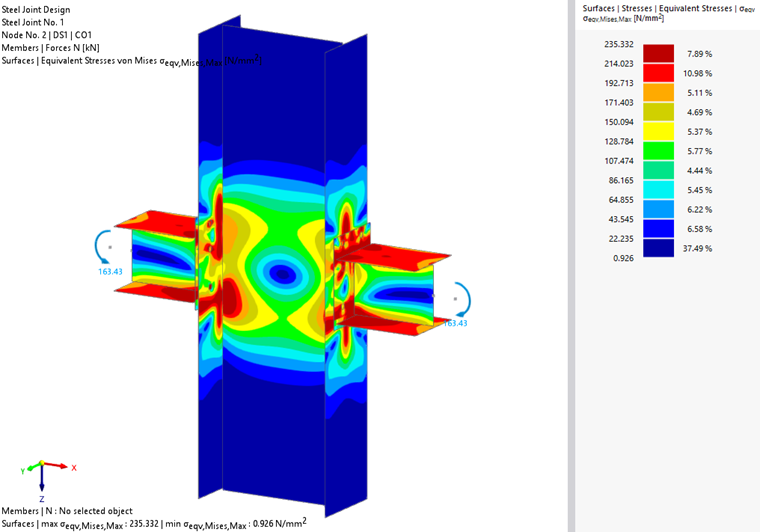
Stress distribution in the joint is influenced by load transfer mechanisms and joint geometry. The symmetrical configuration helps evenly distribute forces, although localized stress concentrations occur. The beam flanges and end plates experience the highest stresses, particularly near the end plate where it is connected to the beam flanges and bolted to the column. The area in deep red indicates stresses at the steel's yield strength. The column faces adjacent to the joint also experience significant stresses.
Plastic Strain
The plates in the connection are designed plastically and involves comparing the calculated plastic strain with an allowable plastic strain. The limiting plastic strain is 5%, according to EN 1993‑1‑5, Annex C. This value is adopted as the default in the Steel Joints add‑on.
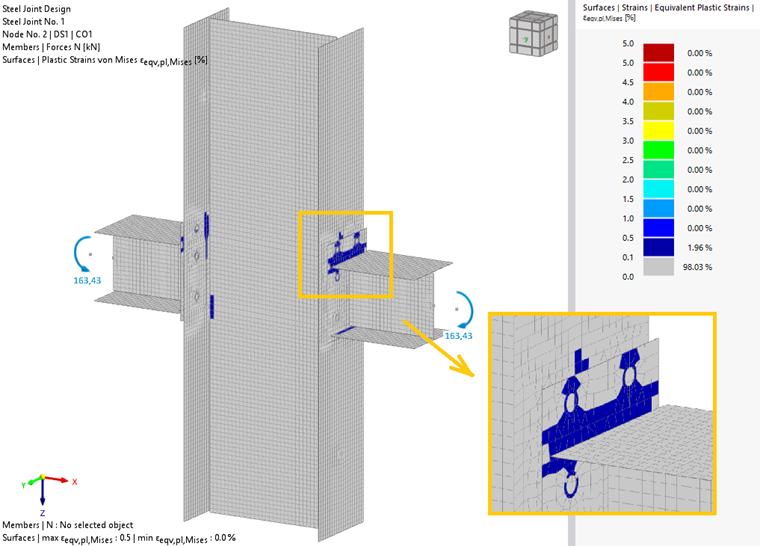
The strain pattern in the joint closely follows the stress distribution. The end plate shows non-uniform strain patterns due to the eccentric load transfer, with strain concentrations around the bolt holes where maximum stress occurs.
Overall, the strain distribution is non-uniform, with higher plastic strains at areas of stress concentration, reaching up to 0.5% at critical locations.
Design ratios on Steel Joint Add-on
A summary of the design ratios is presented in the following table.

Rotational Stiffness
A summary of the rotational stiffness values is presented in the following table.

The joint exhibits two values for rotational stiffness due to its asymmetrical nature. The moments acting in both upward and downward directions produce different stiffness responses. As a result, the rotational stiffness varies depending on the direction of the applied moment, reflecting the non-symmetrical behavior of the joint.
2. Moment Resistant Joints With Flushed End Plates
Steel Joints Add-on Input
The joint setups are presented at the beginning of this article.
The connection design was performed using the Steel Joints add‑on for RFEM 6.
Steel Joints Add-on Outcomes
Detailed representation of the outcomes is given for the Type B.1 joint only.
Moment resistance
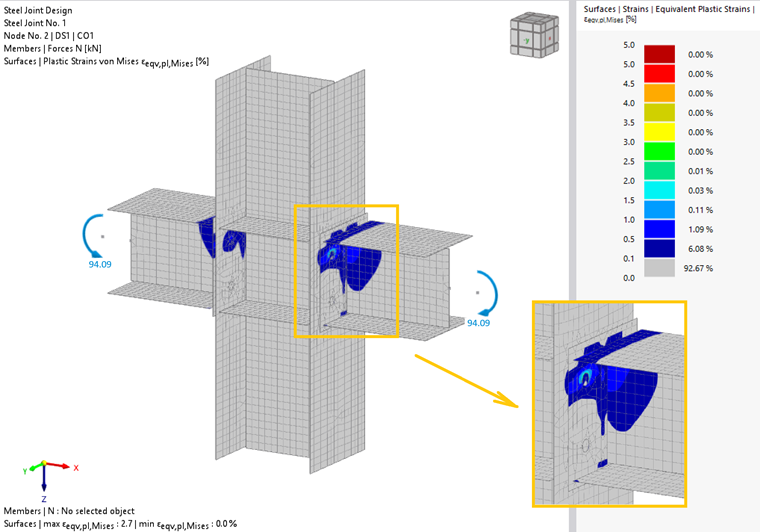
Moment resistance for the Type B.1 joint is 94.09 kNm.

Design ratios and Rotational Stiffness
A summary of the design ratios and rotational stiffness of the joint are presented in the following tables.


Discussion
A few calculations were conducted for the analysis: one for the joint with HEA beam profile and one with IPE beam profile. These geometries were modeled using the Steel Joints Add-on. The results of the computations - both analytical and based on the CBFEM method - are presented below.
| Joint | Type A.1 | Type A.2 | Type B.1 | Type B.2 | |
| Reference | IH ex. 444 [1] | IH ex. 141 [1] | IM ex. 10781 [3] | IM, ex. 10743 [3] | |
| MOMENT RESISTANCE | |||||
| Analytical, kNm | 152.5 | 356.6 | 93.59 | 43.41 | |
|
EPB + BT | EPB + BT | EPB + BT | EPB + BT | |
|
1.0 | 1.0 | 1.0 | 1.0 | |
| Steel Joins Add-on, kNm | 163.43 | 378.5 | 94.09 | 43.13 | |
|
0.221 | 0.234 | 0.477 | 0.908 | |
|
1.000 | 0.991 | 0.909 | 0.848 | |
|
0.981 | 0.989 | 0.994 | 0.998 | |
| Difference in moment resistance value, % | 7.25 | 5.96 | 0.53 | 0.65 | |
| ROTATIONAL STIFFNESS | |||||
| Analytical, MNm/rad | 27.2 | 135.1 | 15.52 | 6.6 | |
| Steel Joins Add-on, MNm/rad | 28.3 | 166.1 | 12.4 | 5.2 | |
| Difference, % | 3.96 | 20.6 | 22.34 | 23.7 |
The comparison between the analytical method and the modern CBFEM approach reveals generally good agreement.
For the Type A joints, the difference in moment resistance ranges from 5.96% to 7.25%, with the Steel Joints Add-on providing slightly higher values due to a more detailed estimation of the joint's moment resistance.
For the Type B joints, the differences in moment resistance are smaller, ranging from 0.53% to 0.65%, indicating excellent agreement between the two methods.
The rotational stiffness shows a larger variation across the joints. For the Type A joints, the difference in stiffness ranges from 3.96% to 20.6%. The larger difference suggests that the CBFEM approach provides a more refined and accurate representation of rotational behavior, capturing more complex interactions within the joint.
For the Type B joints, the differences are even more significant, with variations of 22.34% and 23.7%. These larger differences indicate that the Steel Joints Add-on accounts for more intricate aspects of joint behavior, such as load distribution and deformations, which the simplified analytical method does not fully capture.
When the moment capacity is reached in type A joints, FE analysis shows that end plates experience plastic deformations while bolts reach their resistance. This corresponds with the failure modes from the reference literature. Welds are also at the limit of its capacity.
As for the Type B joints, the moment resistance reached in the FEA in all assessed parts is evenly used, i.e. bolts, end plates and welds. This means the joint is well designed. The high plastic strain in the end plates is evident.
In conclusion, the Steel Joints Add-on provides an accurate and detailed approach, particularly for complex joint configurations.
References
[1] Standardized Joints in Steel Structures to DIN EN 1993-1-8, Complete Edition 2013
[2] DIN EN 1993-1-8:201.0-12 Eurocode 3: Design of steel structures Part 1-8: Design of joints. German version EN 1993-1-8:2005 + AC:2009
[3] Standardized Joints in Steel Structures to DIN EN 1993-1-8, Supplementary Volume 2018. Moment resistant joints lM