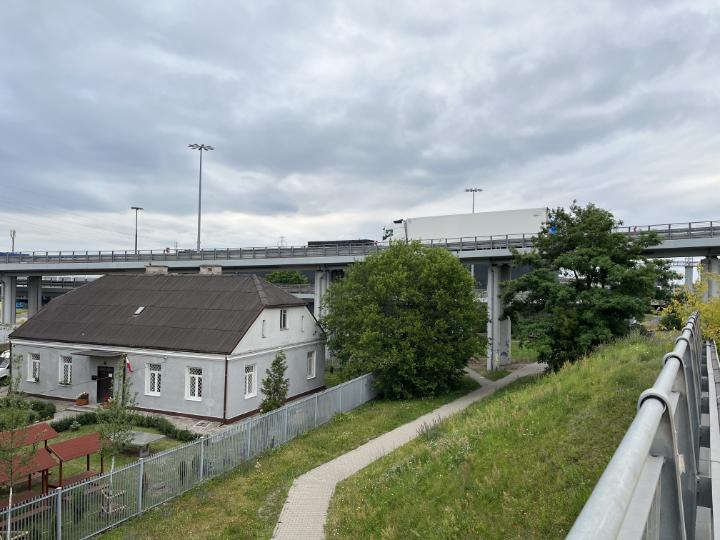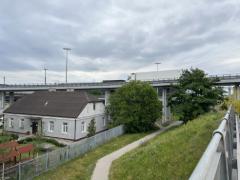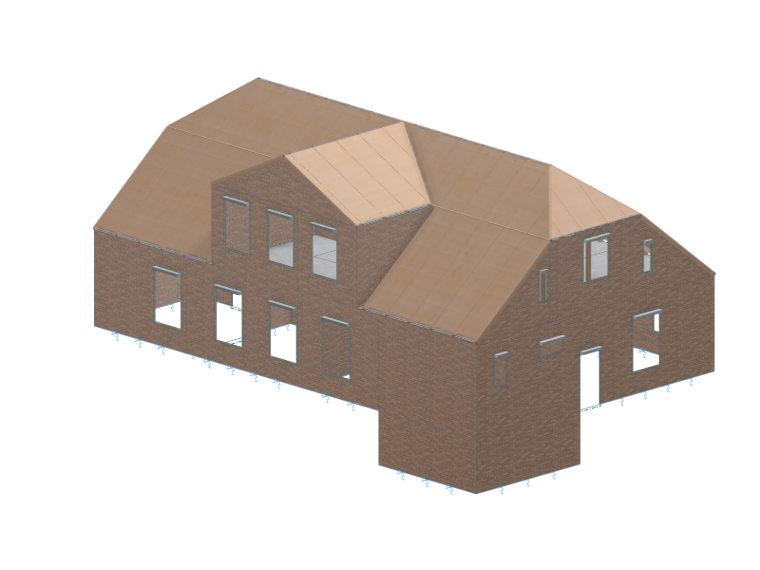
The building is a ground-floor residential structure with an attic, masonry load-bearing walls, a floor supported by the walls and a timber roof. It is listed in the municipal register of historic monuments and had no available technical documentation or original drawings. A particular feature of the building is a dormer wall with diagonal cracking, which was the main focus of the structural investigation. The building is located approximately 80 m from a voivodeship road, 35 m from an expressway and 15 m from a viaduct. The main engineering challenge was to determine whether traffic-induced vibrations were responsible for the observed cracking or whether it resulted from the structural and foundation conditions of the building.
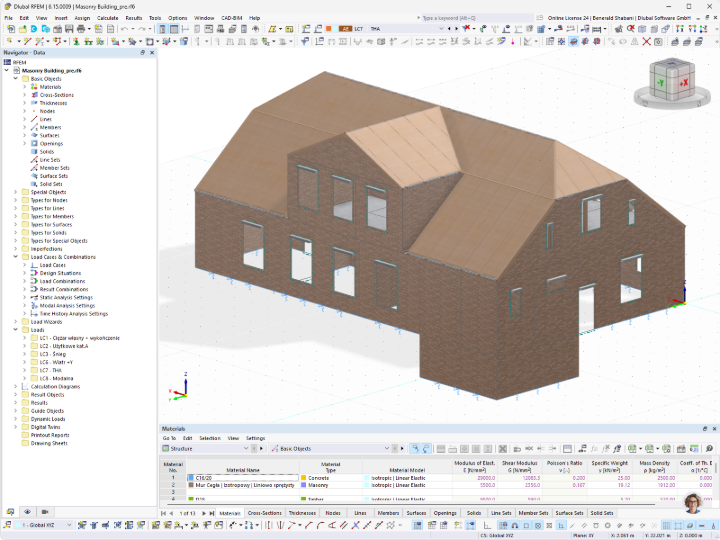
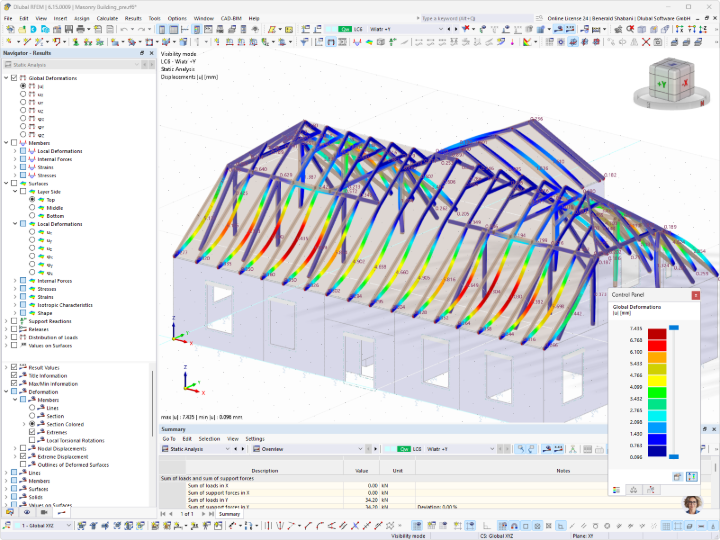
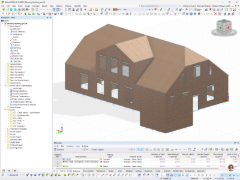
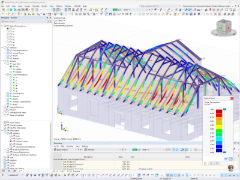
Because the original documentation was unavailable, the actual geometry and structural arrangement were reconstructed using 3D laser scanning with a FARO Focus S70. The resulting point cloud was used to create accurate 2D and 3D CAD documentation and subsequently develop a three-dimensional finite element model in Dlubal RFEM 6.12. The structural system was modelled using beam elements for linear components and shell elements for masonry walls and floor components. The model contained 1,742 member elements and 17,941 surface elements, with a target finite element size of 0.25 m. The materials included clay brick masonry, concrete and timber, with their mechanical and mass properties defined according to the characteristics of the existing structure.
A major difficulty was the uncertainty regarding the actual foundation and soil conditions, as no soil investigation or foundation excavation had been performed. To address this issue, the RFEM model incorporated soil–structure interaction using translational springs at the foundation level. Three different subgrade stiffness conditions were considered, ranging from infinitely rigid support to flexible soil. Foundation uplift nonlinearity was also included for the flexible support condition. This allowed the sensitivity of the building's dynamic and structural response to the uncertain ground conditions to be assessed.
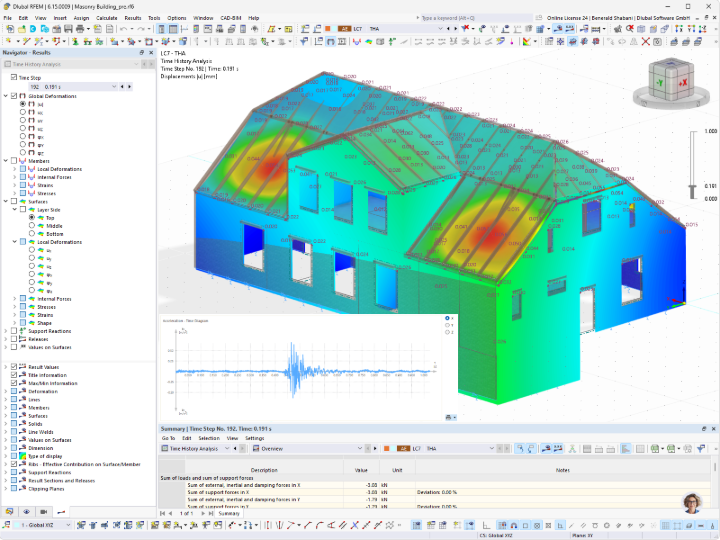
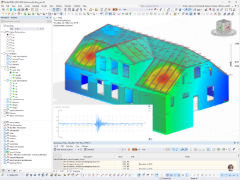
Dlubal RFEM was used for comprehensive finite element modelling, mesh generation and verification, modal analysis, soil–structure interaction and time-history analysis. The Lanczos method was used to determine the natural vibration modes, while the implicit Newmark method with a 0.001 s time step was used for the dynamic analysis. The model was subjected to permanent and variable actions as well as traffic-induced dynamic excitation obtained directly from in-situ acceleration measurements. The measured vibration records were applied at the foundation level, allowing the numerical model to reproduce the actual dynamic excitation experienced by the building. The workflow therefore combined 3D laser scanning, CAD reconstruction, field vibration measurements and Dlubal RFEM analysis into one integrated diagnostic procedure.
The numerical analysis demonstrated that the assumed soil stiffness had a much greater influence on the structural response than the traffic-induced dynamic action itself. The fundamental natural frequencies decreased by up to 65% for flexible soil conditions, while the maximum shear stresses in the analysed dormer wall varied by approximately 30%. In contrast, including the measured traffic-induced vibrations in the load combinations changed the maximum shear stresses by only 0.2–3.7%. Comparison of the calculated principal stress trajectories with the observed diagonal cracking indicated that the damage was primarily related to the support conditions and structural behaviour of the wall rather than to traffic-induced vibrations. The project demonstrates how Dlubal RFEM can be effectively applied to the assessment of complex existing structures, particularly where original documentation is unavailable and soil conditions are uncertain, by combining accurate geometric reconstruction, measured dynamic excitation and advanced numerical analysis.
| Location | Warsaw, Poland |
| Structural Analysis | Instytut Techniki Budowlanej |