


Subject:
Analyzing Progressive Damage of the Millennium Dome’s Tensile Membrane under Storm Eunice
Comment:
This study examines the progressive damage to the Millennium Dome’s tensile membrane caused by Storm Eunice. It highlights how nearby structures amplify wind loads, increasing structural vulnerability. Using CFD simulations, the research emphasizes the need to consider urban and environmental factors. The findings call for resilient design strategies for lightweight membrane structures.
Description:
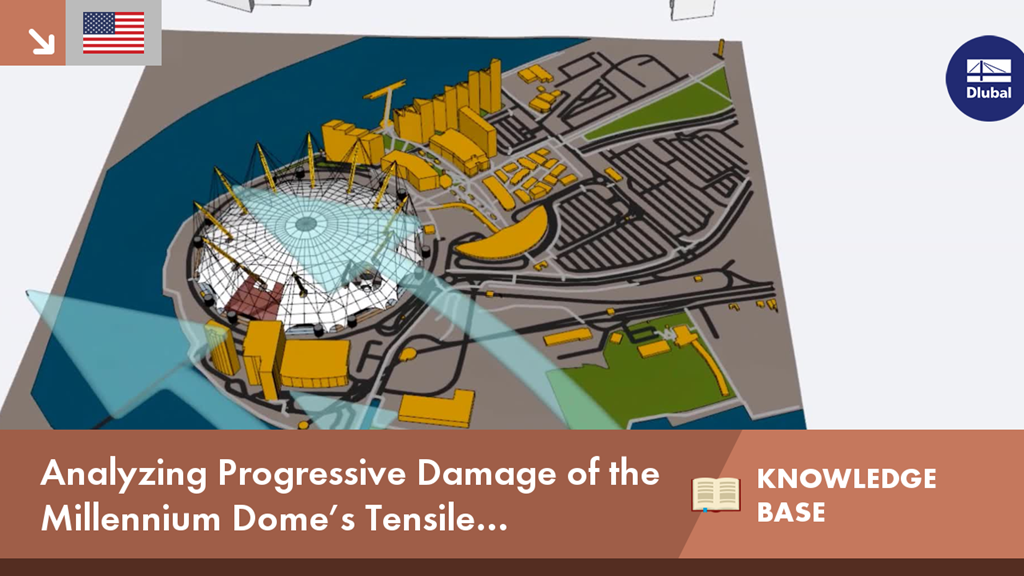
The impact of Storm Eunice across northern and northwestern Central Europe underscores the vulnerability of lightweight structures, particularly those utilizing tensile membrane surfaces (TMS), to extreme wind events. Iconic examples like the Millennium Dome—designed by the Richard Rogers Partnership and Imagination—symbolize modern architecture with their innovative, lightweight canopy systems aligned with celestial paths. This study delves into how wind loads from severe storms progressively damage such tensile structures, focusing on four distinct phases of surface deterioration.
The research further investigates how surrounding urban structures, like the Aura Tower, influence local wind behavior—specifically, amplifying wind speeds and suction pressures in the range of 45 to 55 meters per second, which can induce significant structural harm. Through computational fluid dynamics (CFD) simulations and detailed pressure coefficient analysis, the study reveals that urban planning and environmental factors must be carefully integrated into the design of TMS structures to ensure resilience against dynamic wind environments.
The findings strongly suggest that neighboring high-rise developments can severely exacerbate the wind loading on lightweight tensile membranes, making them prone to progressive tearing, membrane fluttering, and eventual catastrophic failure. The necessity of incorporating turbulence models and accurate environmental load estimations into both architectural and civil engineering design processes is emphasized. These insights aim to contribute to the future-proofing of TMS applications in increasingly dense urban landscapes, especially under the growing threat of climate change and more frequent extreme weather events.