Introduction
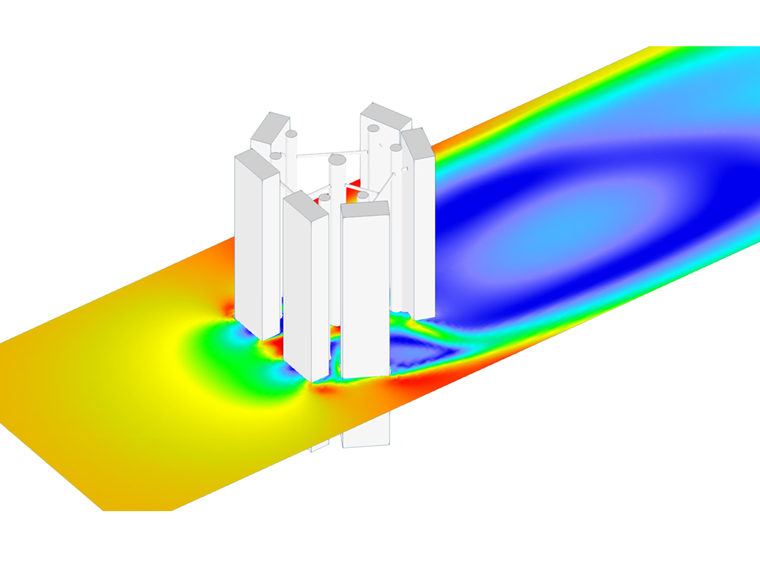
In wind engineering, precise modeling and thorough validation are essential for maintaining the structural stability and aerodynamic efficiency of wind-sensitive structures like antennas (Image 1). Due to their slender form, low mass, and considerable height, these structures are particularly susceptible to wind forces. Even relatively mild winds can exert substantial pressure because of their high surface-area-to-mass ratio. Ensuring the long-term safety, stability, and functionality of antennas demands meticulous design and analysis. To accurately predict wind-induced effects, engineers typically rely on wind tunnel testing, computational simulations, and on-site measurements. Effective evaluation and mitigation are crucial not only to avoid structural failures but also to ensure uninterrupted performance, especially in vital communication and monitoring systems. In the current validation example, the force coefficient for both the CFD simulation in RWIND and the experimental study [1] from RWTH Aachen University is investigated.
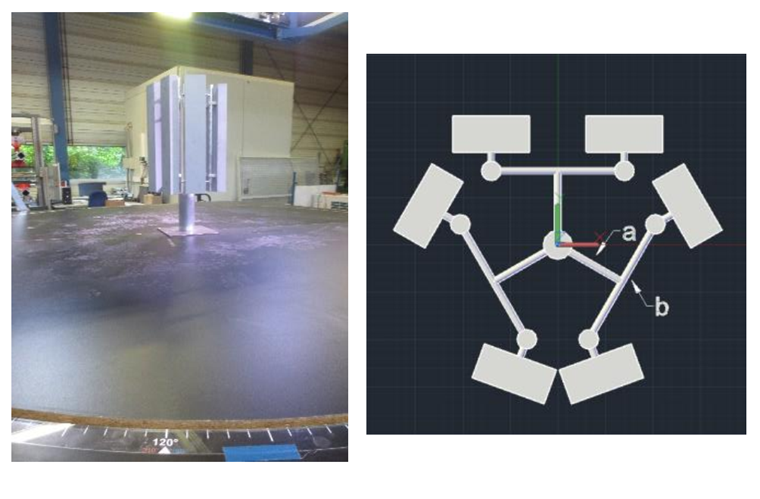
To overcome these challenges, it is essential to rigorously validate computational models to ensure that their predictions reflect real-world behavior. A key example is the validation of antenna wind load simulations using both experimental testing and CFD simulation. This approach enables engineers to fine-tune models, enhance predictive accuracy, and increase the structural reliability of antennas under diverse environmental conditions.
In collaboration with RWTH Aachen University, a leading institution in engineering and applied sciences, practical studies are conducted on antenna structures exposed to wind loads. By combining theoretical approaches with empirical data, the research aims to bridge the gap between simulation and reality, contributing to the development of safer, more resilient antenna designs. This study underscores the importance of validation in wind engineering, demonstrating how collaboration between academia and industry can lead to more precise modeling techniques and improved structural performance in real-world applications.
Description
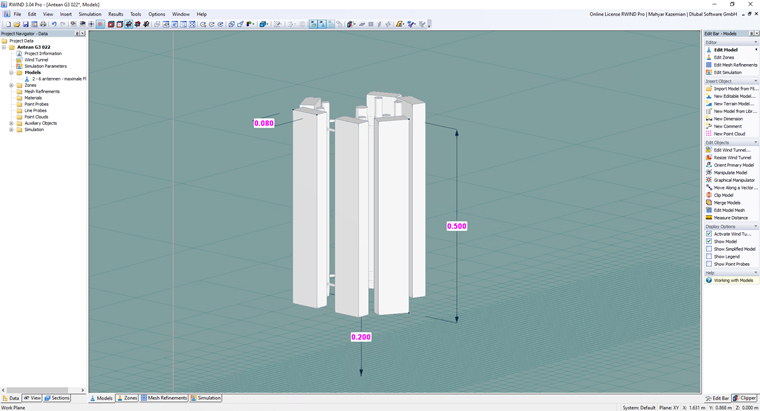
In the current validation example, the force coefficient for both the CFD simulation in RWIND and the experimental study [1] from RWTH Aachen University is investigated. The model represents six sharp-edged antennas in RWIND, positioned above a grid surface that serves as the ground plane or wind tunnel floor. The model includes several dimensional labels in magenta, indicating specific measurements: the total height of the antenna is 0.50 m; its base is elevated 0.20 m from the ground as shown in Image 2.
Input Data and Assumptions
The required assumption of the wind simulation is illustrated in the following table:
| Table 1: Dimensional Ratio and Input Data | |||
| Wind Velocity | V | 10 | m/s |
| Height | h | 0.5 | m |
| Bottom Gap | Gap | 0.20 | m |
| Air Density - RWIND | ρ | 1.25 | kg/m3 |
| Wind Directions | θwind | 0o to 360o with step 30o | Degree |
| Turbulence Model - RWIND | Steady RANS k-ω SST | - | - |
| Kinematic Viscosity - RWIND | ν | 1.5*10-5 | m2/s |
| Scheme Order - RWIND | Second | - | - |
| Residual Target Value - RWIND | 10-4 | - | - |
| Residual Type - RWIND | Pressure | - | - |
| Minimum Number of Iterations - RWIND | 800 | - | - |
| Boundary Layer - RWIND | NL | 10 | - |
| Type of Wall Function - RWIND | Enhanced / Blended | - | - |
| Turbulence Intensity | I | 3% | - |
Computational Mesh Study
A computational mesh study is essential in CFD analysis because it directly affects the accuracy and reliability of the results. While a well-refined mesh improves precision, excessive refinement increases computational cost without much benefit. Therefore, mesh sensitivity studies help find the optimal balance between accuracy and efficiency, enabling better decision-making with practical use of resource. The table displayed in the lower right corner compares various mesh densities ranging from 20% to 35% and their corresponding force coefficients (Cf).

For more info about computational mesh study:
Results and Discussion
Image 4 presents an analysis comparing experimental and simulated data related to the wind force coefficient acting on the complex antenna structure. At the center of the image, a line graph illustrates the variation of the force coefficient Cf as a function of wind direction θ, measured in degrees from 0∘ to 360∘. The vertical axis represents the force coefficient Cf, ranging from 0.0 to 1.0, and the horizontal axis represents wind directions increasing at 30-degree intervals, from 0∘ to 360∘. Two data sets are plotted on the graph: the black line with triangular markers represents experimental measurements, while the green line with circular markers represents the simulation results obtained using RWIND.
For more info about how to calculate the wind force coefficient in RWIND:
Image 4 also illustrates that both experimental and RWIND results follow a closely aligned trend, reflecting strong agreement between the two methods. Overall, the force coefficient Cf demonstrates a cyclical pattern as the wind direction varies, with clear minima occurring at approximately 90∘ and 270∘, where the aerodynamic forces are at their weakest. In contrast, the maxima are evident at around 0∘, 150∘, and 210∘, indicating orientations in which the six sharp-edged antenna structures undergo the most significant wind impact. The close correspondence between the experimental and simulated data confirms that RWIND effectively replicates the aerodynamic behavior of the antenna, maintaining an average deviation of approximately 5%.

Conclusion
Overall, the present study successfully validates the numerical wind simulation by comparing it with experimental data for a structure composed of six sharp-edged antennas. The results demonstrate that RWIND accurately reproduces the experimental findings across a full range of wind directions, indicating its effectiveness in predicting wind loads on geometrically complex, slender structures. The integration of plotted force coefficient data, structural schematics, and CFD flow field visualization offers a comprehensive and coherent presentation of the study’s approach and key outcomes.
In addition, here is the example from RWTH Aachen University that illustrates the single and three sharp-edge antenna models: