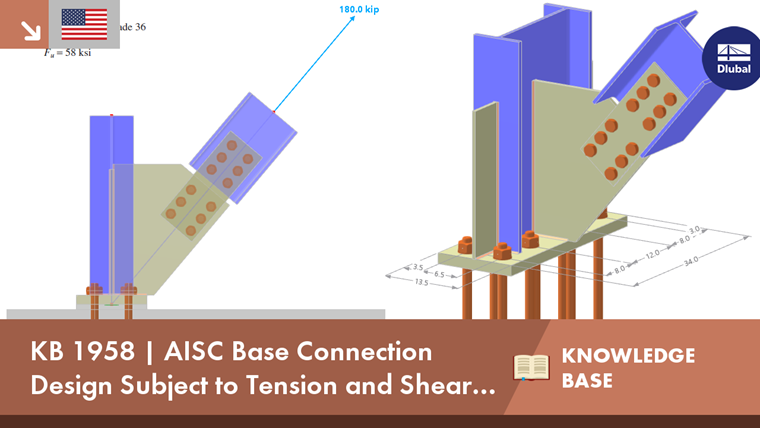
Base connection design according to AISC 360 [1] and ACI 318 [2] can be executed with the Steel Joints add-on. The previous knowledge base article given below provides the modeling workflow, a list of applicable design checks, and a design example of a base plate connection subject to "compression and moment".
In this article, a base connection design subject to tension and shear is presented. Example 4.7-7 of AISC Design Guide 1 [3] is used to verify the results from the RFEM model.
Shear Transfer
For an exposed base connection, how is the shear load transferred from the column into the concrete?
According to AISC Design Guide 1 [3], there are three ways of transferring shear from the column and/or the gusset plate into the concrete:
1) Through friction when compression is present, as shown in Example 4.7-8 of DG 1.
- The compression load generates friction between the base plate and the grout/concrete surface that can be used to transfer shear into concrete. This compression is considered a clamping force that generates a shear resistance in the perpendicular direction. The shear strength due to friction can be calculated in accordance with AISC DG 1 Equation 4-30.
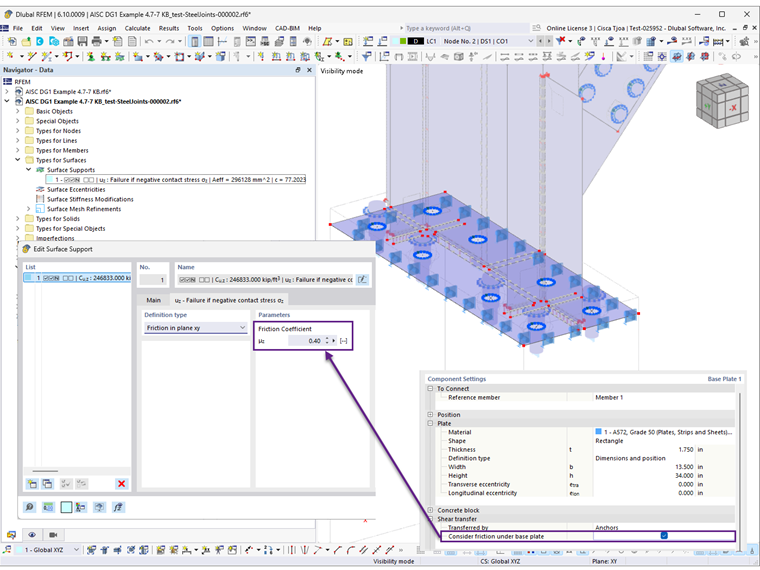
- In RFEM, the concrete block is represented with a surface support which can be viewed in the submodel. Enabling the "Consider friction" option activates friction within the surface support, allowing it to transfer a portion of the shear force (Image 1). The remaining shear force is carried by anchor rods or shear lugs. A design check to limit the design shear strength according to Equation 4-30 is not performed in RFEM.
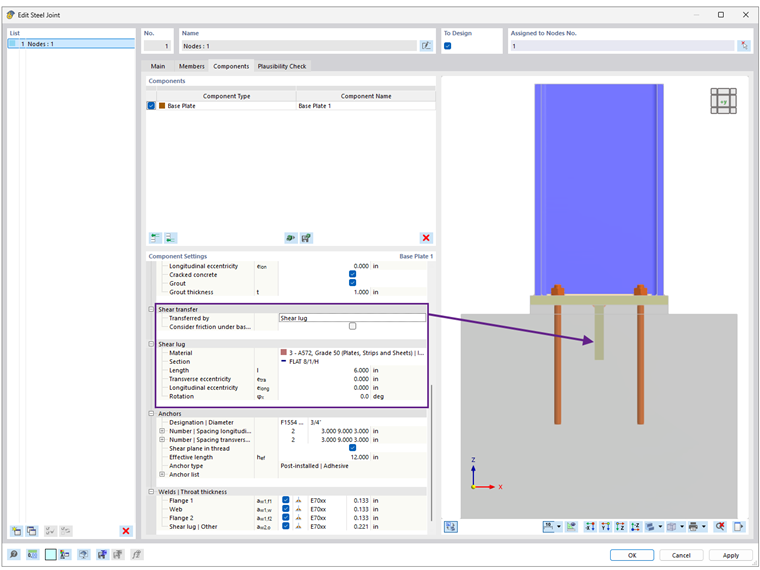
2) Using shear lugs, as shown in Examples 4.7-4 and 4.7-5 of DG 1.
3) Through shear in the anchor rods. The following construction methods are available:
- Anchor rods alone with oversized holes (unequal shear distribution).
- Plate washers with standard holes are welded to the top of the base plate to ensure equal shear transfer, as shown in Example 4.7-6 of DG 1. This configuration allows significant bending in the anchor rods, which is not currently considered in RFEM. Future updates will include checks for anchor rod bending.
- A setting plate with standard holes field welded to the bottom of the base plate for equal shear distribution to all anchor rods. A setting plate prevents bending in the anchor rods, which is the assumed condition in RFEM.
Example
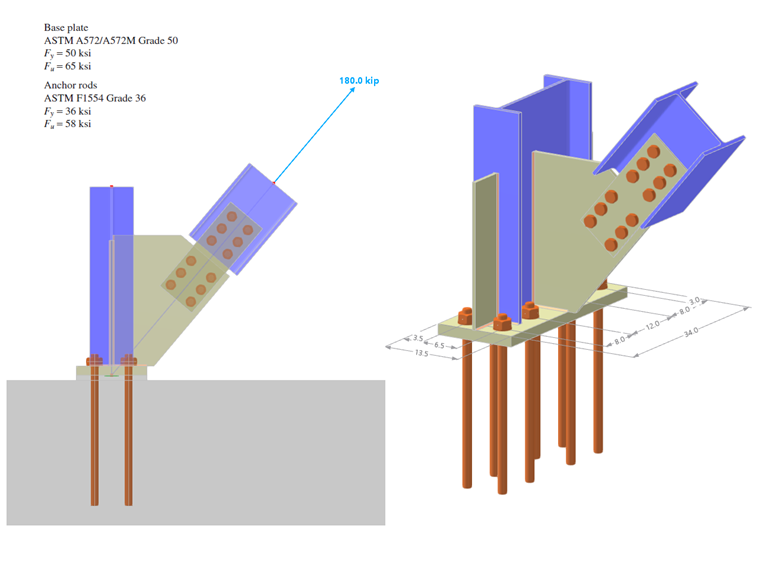
Example 4.7-7 from AISC Design Guide 1 is used to validate the RFEM model results. A base plate connection for a W21x83 column subject to tension and shear is designed in this example. The column is attached to a concrete foundation with a specified compressive strength, ƒ'c = 5,000 psi. The actual dimensions of the concrete are not given, and it is assumed that the base plate is not located near any concrete edges. To reflect this, a large concrete block measuring 175 in × 175 in × 100 in is modeled.
Shear transfer in the example is assumed to occur through a welded setting plate (not modeled), which prevents bending in the anchor rods. The brace member and connection are included in the model to better represent realistic joint behavior.
The base plate is 1.75 in thick with an assumed grout thickness of 1.0 in. The effective embedment length, hef, is equal to 24.0 in. The loads and material properties are shown in Image 3.
Results
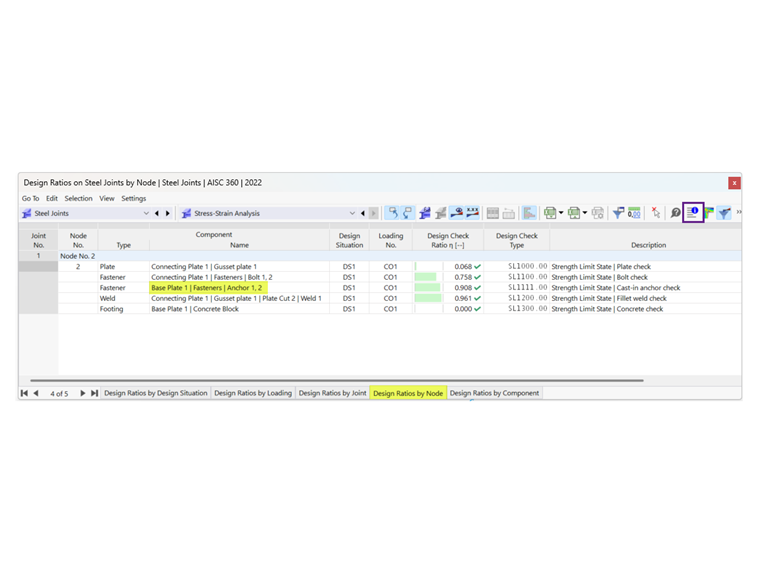
After running the Steel Joints calculation, the result for each node is presented in the Design Ratios by Node tab. Next, select Anchor 1,2 to view the design check details (Image 4).
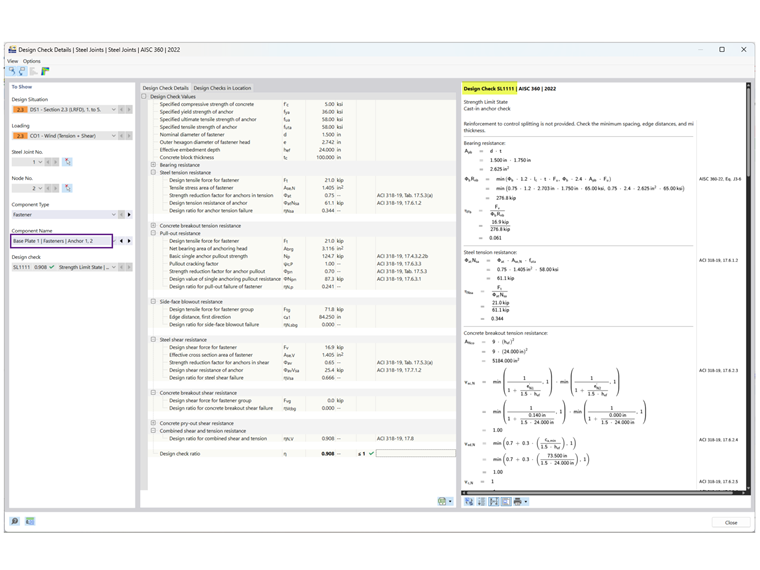
The design check details provide all of the formulas and references to the AISC 360 and ACI 318 standards (Image 5).
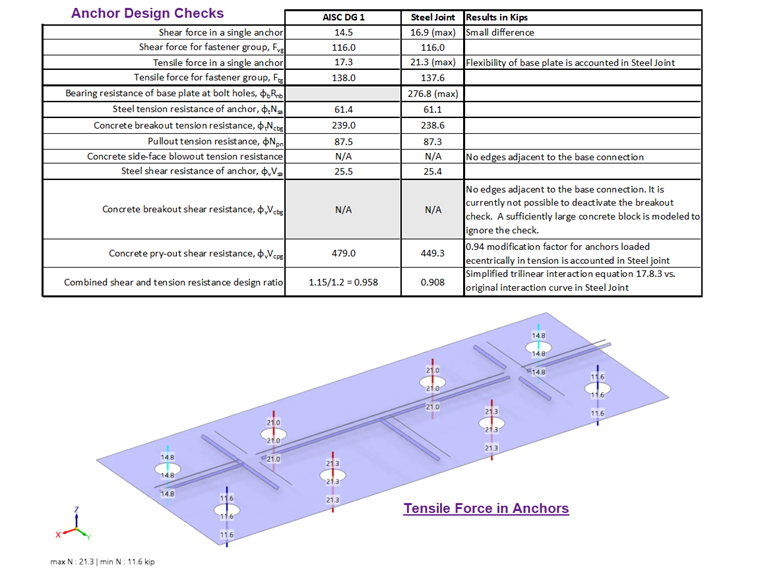
The results from AISC and Steel Joints are summarized below, including the reasons for discrepancies.
Anchors
Base Plate
In this example, the design of the base plate thickness is governed by tension in the anchor rods. Per AISC calculations, the available flexural strength (207 kip-in) is much greater than the required flexural strength (51.9 kip-in). This suggests that the thickness of the 1.75-in base plate can be reduced.
In Steel Joints, plate design is performed using plastic analysis by comparing the actual plastic strain with the allowable limit of 5% specified in the Strength Configuration. The 1.75-in-thick base plate has an equivalent plastic strain of 0.00%, indicating that a thinner plate can be used. However, reducing the plate thickness may increase tension forces in the anchors.
Conclusion
In the Steel Joints add-on, shear transfer through anchor rods is assumed to be equally distributed by using a setting plate, which eliminates bending in the anchor rods. While anchor rod bending is not currently considered, it is planned for a future release.
This article confirms that the results from the Steel Joints add-on are consistent with those from the AISC Design Guide 1 example, validating the accuracy of the RFEM model for base connection design under tension and shear.