Introduction
Wind load simulations are fundamental to the structural analysis and design process for buildings, towers, and a wide range of civil engineering structures. These simulations enable engineers to evaluate how wind interacts with different types of structures and assess the resulting structural demands with greater precision. The integration of advanced computational tools, such as numerical wind tunnel software like RWIND and finite element analysis platforms like RFEM, has significantly enhanced the reliability and depth of wind-related assessments.
A common limitation in both experimental wind tunnel testing and many CFD simulations is that they typically report only surface pressure distributions, not the resulting support reactions. However, support forces and moments at the foundation level are crucial for designing stable and safe structures. This article addresses that gap by showing how pressure results from RWIND can be imported into RFEM to calculate accurate support reactions.
Through this workflow, engineers can simulate realistic wind flow patterns, turbulence effects, and pressure distributions across a structure’s surface even for irregular or non-standard configurations and ultimately derive the forces and moments transferred to the foundation or anchorage system.
Importance of Support Forces
Support forces (or support reactions) represent the internal forces and moments that a structure transmits to its supports due to applied loads. In wind engineering, these reactions are particularly important for:
- Designing foundations (e.g., footings, piles, anchor bolts)
- Assessing uplift and overturning
- Evaluating lateral sliding forces
- Verifying equilibrium of the global structure
Wind-induced support forces can differ significantly from other static loads due to their dynamic nature, directionality, and variability with height.
Workflow in RFEM and RWIND
To obtain accurate support forces in RFEM under wind loading, a typical workflow includes:
Step 1: Structural Modeling in RFEM
- Define geometry, materials, and cross-sections
- Assign boundary conditions (supports, hinges, restraints)
Step 2: Wind Load Simulation in RWIND
- Export RFEM model to RWIND
- Define wind directions, velocity profiles, turbulence models
- Run CFD simulation to compute surface pressure distributions
Step 3: Importing Wind Loads to RFEM
- Import CFD wind pressure as surface loads
- Automatically apply them to the structure as nodal or elemental loads
Step 4: Static Analysis in RFEM
- Run load combinations including wind actions
- Analyze internal forces, deformations, and support reactions
Types of Support Forces
In RFEM, the following reactions are typically obtained:
- Horizontal forces (Fx, Fy): Lateral wind pressure (Available in RWIND and RFEM - Images 1 and 2)
- Vertical forces (Fz): Uplift or downward pressure (Available in RWIND and RFEM - Images 1 and 2)
- Moments (Mx, My, Mz): Torsional or overturning effects (Available in RFEM - Image 2)
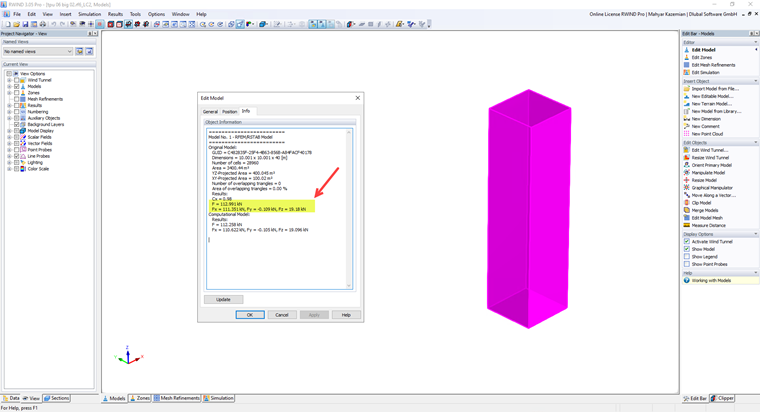
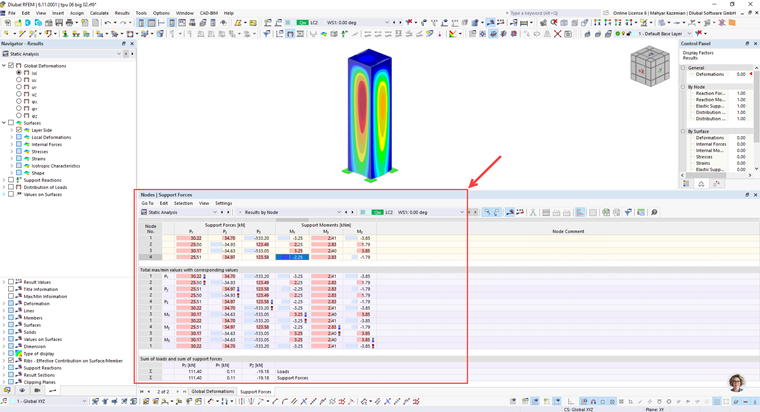
Engineers can review these reactions per support point or globally for each load case and combination. They are also crucial inputs for geotechnical verification.
Practical Considerations
- Wind Direction: Varying wind directions can lead to different reaction patterns, so simulations should cover all relevant angles (e.g., 0°, 45°, 90°, etc.).
- Mesh Resolution in RWIND: Fine surface mesh ensures accurate pressure distribution, directly affecting support forces.
- Load Combinations: Wind loads must be properly combined with dead, live, and other dynamic loads based on applicable codes (e.g., Eurocode, ASCE 7).
- Nonlinear Effects: For flexible structures, second-order effects and dynamic amplification may influence support reactions.
Conclusion
Support force analysis is a foundational part of wind load design in RFEM. By combining RWIND’s precise wind simulation capabilities with RFEM’s powerful structural analysis engine, engineers can ensure that their structures are safe, economical, and compliant with modern design standards. Proper extraction and interpretation of these support forces are key to achieving reliable results and successful engineering outcomes.