📝 Introduction
Roller coasters represent some of the most striking achievements in modern engineering, seamlessly merging structural ingenuity with human thrill-seeking experiences. While they are often celebrated for their breathtaking speed, dramatic drops, and intricate track layouts, their true complexity lies in the engineering discipline that guarantees both safety and performance. Beyond the visual spectacle and adrenaline-inducing dynamics, every roller coaster is the result of meticulous analysis, advanced design tools, and rigorous testing.
Among the many forces acting on these structures, wind–structure interaction plays a particularly significant role. Due to their lightweight, open-frame configurations and elevated geometries, roller coasters are especially sensitive to wind-induced effects, which can influence not only the structural stability and fatigue behavior of critical members, but also the comfort and safety of passengers. As such, the study of wind impact is not merely an additional design consideration, it is a fundamental requirement that underpins the reliability of these complex engineering systems.
🌬️ Why Wind Matters for Roller Coasters
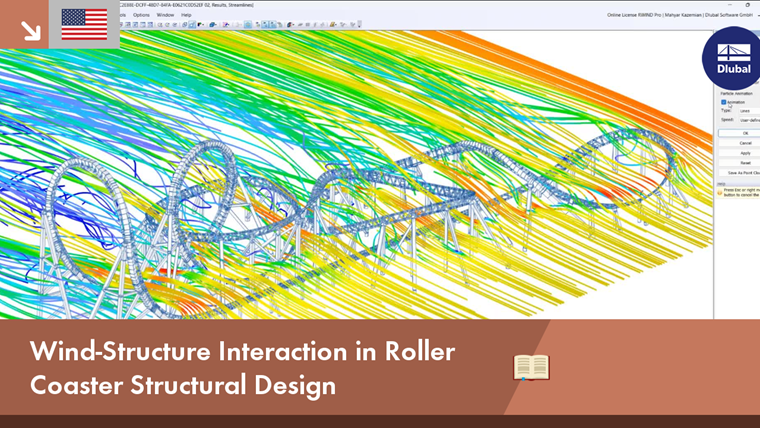
Roller coasters are lightweight, flexible structures with complex geometries and dynamic loading conditions. Due to their open-frame steel or wooden design and elevated track systems, they are particularly sensitive to wind-induced effects, which can influence both structural safety and passenger comfort. Wind loads simulated in RWIND using CFD are transferred directly to RFEM as surface or nodal loads. These loads can be included in design load combinations according to Eurocode or ASCE 7 (LRFD). Each wind direction from RWIND is treated as a separate load case, allowing for realistic and project-specific wind effects to be integrated into structural design. This approach improves accuracy, especially for complex geometries.
Roller coasters are often built as open-frame steel or wooden structures, featuring long spans, elevated tracks, and lightweight designs. These characteristics make them especially susceptible to wind effects. Crosswinds, gusts, and turbulent flows can affect:
- Structural safety → by increasing loads on columns, track, and connections.
- Passenger comfort → by generating unwanted vibrations and oscillations.
- Serviceability → by influencing operational limits under extreme weather.
Unlike enclosed buildings, roller coasters are geometrically complex, with slender supports and constantly varying orientations. This complexity makes conventional simplified wind load codes insufficient for precise assessment.
💻 From CFD to Structural Design
To address these challenges, CFD tools such as RWIND are increasingly used. RWIND simulates wind flow around the entire roller coaster geometry, capturing pressure distributions across tracks, supports, and platforms.
The resulting wind loads are then automatically transferred to RFEM or RSTAB as either:
- Surface loads (acting on panels and areas)
- Nodal loads (applied at key structural points)
Once imported, these loads can be incorporated into load combinations defined by design standards like Eurocode or ASCE 7 (LRFD). This ensures that roller coaster structures are not only thrilling but also code-compliant and safe.
🔄 Wind as a Load Case
Each wind direction modeled in RWIND is treated as an independent load case in RFEM/RSTAB. This approach allows engineers to:
- Capture realistic wind conditions,
- Combine loads dynamically with other effects (self-weight, passenger loads, thermal stresses), and
- Optimize structural member sizes without unnecessary overdesign.
Such coupling provides a project-specific, highly accurate representation of wind behavior, which is especially critical for nonstandard geometries like roller coasters.
🚀 Case in Point: Dragon Flight, China
Dragon Flight is being built for the Romon U-Park urban theme park in Ningbo, China. The X‑Train Flying Launch Coaster structure has a length of 504 m (1,653.5 ft) and its seven rollercoaster elements include three inversions. The roller coaster has a length of 504 m (1,653.5 ft). Its seven roller coaster elements include three inversions. The X‑train has a capacity of 20 passengers. With top speeds of 56 mph, the train reaches up to 4.5 g (g‑force) several times. The base area is 113 m× 51 m (370.7 ft × 167.3 ft). At the highest point of the coaster ride, which is called the top hat, a vertex height of approximately 30 m (98 ft) is reached. The overall structure consists of a tubular structure with 6,201 members and 86 cross‑sections.
🎯 Future Outlook
The field of wind–structure interaction in roller coaster engineering is evolving rapidly, driven by advances in both simulation technology and structural design methods. Future developments are likely to focus on four main directions:
- Two-Way Fluid–Structure Interaction (FSI)
Current practice often involves one-way coupling, where wind loads are applied to a fixed geometry. The next step is two-way FSI, where structural deformation feeds back into the airflow. This approach allows engineers to study vortex-induced vibrations, aeroelastic effects, and resonance phenomena that may occur in roller coasters with long spans and flexible supports.
- Integration with Digital Twins
By combining CFD-based predictions with real-time sensor data, engineers can build digital twins of roller coaster structures. These twins can continuously monitor wind effects, compare measured data with simulations, and provide early warnings for operational risks, ensuring both safety and optimized maintenance.
- AI and Machine Learning in Wind Prediction
Machine learning can be applied to shorten simulation times and predict site-specific wind patterns. Trained on historical data and CFD results, AI models could support rapid design iterations, enabling more efficient roller coaster planning in diverse environments.
✅ Conclusion
Roller coasters may symbolize fun and excitement, but their safety relies on some of the most advanced engineering tools available today. By combining CFD wind analysis with structural FEM design, engineers can ensure that these thrilling rides remain structurally robust, safe, and optimized delivering both the exhilaration passengers crave and the safety engineers demand.
_LI.jpg?mw=760&hash=08afe6762d6887a05b9da0069cb630169ffc359f)