Description
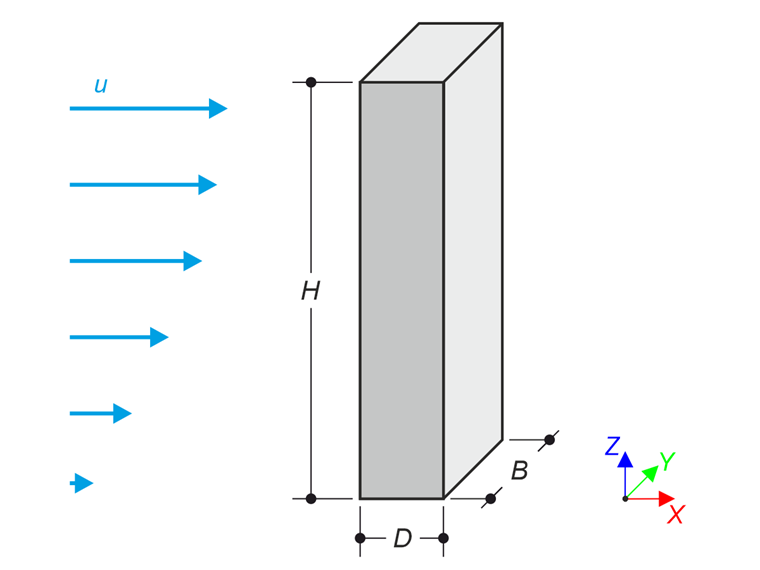
This verification case, based on the document of the German WTG: Fact Sheet of Committee 3 - Numerical Simulation of Wind Flows, Chapter 9.2 (see references), compares computational fluid dynamics calculations of wind pressure coefficients to experimental data from Tokyo Polytechnic University's (TPU) aerodynamic database (see references). The analysis focuses on a high-rise building model (ratio 2:1:5). TPU's boundary layer wind tunnel data – rigorously validated through peer-reviewed studies and publicly accessible via their wind engineering portal – provides benchmark metrics for assessing turbulence modeling accuracy and grid sensitivity effects. Key comparison parameters include mean values of pressure coefficients at critical building zones (windward face, sidewalls, leeward separation regions).
| Fluid Properties | Kinematic Viscosity | ν | 1.500e-5 | m2/s |
| Density | ρ | 1.250 | kg/m3 | |
| Wind Tunnel | Length | Dx | 2720.000 | m |
| Width | Dy | 900.000 | m | |
| Height | Dz | 720.000 | m | |
| Building | Breadth | B | 80.000 | m |
| Depth | D | 40.000 | m | |
| Height | H | 200.000 | m | |
| Calculation Parameters | Reference Velocity | uref | 22.000 | m/s |
| Reference Height | zref | 10.000 | m | |
| von Kármán Constant | κ | 0.410 | ||
| Turbulence Viscosity Constant | Cμ | 0.090 | ||
| Aerodynamic Surface Rougness Length | z0 | 1.000 | m |
Analytical Solution
An analytical solution is not available. The example provides a comparison of RWIND CFD simulation results and experimental data (TPU Aerodynamic Database).
The wind speed profile is calculated from the Power Law according to the following formula:
where profile exponent α is defined as
The turbulence intensity is taken from the TPU Aerodynamic Database according to the following graph for α=0.25.

RWIND Simulation Settings
- Modeled in RWIND 3.04
- Transient flow simulation type
- Mesh density is 20% with refinements: 5,698,702 cells
- Spalart-Allmaras DDES model
- Inlet boundary condition - velocity profile and turbulence intensity profile
- Tunnel bottom - no-slip boundary condition
- Tunnel walls and top - slip boundary condition
- Outlet boundary condition - zero pressure; zero velocity gradient
Results
Validation metric is calculated according to WTG: Fact Sheet of Committee 3 - Numerical Simulation of Wind Flows, Chapter 5.3.2 (see references). At first, the value of the hit rate parameter q for the mean value of the pressure coefficient is calculated. The ralative deviation Wrel is considered.
|
N |
Total number of data points |
|
ni |
Indicator function (1 if prediction is “correct”, 0 otherwise) |
|
Pi |
Predicted value |
|
Oi |
Reference value |
|
Wrel |
Allowed relative deviation |
Alternatively, the relative mean square error e2 can be also calculated according to the following formula.
The desired values of the hit rate parameter q are more than 90% and the relative mean square error should be lower than 0.01. From the following table it is clear that the comparison of experimental data from TPU and the results of flow simulation in RWIND does not meet the requirements.
| Surface | q [%] for Wrel = 10 % | q [%] for Wrel = 20 % | e2 [1] |
| Windward | 27.3 | 72.7 | 0.035 |
| Right Sideward | 0.0 | 9.1 | 0.114 |
| Left Sideward | 27.3 | 45.5 | 0.121 |
| Leeward | 0.0 | 0.0 | 0.118 |
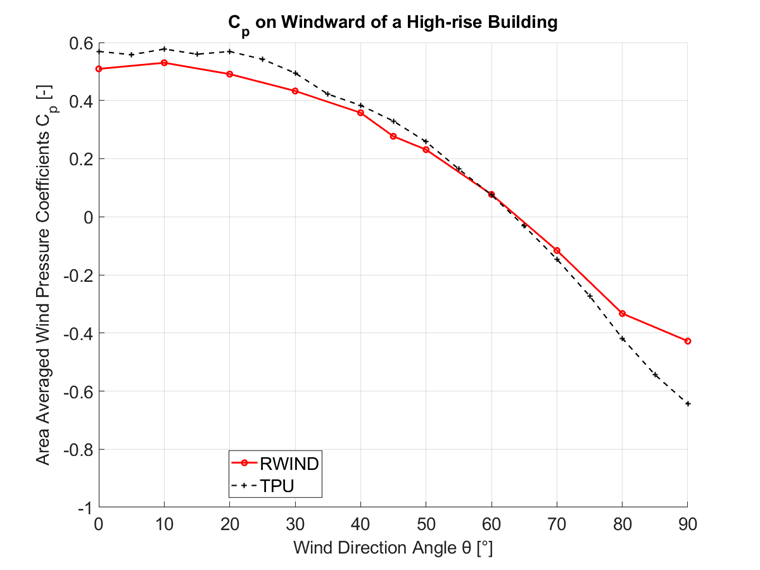
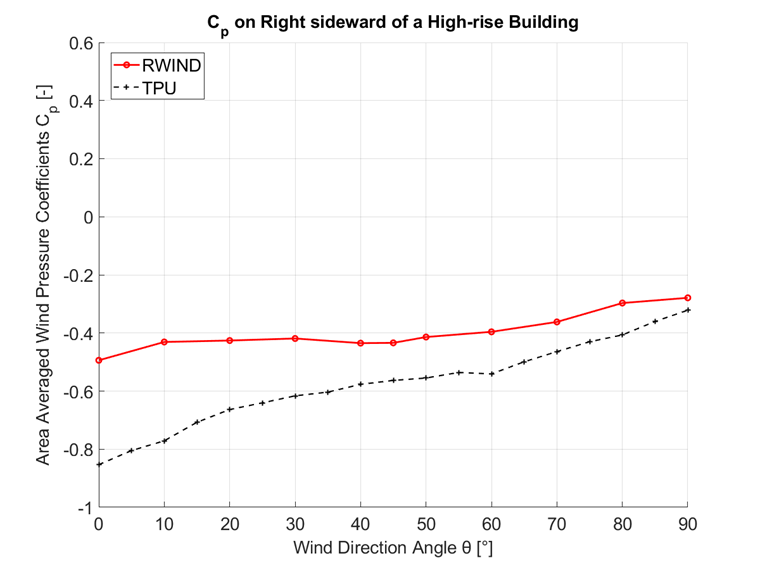
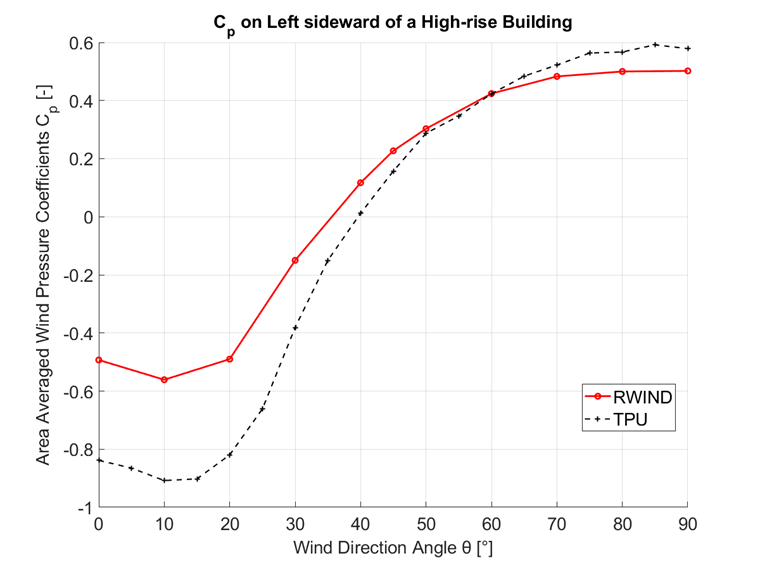
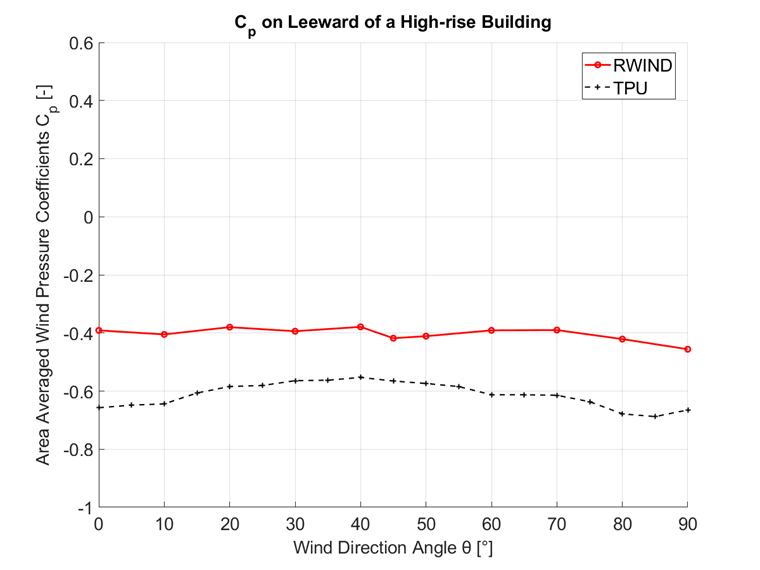
In the following graphs, average wind pressure coefficients obtained by means of RWIND simulation are compared to the mean values from time series in the test points measured by means of the TPU Aerodynamic Database. The comparisons are carried out on the windward, right side, left side, and leeward surfaces of the building.
The graphs show very good agreement on the windward surface. Wind pressure coefficients are crucial for building loads, especially on this surface. In the case of other surfaces, good agreement between the trend of the simulation results and the experiment is seen.
Remark: The experimental data shown in the graphs are plotted on the basis of data files obtained from the TPU website. However, the graphs shown on the TPU website match the data files only in the case of the windward surface.