


|
Author
|
Emmanouil-Ioannis Daktylidis
|
|
University
|
National Technical University of Athens, Greece |
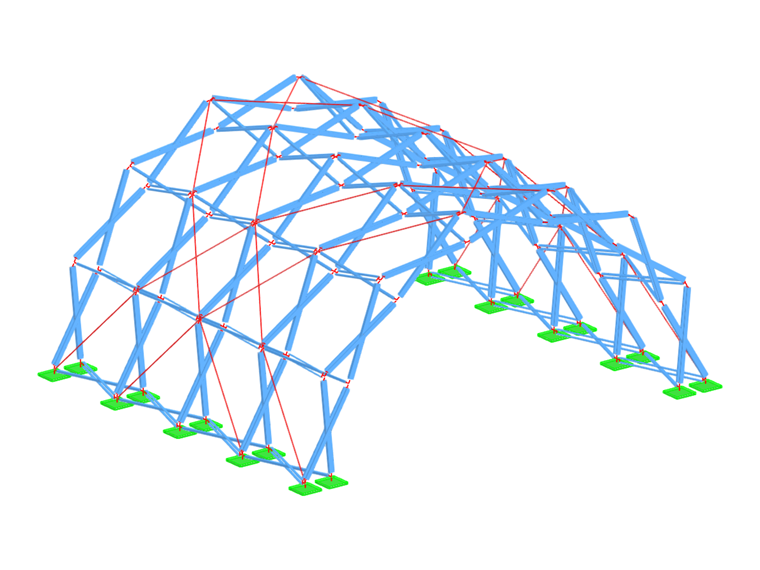
These eccentricities often influence the structural behavior under loading conditions such as wind or snow. The present study aims to develop a joint capable of accommodating the connected members without introducing eccentricities. This is achieved through the adoption of double scissor-like elements, involving the addition of an extra member to the conventional two-member scissor configuration. In this way, eccentricities are eliminated during the geometric configuration of the joint.
The geometry of the joint is directly dependent on the cross-sectional geometry of the connected members. Therefore, a methodology is followed to determine the optimal hollow aluminum cross-sections to be used in the structure. Initially, rigid elements are assumed for the joints and linear beam finite elements for the members. Linear analyses are then performed by applying the assumed joint loads, as well as snow and wind loads, according to the relevant design standards.
The finalization of the cross-sections is achieved through two approaches. First, geometrically nonlinear analyses (GNA) are performed to compare the internal forces with those obtained from linear analysis. Subsequently, geometrically nonlinear analyses with imperfections (GNIA) are conducted, using initial imperfection shapes derived from the buckling mode shapes obtained through preceding linear buckling analyses. The final cross-sections are determined through comparison of the results and verification according to the provisions of Eurocode 9 for aluminum structures. Οnce the cross-sections are finalized, the geometry of the joint is also determined, and the corresponding joint loads in the structure are revised accordingly.
Finally, a simulation of the joint and the members is conducted using solid finite elements. This analysis yields conclusions regarding the developed stresses of the joint and the elements, providing valuable insight for the design of a potential experimental setup.