


It is a house without eyes and yet it sees everything: 33 Thomas Street in New York City is one of the most notorious buildings in the world. Once built to withstand all external attacks: a giant of brutalism. Then used to attack from within: its own people, allies, the whole world.
What is behind 33 Thomas Street and what does a former hub for telephone lines have to do with the leaks from Snowden, probably the world's most famous whistleblower? We compile what we know today about 33 Thomas Street – and what we don't know.

Let's be honest: we all love spy movies! Whether it's Bond or Men in Black, the undercover agents get out of their cars and make sure no one sees them. They look left, they look right. Their cover is intact. And then they enter a building. A casino, a Thai restaurant, a public restroom. Important: Greet the dog at the entrance! Nothing special. Not yet.
A touch on the third stone from the bottom, right next to the door. The warm light of an iris scanner and bang: a trapdoor opens. Or the wall, and behind it is a hidden elevator. Once downstairs, we find a completely different world. Numerous corridors lead to rooms where everything is flashing and beeping. People rush frantically from one screen to the next. Your hands tingle with excitement: this is where real surveillance takes place, real espionage – deep underground.
But what if real espionage doesn't take place in secret labyrinths beneath our feet – but right in front of our eyes? For example, in a huge, colossal skyscraper in the middle of Lower Manhattan, very close to City Hall. Residents and even visitors to the neighborhood have suspected for decades that something is not right at 33 Thomas Street.
33 Thomas Street: Colossus of Brutalism
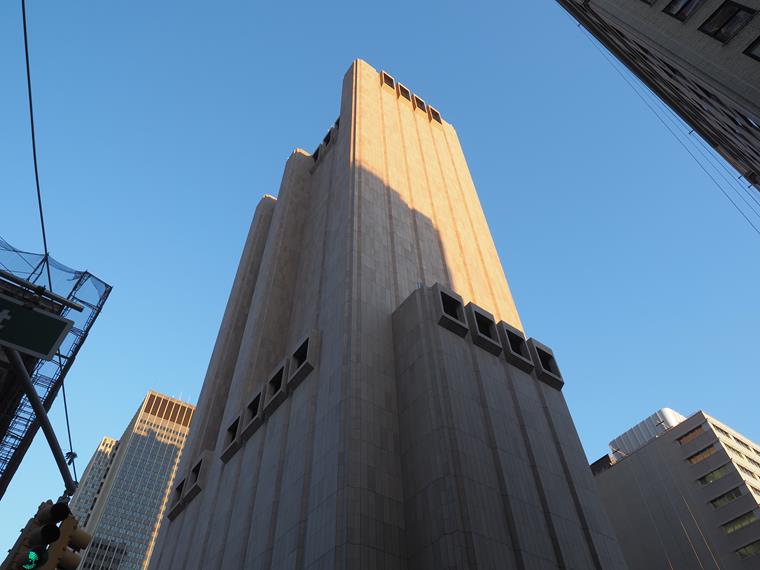
One look at the building and we nod in agreement. It's definitely not normal. Between 1969 and 1974, a huge block of a high-rise building was constructed here. The facade is made of flamed Swedish granite. There are no windows, only huge ventilation shafts that look like completely out-of-place growths. Even for the brutalist architectural style, this is quite something. Take a look at our article on Brutalism Architectural Style to find out the most important features.
What was 33 Thomas Street intended for?
So, why was such a building needed at that time? And why in Manhattan of all places?
This colossus was commissioned by AT&T / Bell System, a company that at that time held an absolute monopoly in telecommunications technology. The goal was to establish a nationwide crisis-proof network.
The long lines, that is, networks that allowed for long-distance calls between cities and states, were of particular importance. Manhattan was to become a gigantic hub for massive traffic density.
This was because Manhattan had the highest concentration of subscribers and was within easy reach of all the important institutions: stock exchanges, government agencies, and the major media companies. Everything was in one place and meshed together by long lines. This was a significant factor, as signal loss and delays in the response of communication systems had to be minimized as much as possible.
Architecture of 33 Thomas Street
The architectural team John Carl Warnecke & Associates was commissioned to design a building that would fulfill all requirements: for the 1970s and far beyond. 33 Thomas Street was to serve as a telecommunications hub.
Let's take a step back: what did telecommunications even mean back then? In short: large electromechanical systems with huge devices that could easily fill an entire room.
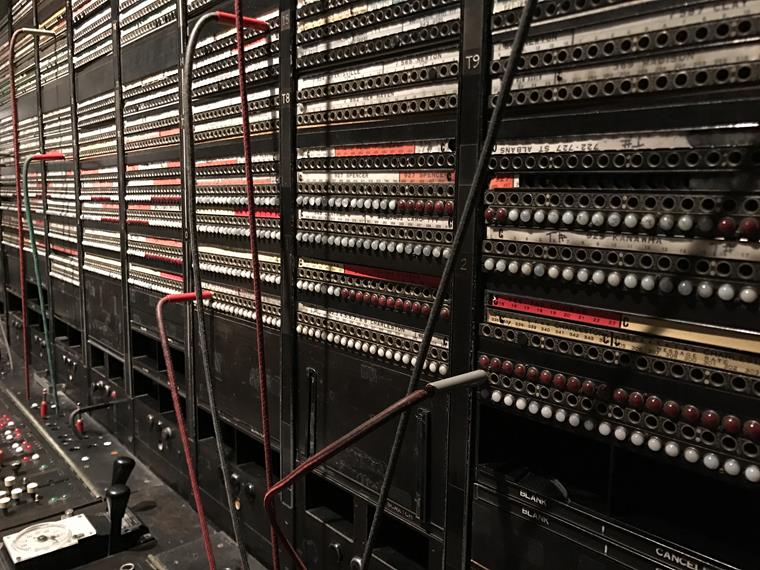
The heavy technology not only placed a considerable load on the ceilings, but also generated a lot of waste heat. No wonder, then, that the floors were set quite high. After all, the aim was to be prepared for the future.
Gigantic cable trays ran vertically across many stories, and it was necessary to lay thousands of copper cables. It was as if 33 Thomas Street were not a fully-fledged office and technical building, but a multi-layered technical platform—a huge, multi-story motherboard from the last century.
Stylistically, 33 Thomas Street can be classified as late brutalism or infrastructure brutalism. The reinforced concrete monolith has no windows. Nothing comes in or out. No playful design, no client logo, no frills: function clearly took precedence over appearance here.
What's more, the sole purpose here was to create a building that could withstand all the hazards of its time. And to guarantee that communication with other cities and states would be ensured in any case.
33 Thomas Street in Context: Security & Cold War
If we turn away from the technical side and look at the political situation at the time, another key point stands out. 33 Thomas Street was planned in the middle of the Cold War between the US and Russia. In the arms race at the time, everything was expected: sabotage, nuclear strikes, or electromagnetic interference.
So the team of architects opted for a building entirely in the brutalist style. But not because they found the architectural style so beautiful – who does that already? – but based on the numerous advantages that this construction method offers. A massive concrete shell, protected by flamed Swedish granite. No windows, no points of attack, and partially shielded rooms.
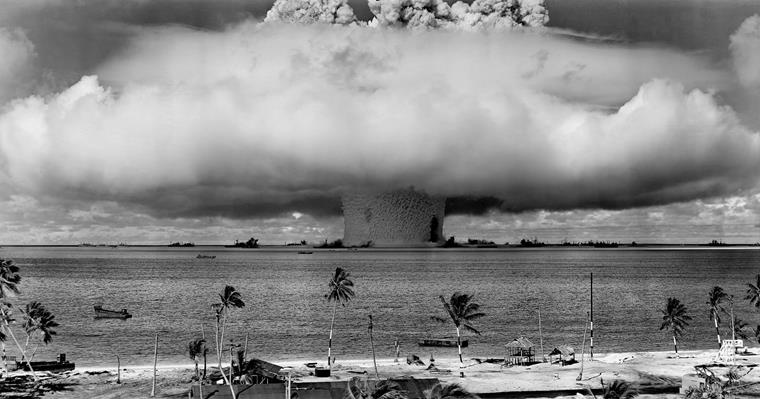
This meant that 33 Thomas Street was protected against all threats that were relevant at the time. The hub for the Long Lines would even survive a nuclear explosion. So we can summarize: Originally, 33 Thomas Street was not a secret service building, but simply a civilian infrastructure bunker.
33 Thomas Street: Structure & Engineering Achievement
We have already discussed the architecture of the building. Now let's take a look at a few technical details. With a height of 170 m and 29 stories, it fits, purely in terms of data, into the category of large office buildings that were typical at the time.
Conventional office buildings have a payload of approximately 2.0–3.0 kN/m². At 33 Thomas Street, the values are significantly higher. Experts estimate a minimum of 7–10 kN/m².
The massive reinforced concrete slabs were therefore designed to withstand far more than the usual loads. Not only were considerable expansion reserves taken into account, but the redundancy of the supporting structure was also of great importance.
In short: if important structural components fail, for example due to bombs or natural disasters, the surrounding areas can absorb the necessary loads. The absence of windows also supports the stability of the building, as loads can be transferred directly downwards without being diverted. This makes 33 Thomas Street extremely resilient, both to attacks and to storms and earthquakes.
But that's not all. The monolithic structure with high dead weight and no overhangs ensures low vibrations – both inside and outside. This was particularly important for the telecommunications equipment, as it is sensitive to vibrations caused by traffic and wind.
33 Thomas Street: Self-Sufficient Skyscraper
Another interesting fact: since its construction, 33 Thomas Street has had its own power supply and corresponding emergency power systems. This was particularly important for cooling the technical areas. The switching and control technology and the associated massive cable trays ultimately emitted a considerable amount of heat.
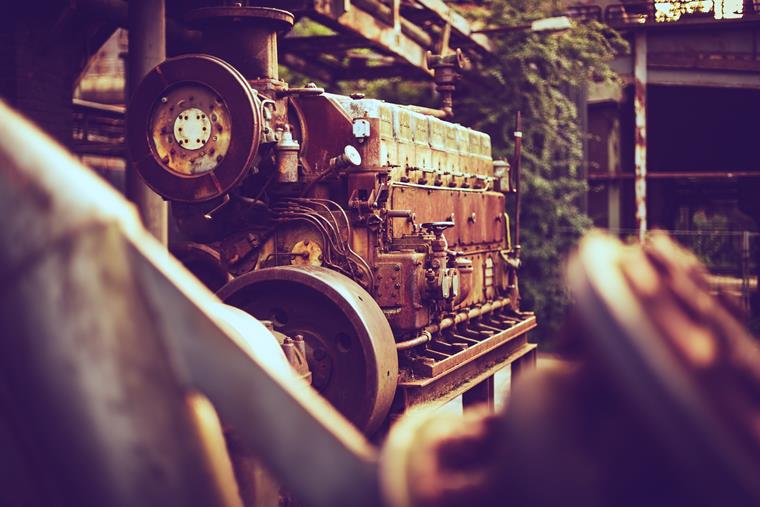
Speaking of heat: How do you make a windowless building safe from fire in the first place? Without windows, neither natural smoke extraction nor classic rescue via the facade is possible. The solution for fire resistance in such a high-rise building is to use zone-based fire resistance sections, such as those used in bunker facilities: pressure-ventilated escape routes and several independent supply systems.
33 Thomas Street in Technological Change
From the 1980s onwards, the data wind changed direction. Existing telephone lines became increasingly irrelevant. Analog disappeared and made way for digital data transmission. The once analog audio signals were automatically translated into bitstreams. Only 1s and 0s ran across the screens.
Most of the major longline hubs were dismantled. They were simply no longer needed. And 33 Thomas Street still stands today. Why? Quite simply because it was perfect for repurposing. The supporting structure was far from reaching its limits, its interior spaces were flexibly usable and important infrastructure, such as ventilation, cooling and electricity, could be further expanded.
Snowden Leaks – Titanpointe
In 2013, a young man notified his employer that he would be taking a few days off. However, he did not return to his family, but instead boarded the next flight to Hong Kong. From there, he published secret documents. You've probably guessed by now: we're talking about Edward Snowden, a former NSA employee. And perhaps the greatest whistleblower in history.
His leaks exposed a global system of mass surveillance, including by US intelligence agencies. His documents made it clear that data was not only being deliberately tapped from civilian fiber optic networks. Rather, the whole thing was happening directly at the central hubs of the telecommunications infrastructure. Often even in close cooperation with the network operators. Of course, this was a huge scandal.

You get the picture: key hubs in the telecommunications infrastructure. That's what 33 Thomas Street used to be. And in the years that followed, investigative research revealed that, strictly speaking, nothing had changed. The building at 33 Thomas Street in New York could definitely be linked to the code name “Titanpointe”.
What Happened to 33 Thomas Street?
We don't know exactly what happened to 33 Thomas Street after the demise of most telecommunications hubs. In fact, all known information comes from leaked files. Much of what is written in the news or on various websites about 33 Thomas Street is not verified information.
The flood of adventurous conspiracy theories – from secret laboratories with alien technology to a bunker for the super-rich in the event of a fallout scenario – is questionable at best. A lot of imagination, an excessive dose of paranoia, and a great deal of fantasy seem to be their source.
In this article, we want to rely on verified, verifiable facts and use common sense to establish connections where they are realistic. One thing is certain: Snowden provided the first concrete evidence that the NSA sticks its nose into far more than its own affairs.
Among other things, the building at 33 Thomas Street, now known as Project Titanpointe, was used to intercept not only the data streams of its own population, but also global communications. What makes 33 Thomas Street the perfect location for such a project?

One point is the former purpose of the high-rise building. As a central long-line node, 33 Thomas Street is the place where the main fiber optic lines converge. For decades, cutting-edge equipment was located here to process signals on a large scale. And more than enough reserve capacity was planned during construction to expand the technical scope in the future. It is almost certain that this is exactly what happened.
What we do not know for sure is to what extent the NSA uses 33 Thomas Street for monitoring global data traffic. It is also unclear exactly what data was collected here and what ultimately happened to it. It is not even clear whether the NSA continued its activities in the same way after the Snowden leaks. There was never an official statement.
There are no official construction plans or documents for structural analysis that suggest NSA use. The fact that the intelligence agency has one of its largest espionage main bases here is merely an inference based on the known infrastructure of 33 Thomas Street and the information from the leaks. So we don't know much for sure, but we can guess most of it.
Why 33 Thomas Street is ideal for the NSA?
From a technical perspective, 33 Thomas Street is virtually ideal as an interception hub. It is practically predestined for this purpose. The building provides high reserves in its supporting structure. Heavy computing and analysis equipment is no problem for this reinforced concrete colossus. Add to this a self-sufficient energy supply for the large technical areas: you can hardly get more energy security than that.
The massive shielding, whether electromagnetic or physical, also makes it a perfect bunker, in which external influences will probably never be felt. From the outside, there is absolutely nothing to indicate what goes on inside. 33 Thomas Street is tailor-made for monitoring billions of data streams from here.
Conclusion: NSA Bunker 33 Thomas Street
In summary, we can say that Brutalism did not serve as a style here, but rather as architecture in which a function was placed far above design. It provided protection from the outside world in order to ultimately monitor and control it. The high-rise building without windows offers no insight into the world beyond the flamed Swedish granite. No weak points, no public access.
One could almost say that 33 Thomas Street is less a skyscraper than a vertical bunker. Or rather a technical infrastructure monster. One thing is certain: the NSA's use of the building is widely recognized, even by experts. But we are still far from knowing everything – and that is likely to remain the case.
Architecture is never neutral or innocent. Even if 33 Thomas Street was certainly not designed as an NSA listening post at the outset. However, its use by the secret services after the end of the telephone era was only logical. Perhaps it would simply have cost a fortune to demolish this colossus.

Would it have been possible to repurpose it? Sure. Theoretically, it was already possible. But why use it for something public and innocent when it was practically predestined for all kinds of things that were not meant for the public? The decision to exploit this communications hub to its fullest extent is far from morally acceptable. But, if we are honest, it was an obvious choice. So obvious that the NSA must have stumbled over it at the time.
From an engineering perspective, Titanpointe, or 33 Thomas Street, if we want to use its real name, is fascinating in any case. This oversizing, the enormous potential behind the building, is simply magnificent. Today, something like this would probably cost a fortune.
The NSA would have to take out a hefty loan to finance it. This makes it all the more exciting to continue observing. Perhaps there will be new leaks, detailed files, and possibly even construction plans at some point. We will definitely keep an eye on this topic.