


The collapse of the Québec Bridge in 1907 was undoubtedly one of the most devastating disasters in the history of the construction industry. This is because the Québec Bridge collapsed not just once, but a second time later on during construction. 75 people died in the first collapse of the Québec Bridge. Let’s take a closer look at the construction of this steel colossus. How did this disaster change the way risk, responsibility, and quality assurance are handled in engineering? Stay tuned!
Québec Bridge: Bridge Construction at Limit
At the beginning of the 20th century, the Canadian city of Québec City was a major hub for trade. Industrialization led to rapid population growth, and it soon became clear that keeping pace with this development would require adequate infrastructure.

A railway connection across the ‘’'St. Lawrence River'‘’ was planned. This would connect Québec to the broader trade network, and it would no longer be necessary to transport goods across the river by ferry. For such a connection, a bridge was needed—but not just any bridge!
The planned bridge was to have one of the longest spans in the world and be constructed as a cantilever bridge. Risky, but theoretically feasible. The Québec Bridge would thus set new standards in bridge construction. Although the project was teetering on the edge of the abyss with this design, the risk was taken deliberately.
After all, it was nothing new for bold projects to be carried out in structural engineering. For example, many colleagues thought Eugène Freyssinet was crazy until he proved that his invention, prestressed concrete, could revolutionize construction. If you're interested in his story, we recommend this article: Eugène Freyssinet: Father of Prestressed Concrete .
Québec Bridge: Errors in Construction and Design
So what exactly did the plan entail? The chosen structural system was a classic cantilever bridge. Nothing particularly exciting about that, then. Two massive cantilever arms were to support a central suspension girder. This meant high compressive forces in the upper flanges and tensile forces in the lower ones. A bridge like many others that had already been built, just not on this scale.
The person responsible for this megaproject was no stranger to the field. Theodore Cooper was a renowned bridge engineer at the time. So was the Québec Bridge in good hands? Yes and no. Because there were some critical issues with the design. With such a span, the self-weight is considerable. Not only that.
One of the biggest problems with the Québec Bridge was the changes made to the design during the design phase. We’ve covered this topic quite often on this blog. It’s not uncommon for large-scale projects to already run into problems during the design phase. Or because, right in the middle of the construction stage, suddenly something needs to be changed.
This situation persists to this day, especially in the German construction industry. If you're interested in the reasons why large-scale projects often end in a real disaster, we recommend this post: Large-Scale Construction Projects in Germany .
In the case of the Québec Bridge, for example, the ‘’'actual weight'‘’ of the structure increased significantly during the design phase. Somehow, it had to be possible to achieve the span and make it as safe as possible. The main problem was the slender compression elements. The upper flanges were susceptible to failure under high buckling loads.
.jpg?mw=760&hash=a0d3b1d522fa832b9ccb250937f220cad95302d1)
On top of that, there was no iterative re-calculation, meaning that the subsequent design changes were not re-evaluated. People probably thought: It’s just the largest bridge of our time; it’ll hold up already somehow. And it did, at least at first. Because even during the construction stage, it quickly showed that the bridge structure of the Québec Bridge was deforming unusually.
An increasing deflection of the supporting structure was observed. Observed and noted. Unfortunately, these warning signs were not interpreted correctly, and so construction simply continued. And so, inevitably, the inevitable happened.
First Collapse of Québec Bridge in 1907
On August 29, 1907, the deflections became critical. This led to a sudden failure of the supporting structure and the Quebec Bridge collapsed. What exactly happened, and what was the trigger? Let’s take a brief look. Because at this point, it already shows that it wasn’t just a single mistake.
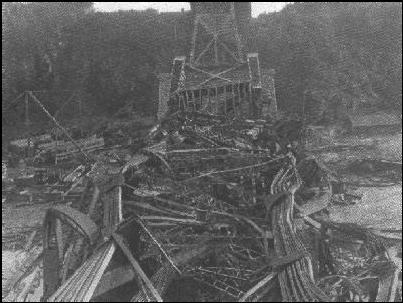
It all started with a local instability. A compression element of the southern cantilever gave way under the considerable self-weight of the half-completed Québec Bridge. The load then fell onto the surrounding supporting structure, but it could not absorb the additional forces. This led to a complete collapse of the bridge, a tragic chain reaction.
Within 15 seconds, the entire Québec Bridge—at the time the world’s longest cantilever bridge—crashed into the St. Lawrence River. In this disaster, 75 of 86 workers lost their lives. The collapse of the Québec Bridge is considered the greatest engineering disaster of the 20th century, and the investigation showed alarming findings.
Failure of Québec Bridge in 1907: Technical Causes
The failure of such a large central section of the bridge could not be compensated for by the surrounding structure. Here, the critical buckling load was far exceeded. And no one had previously thought to build in a certain degree of redundancy, that is, a contingency plan in case the Québec Bridge became unstable at any point during construction.
So who was to blame? The engineers? Not really, because several of them had ‘’'reported deformations on site'‘’. Management, however, either did not react at all or only very late. They hoped that in the end, everything would work as it should.
To analyze the exact causes of the collapse of the Québec Bridge, a Royal Commission was established. Part of this group included external experts, who analyzed the design and construction of the Quebec Bridge for errors. And they quickly found what they were looking for.
The loads on the Quebec Bridge’s supporting structure were not recalculated following the design changes. This resulted in an incorrect calculation of the actual self-weight and its effects on the bridge structure. Additional loads were not taken into account, which led to compression elements becoming unstable. Buckling effects that occurred were also not considered, even though their significance was already known in structural engineering at the time.
Another important point was the lack of redundancy, which we have already briefly mentioned. The failure of a single element led directly to the total collapse. Of course, something like this must not happen in a major construction project. However, it was not only technical issues that led to the failure of the Québec Bridge.
Collapse of Québec Bridge: Human Errors
A fundamental problem with the construction of the Québec Bridge was the poor organization of the entire project. A single authority made all the decisions. It all had to be approved by Theodore Cooper, who relied primarily on his own expertise and his—apparently insufficient—gut feeling.
It turned out that the entire construction site was an organizational disaster. Poor communication was evident everywhere you looked. Ultimately, there were several warnings from various engineers who had worked on the Québec Bridge, but there was little to no response to them. An independent review or a second opinion on the final calculations was also not considered.
So was the problem just at the top? Not quite. Because decisions from above were rarely questioned and all notes about problems with the load-bearing structure were ultimately interpreted in a way that fit into the existing image. So they pieced together their own reality. Because the enormous time pressure the team was under and the high expectations for the Québec Bridge project ultimately ensured that progress was prioritized over safety. The result: a sad pile of steel girders and many unnecessary casualties.
Québec Bridge: Second Collapse in 1916
What happened after this disaster? The province remained committed to building a bridge over the St. Lawrence River. The design of the Québec Bridge was modified, and the calculations were reviewed. Construction of the Québec Bridge resumed according to the revised design. It was to have the same span, but with a modified structure.
Instead of curved flanges in the cantilevers, these were now straight, and the suspension girder—the heart of the project, so to speak—was slightly shorter. Overall, the new bridge structure was significantly more massive than the previous one. The assembly, on the other hand, was to proceed in the same manner. Once again, under the constant supervision of the new chief engineer Ralph Modjeski, the cantilevers were constructed over the river using the cantilever method. This time, there were no problems.
In 1916, the time had come. The suspension girder was pre-assembled on the riverbank and awaited its deployment there. Three barges—floating cargo vessels without their own propulsion—were used to transport it to the bridge. Then the 5,000-ton suspension girder was to be hoisted into place in several lifts.
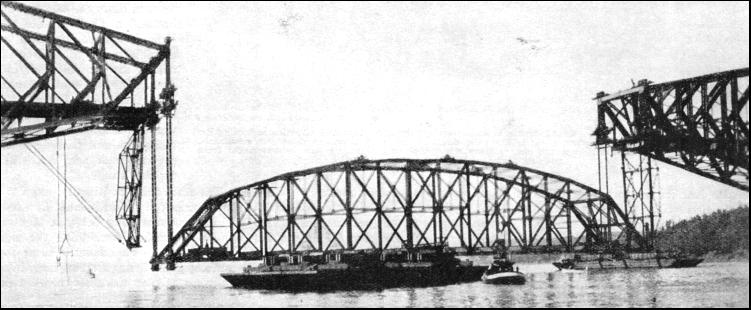
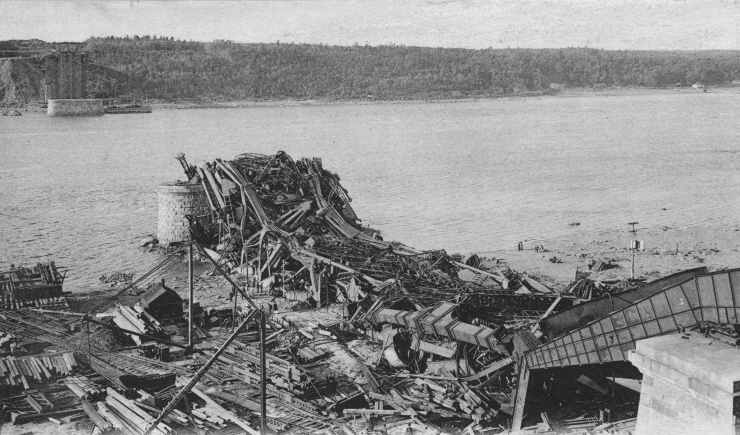
Then, on September 11, 1916, another accident occurred. Once again, the bridge—or at least part of it—collapsed into the river. And yet, the completion of the Québec Bridge had been within reach. The team failed at what was arguably the most difficult part of the entire assembly. As the girder was being moved into its final position between the two cantilevers, it suddenly plunged into the river. Thirteen people died in the incident.
Later, the analysis of the accident showed that a support component had not been optimally designed or mounted during the lifting process. The securing during hoisting had been insufficient. To this day, the debris of the suspension girder lies on the riverbed, at a depth of about 60 meters. And the bridge?
Completion of Québec Bridge
Once the analyses were completed, work on the bridge resumed. A new cantilever girder was constructed and, this time, installed over a longer period. After four days, everything was in place. In 1919, following the end of World War I, the Québec Bridge was officially inaugurated.
The entire project shows that large-scale structural projects present unique challenges that must not be overlooked. Especially during the construction process, safety is not an option, but rather the absolute priority. The complexity of temporary construction stages is often underestimated.
When a structure is not yet fully completed, it often shows even more complexity than in its final state. During the construction stage, such risks are not infrequently dismissed with a shrug. In many cases, this goes well; in others, as with the Québec Bridge, it costs human lives.
Conclusion: Collapse of Québec Bridge
CStructural engineering is constantly evolving and ‘’'learns from mistakes'‘’, no matter how tragic they may be. The collapse of the Quebec Bridge continues to have an impact to this day. We’ve compiled ‘’'seven lessons'‘’ that the construction industry can take away from this tragedy.
- Number 1: Safety reserves are not optional, uncertainties must be actively accounted for.
- Number 2: Independent inspections as standard; it is necessary to have a third or fourth opinion in complex projects—for both the structure and the team.
- Number 3: Consistent monitoring of measurement data and installation of early warning systems.
- Number 4: Consideration of all load cases, especially during the construction stage.
- Number 5: Constructive communication among team members, regardless of hierarchies.
- Number 6: Responsibility extends beyond the client; building for the public.
- Number 7: Safety takes precedence over time pressure and profit.
The collapse of the Québec Bridge is still used today in the training of new structural engineers After all, the collapse of the Quebec Bridge was not a simple calculation error, but a failure on multiple levels. It clearly shows that technical feasibility is not enough to create monumental structures. Organization and communication must be in sync on such large projects; otherwise, not only the structures but, in the worst case, people will be harmed.
Another mega-project that faced major problems was the so-called Eighth Wonder of the World: the Panama Canal. Here, misconceptions, a big ego, and human greed collided. Feel free to read more if the topic interests you:
Panama Canal: Eighth Wonder of the World and Its Bloody Price
.