


Additional foundation loads, such as the self-weight of the foundation, the earth covering, and ground water, are not fully considered in the global structural model in RFEM 6; instead, they are added and evaluated for design purposes in the “Concrete Foundations” add-on.
It is important to correctly model these loads in the load case structure:
The self-weight of the structural frame and the foundation can be considered in the self-weight load case.
Earth covering and ground water, on the other hand, should be defined in separate load cases and not included in the self-weight as a lump sum.
The reason for this is that these actions can have both favorable and unfavorable effects, depending on the design.
Ground water, for example, may cause buoyancy, but in other cases, it may have a relieving effect. The same applies to earth covering, which can have a stabilizing effect or may cause additional loading.
By defining these actions separately in their own load cases, they can be specifically included or excluded from load combinations. This ensures that the governing load case is correctly accounted for in the respective geotechnical design checks (for example, ground failure, sliding, or uplift limit state).
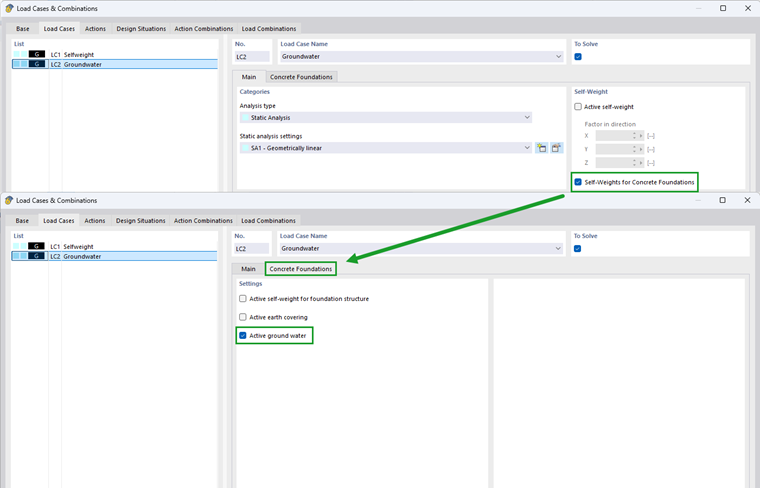
For the plausibility check, it is recommended to evaluate the “Support forces with foundation load” in the structural analysis to verify whether the additional foundation loads have been accounted for in the expected magnitude.