


1. Mesh Size
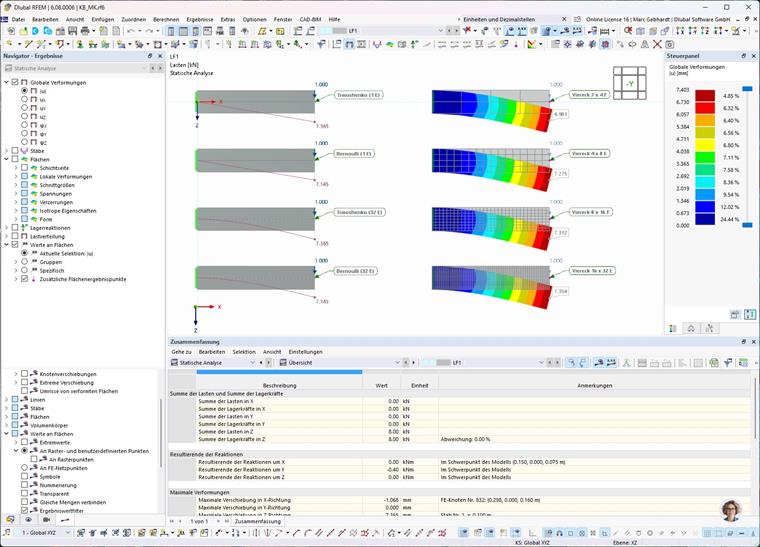
The size of the mesh plays a crucial role in the accuracy of a nonlinear analysis. In most cases, a finer mesh generally results in higher accuracy, as it can capture the geometry and behavior of the model in more detail. However, it also increases the computational effort as the number of mesh elements grows.
Therefore, it makes sense to find the balance between accuracy and computational time. This is usually done by carrying out a mesh convergence study, which is further explained in this knowledge base article:
2. Increments
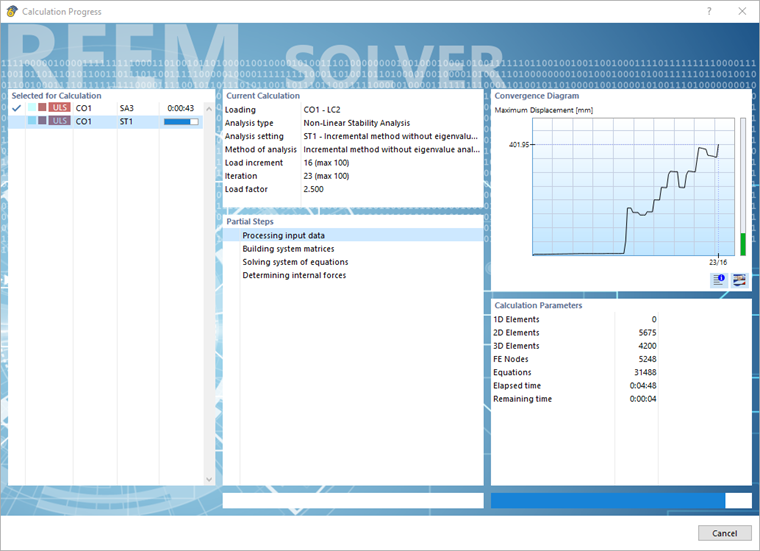
In nonlinear analyses, applying the load in multiple increments can improve the quality of the results. Additionally, using increments usually helps with convergence issues by reducing the susceptibility to instabilities. However, it also increases the computational effort, as the program tries to reach the convergence threshold for every increment.
Hence, if you have issues with the result quality, convergence, or instabilities, try out multiple load increments. For most cases, 3 to 5 increments are sufficient. But in some cases, e.g. when the load level is close to the critical load factor of a model, it might be necessary to use more load increments.
3. Analysis Type (First-/Second-/Third-Order)
The choice of the analysis type influences the way the model responds to nonlinearities, because: In contrast to first-order/linear analysis, second-order/P-Δ analysis and third-order/large deformation analysis takes into account secondary effects due to deformations, which can influence the behavior of nonlinearities in the model.
Generally, increasing the order of the analysis improves the quality and accuracy of the results, but also increases the computational effort and may cause convergence/instability issues that need to be treated, e.g. by adjusting the properties of object nonlinearities or by using multiple increments.
4. Treatment of Nonlinear Members
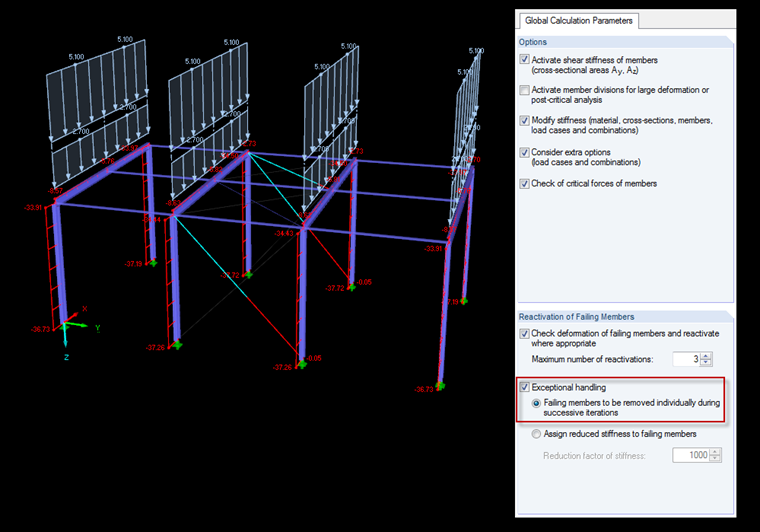
Members with a nonlinear stiffness type, such as tension/compression members, that can fail during a calculation, may require special treatment during the calculation to prevent instabilities.
Please refer to the following Knowledge Base article for more details:
5. Convergence Criteria
Convergence criteria define the conditions under which the iterative solver will stop.
While these criteria do not usually have to be changed, they can be used as a tool to assess the quality of the results. Please note that the criteria should be used mainly for testing purposes.
You can find more information about these settings here, in the online manual:
Conclusion
Nonlinear analyses are sensitive to a variety of settings that can have significant effects on the results and the calculation stability. As they depend strongly on the model and loading conditions, trial and error may be used to find the most suitable settings. To facilitate this process, it is highly recommended to include nonlinearities step by step into the model. That way, it is much easier to deal with issues arising from adding nonlinearities.