Description
A rod with a square cross-section is fixed on the top end according to the following figure. The rod is loaded by its self-weight. For comparison, the example is also modeled with the concentrated force load of which the value is equal to the gravity. The aim of this verification example is to show the difference between these types of loading, although the total loading force is equal. The problem is described by the following set of parameters.
| Material | Steel | Modulus of Elasticity | E | 210000.000 | MPa |
| Poisson's Ratio | ν | 0.296 | - | ||
| Density | ρ | 7850.000 | kg/m3 | ||
| Geometry | Rod | Length | L | 10.000 | m |
| Cross-Section Width | w | 20.000 | mm | ||
| Load | Gravitational Acceleration | g | 10.000 | m/s2 | |
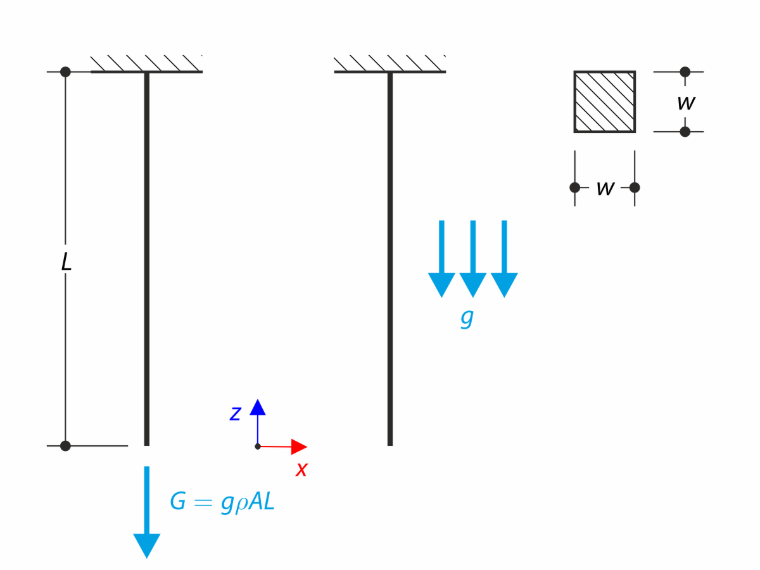
The self-weight is neglected in the first case. Determine the maximum deformation of the rod uz,max.
Analytical Solution
The equation of equilibrium in one-dimensional case can be written as:
The axial stress σz is defined by Hooke's law.
Concentrated Force
At first, the loading by the concentrated force is considered. The concentrated force is equal to the gravity.
The volume force fz is equal to zero in this case. Then the strain εz remains constant
where the strain εz is defined as:
Then the final differential equation is:
The solution of this differential equation has the form of the following linear function.
The integration constants C1, C2 can be obtained from the boundary conditions.
Hence,
Finally, the formula for the displacement uz can be completed and the maximum displacement uz,max calculated.
Self-weight
In case of self-weight, the volume force is defined as:
Using the equation of equilibrium mentioned above again, the differential equation of equilibrium can be rewritten as follows:
Please note that the strain εz is not constant. The deformation uz is then the following:
The boundary conditions in this case are the following:
Hence,
Finally, the formula for the displacement uz can be completed and the maximum displacement uz,max calculated.
RFEM Settings
- Modeled in RFEM 6.14 and RFEM 5.06
- The element size is lFE = 0.100 m
- Isotropic linear elastic material model is used
Results
| Type of Loading | Analytical Solution [mm] |
RFEM 6 [mm] |
Ratio [-] |
RFEM 5 [mm] |
Ratio [-] |
| Concentrated force | −0.037 | −0.037 | 1.000 | −0.037 | 1.000 |
| Self-weight | −0.019 | −0.019 | 1.000 | −0.019 | 1.000 |