


The Rock Temples of Abu Simbel have been a World Heritage Site since 1979. But their history goes back much further. They were built about 3,000 years ago on the banks of the Nile, in southern Egypt. The giant statues at the entrance to the Rock-Cut Temples of Abu Simbel are particularly famous. Standing 20 meters tall, they are truly impressive. They have withstood desert storms and the changing fortunes of the empire over the course of time. And yet, in the 1950s, a threat loomed that could have spelled their doom.
The waters of the Nile would rise and bury the temple forever. The planned reservoir threatened to wipe out numerous ancient monuments in Nubia. Yet Abu Simbel had been one of the most significant temple complexes of ancient Egypt since its discovery in the 19th century. So what to do? Simply give up such a cultural heritage? No. Egypt wanted to save the Abu Simbel temples. And they did so with an extremely unusual approach: We’ll simply take the temples and move them somewhere else! In this article, we’ll take a closer look at this unique rescue operation.
Abu Simbel: Unique Temple Complex
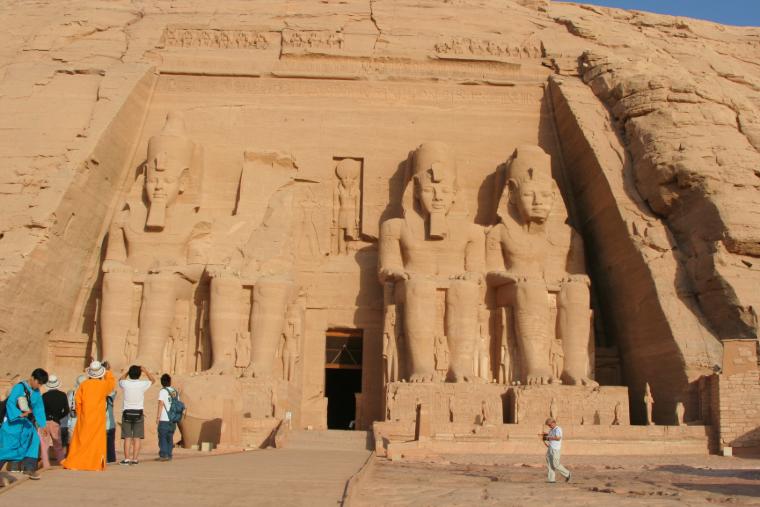
Before we take a closer look at the details of the rescue mission, let’s take a look at the Abu Simbel Temple Complex. What makes it so special? Temples like these were built by the ruling pharaohs of the time—as a final resting place and a symbol of their power in ancient Egypt.
Abu Simbel was built in the 13th century B.C.E.. This means the temple complex is a good 3,000 years old. It was commissioned by the Egyptian Pharaoh Ramses II in the region of Nubia, which is now southern Egypt. The complex itself consists of two temples that were carved directly out of the sandstone rock. The rocks were thus integral parts of the temples themselves—a fact that will prove significant later on.
The Great Temple was primarily dedicated to the gods Amun-Re, Re-Harachte, and Ptah, as well as to the deified Ramses II. The smaller temple is dedicated to Hathor and is closely associated with Nefertari, the Great Royal Consort of Ramses II. Like his predecessors, Ramses II also used his temple as a demonstration of his power. After all, the four seated statues, standing 20 meters tall, are truly impressive.
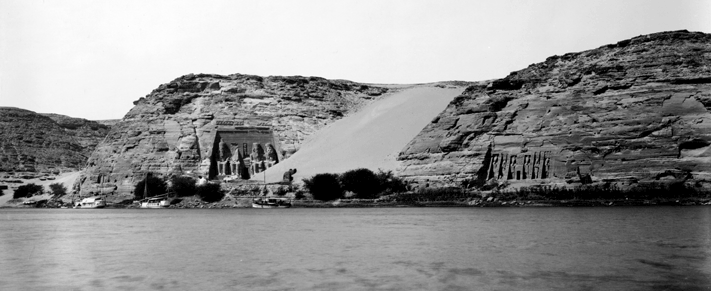
Like many ancient Egyptian temple complexes, Abu Simbel met the same fate: over the centuries, it became completely buried under sand. In 1813, the Swiss traveler Jean-Louis Burckhardt rediscovered the complex, and four years later, Giovanni Battista Belzoni began unearthing the entrance to the Great Temple. From that point on, Abu Simbel became a significant discovery—both archaeologically and culturally.
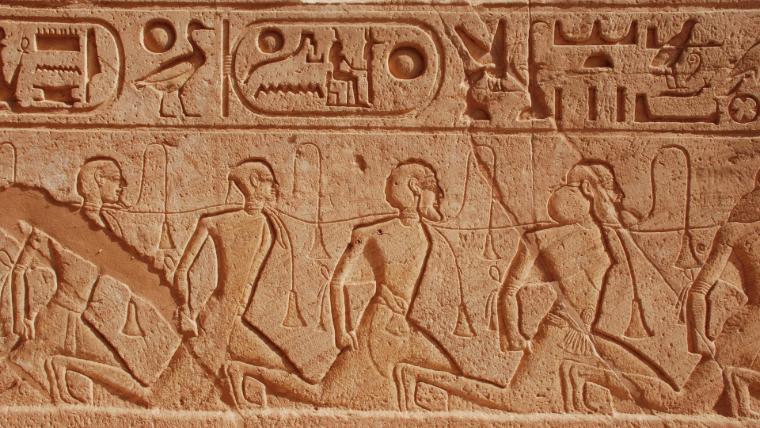
The plan for the relocation of the temple complex was therefore not just about an ordinary building. Rather, it involved two temples of enormous dimensions that were firmly connected to the rock into which they had been carved. Not only the statues on the exterior and the numerous reliefs inside, but also the architecture itself was worthy of protection. And all of this was to be preserved.
Fate of Abu Simbel: Price of Progress
We had already mentioned that a reservoir was to be created at the old site of Abu Simbel. How could something like that be more important than preserving such a significant and ancient temple complex as Abu Simbel? Quite simply: ancient advanced civilization was to give way to modern progress.
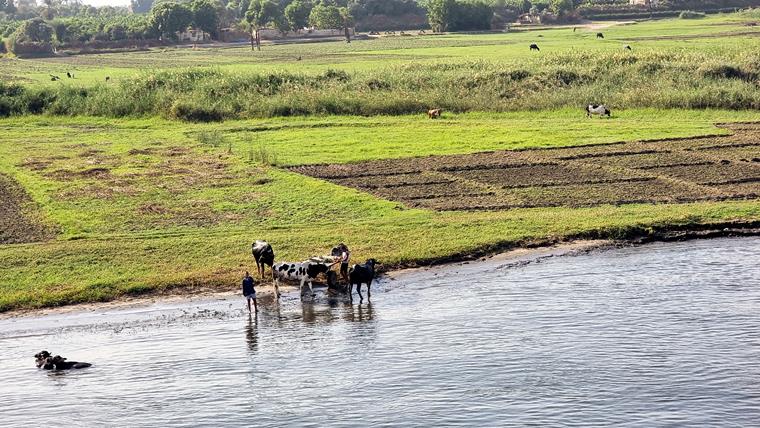
Egypt had always had problems with its water supply. Although the Nile was the country’s lifeline, it was unreliable, especially for a growing population and industrialization. Controlled irrigation was essential for agriculture, and a dam would also provide electricity. Dams along the Nile, in particular, cause problems time and again. In another post, for example, we discussed the GERD dam in Ethiopia. Feel free to check it out if you’re interested: GERD Dam in Ethiopia: Opportunity or Development Deception?
The dam was intended to create the massive Lake Nasser and flood large areas of the Nile Valley in the south. Abu Simbel was located in an area that was consequently highly endangered. The rising water would have caused the temple complex to disappear completely. And unlike sand, water does not preserve such structures; rather, it destroys them—especially the numerous reliefs and inscriptions.
Thus, a conflict between culture and progress showed itself. On the one hand, a modern infrastructure project that would supply millions of people with water and electricity. On the other hand, an irreplaceable cultural heritage, which would suffer irreversible damage from the flooding. It was not possible to build the dam. Therefore, it is necessary to reconcile the structural project and the preservation of the monument. The idea: an international rescue operation.
Rescue of Abu Simbel
The Abu Simbel Temple Complex needed to be saved. But how? In 1959, Egypt asked UNESCO for assistance in protecting the endangered Nubian monuments. And it was successful. On March 8, 1960, the international campaign to save the monuments of Nubia was launched.
Experts from a wide variety of countries pooled their archaeological, architectural, and engineering expertise. The rescue of Abu Simbel thus became part of a larger international campaign that was truly impressive. In total, 22 monuments and historic sites were saved from flooding in this way.
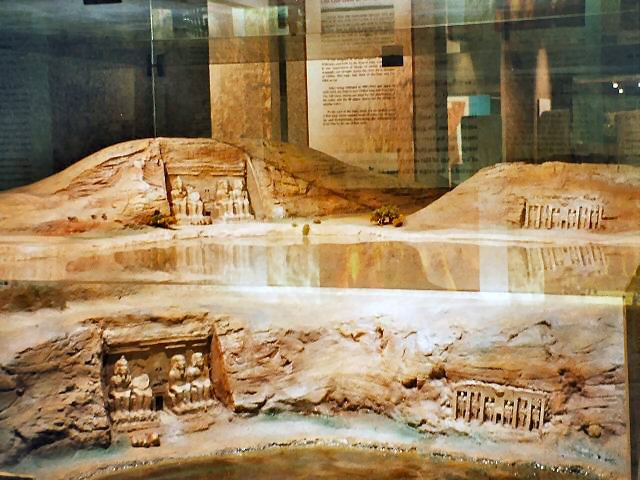
Initially, there was discussion about protecting Abu Simbel from the water with protective structures. Then, the idea of simply raising the temple complex was considered. Or was it really possible to dismantle such a large temple complex, carved into the rock, in order to rebuild it elsewhere? Ultimately, it was precisely this proposal that prevailed. The experts had not yet agreed on how this would be accomplished.
Abu Simbel: Temple to Dismantle
A simple measure to protect against water and raising the temple complex were ultimately rejected. Abu Simbel was to be broken down into individual blocks, transported to a higher location, and reassembled there. Work on this project began in 1963. However, because both temples were not freestanding but carved into the rock, the entire undertaking proved to be difficult.
Challenge 1: Dismantling Temple
Not only the visible architecture but also a portion of the surrounding rock was necessary to work on. First, the rock masses behind and above the temple complexes were carefully removed. Then the workers dismantled the temple structures with wire saws into large blocks. It was necessary to plan the sections so that everything can be reassembled as precisely as possible. Often, this comes down to a matter of millimeters.
Challenge 2: Moving Thousands of Metric Tons of Stone
Ultimately, the temples yielded about 1,000 blocks of sandstone. The figure of around 1,036 blocks is often cited, but the exact number varies depending on the source. Each block had to be documented and labeled so that it can be placed in the correct position at its new location. The goal: In the end, no section edges should be visible.
No sooner had they been cut than the second major hurdle arose: transportation. Each block weighed about 7 to 30 metric tons. On top of that, sandstone was quite fragile and could break or be damaged by overturning, internal stresses caused by improper loading, or vibrations. This had to be avoided at all costs. So how exactly did the transport take place? After being cut, the blocks were marked and prepared for lifting. To do this, lifting devices were attached to the stones. Where necessary, the porous sandstone was first stabilized with synthetic resin.
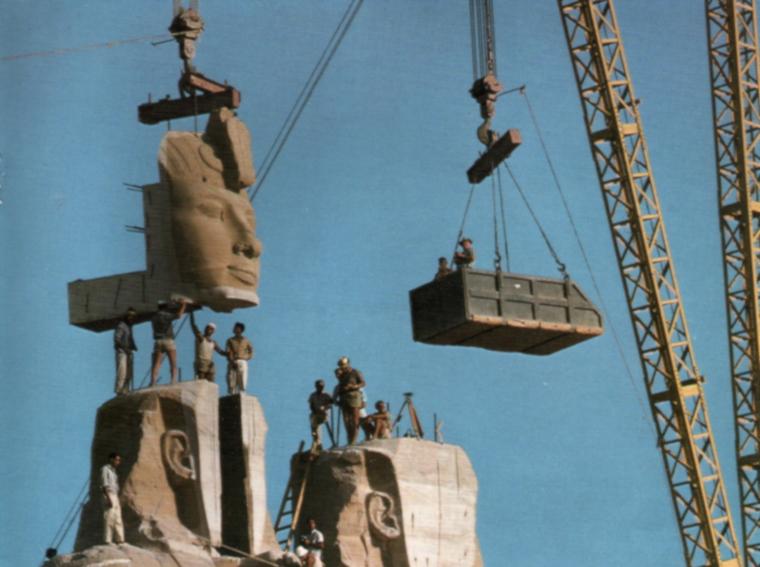
At the temples themselves, braced derrick cranes were used. A technical report describes lifting equipment with load capacities of 20 and 30 metric tons. The blocks were lifted as carefully as possible and without unnecessary tilting to prevent cracks and damage to the reliefs.
The blocks were then placed on flatbed trailers and slowly transported to a 44,000 m² storage area. There, the pieces were stored in an organized manner until they could be reinstalled at their new location. The blocks were then reloaded onto flatbed trucks and transported to the new temple complex. There, workers lifted them into their intended positions using additional heavy-duty cranes. It is necessary for each block to fit precisely into its surroundings.
Challenge 3: New Home
The new location for Abu Simbel was about 65 m higher and roughly 180 to 200 m further inland. Here, the structures were safe from the dammed waters of the Nile. During reconstruction, however, there was another hurdle to overcome: the supporting structure. The original Abu Simbel structures had been carved out of stone. Up here, there was no rock. It is necessary for engineers to come up with a solution.
They erected large reinforced concrete structures in the shape of domes or support shells behind and above the reconstructed temple chambers. These structures transferred the structural function of the artificial rock mountain. The entire complex was then coated with rock material so that it once again looked as if the temples had been hewn out of the rock. The rescue of Abu Simbel was a logistical and engineering masterpiece.
Challenge 4: Preserving Not Just Stones, but Also Significance
The original layout of the rooms, the facades, and the reliefs were to be restored as faithfully as possible to the original. This was particularly important for the Great Temple. Twice a year—traditionally around February 22 and October 22—the rays of the rising sun penetrate through the entrance of the Great Temple, reaching deep into the sanctuary. In doing so, they pass through several rooms and travel approximately 60 meters inside the temple.
They then strike four statues seated side by side: Re-Harachte (a sun deity), Ramses II himself, Amun-Re, and Ptah. Three of these statues are illuminated by the sun, while only Ptah—who is associated with the underworld—remains in darkness. This phenomenon, which is also known as the solar miracle, was, of course, to be preserved.
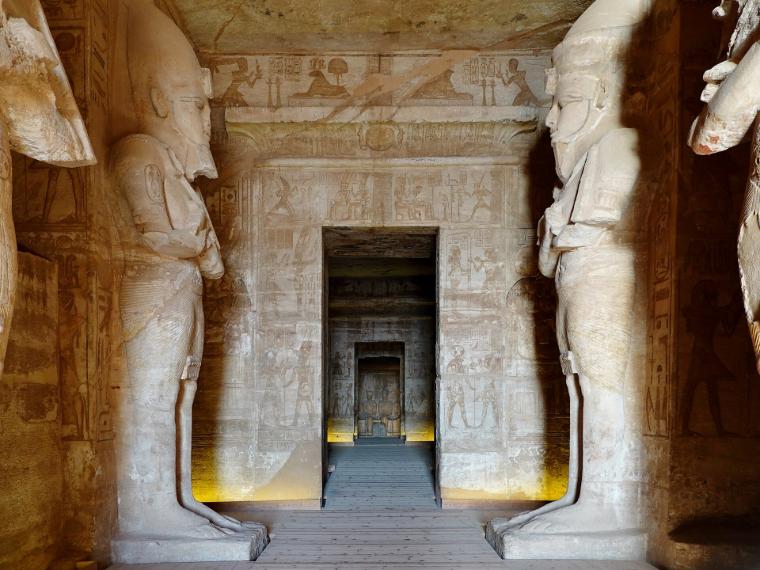
The designers took the original orientation of the temple into account during the reconstruction. The phenomenon was preserved, even though the times of illumination have shifted slightly compared to the earlier situation. Architecture, surveying, building physics, and archaeological documentation must work closely together to ensure that such a significant phenomenon is not lost.
Conclusion: How did the rescue of Abu Simbel suceed?
The relocation of Abu Simbel was a success. Both temples were restored without damage. On September 22, 1968, Abu Simbel was officially inaugurated at its new location. The once-endangered facades, statues, and interiors were finally accessible again and safely preserved for the future.
Egypt had succeeded, with the help of UNESCO, in preserving such an impressive structure without having to sacrifice the necessary technological progress. The Abu Simbel rescue operation remains to this day a symbol of what is possible when experts come together to form an international team.
UNESCO coordinated the campaign, while numerous countries contributed financial resources and technical support to save this cultural heritage. Depending on the source, the cost of saving Abu Simbel was approximately $40 million. The campaign surrounding the rescued Nubian monuments played a governing role in making the subsequent 1972 World Heritage Convention possible in the first place.
If you found this topic interesting, you’ll find more exciting articles here that you might enjoy. Feel free to check them out:
