Taking the initial state into account can be of considerable importance for correct material behavior. The reason for this is that it defines the initial stress state from which the further reaction is evaluated.
This can be illustrated relatively clearly using the example of geotechnical material models, such as the Mohr-Coulomb and Hardening Soil models.
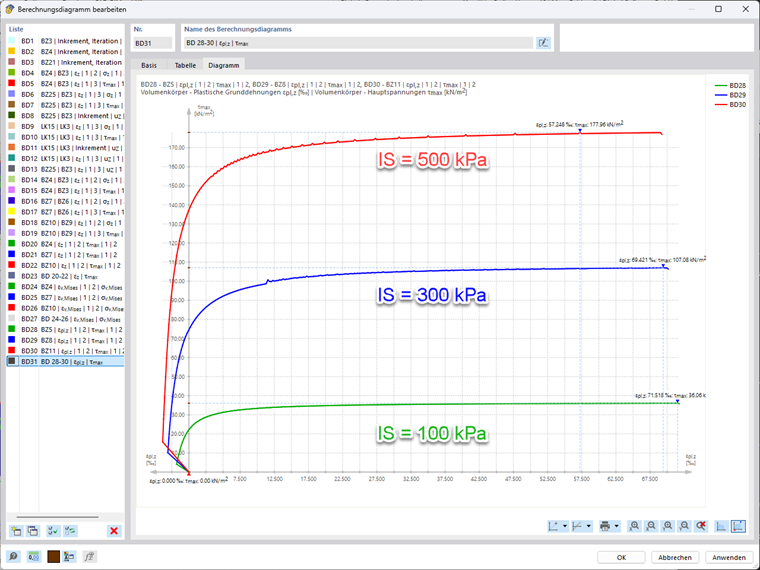
Their failure surfaces are usually dependent on the hydrostatic axis. This is defined in the principal stress space by the fact that all principal stress components are equal at every point. The failure surface according to Mohr-Coulomb, for example, is a pyramid with its apex pointing towards tension on all sides and its (open) main surface pointing towards pressure on all sides.
If this failure surface is used as the flow condition for the assumed material behavior, this means that at higher pressure on all sides, the tolerable deviation (for example, due to unilateral pressure or tension) can be greater the more the FE element is subjected to pressure on all sides. The initial stress state depends on the load history and includes, for example, the self-weight of the soil and existing structures. The same applies, of course, to cohesive material behavior, as the initial stiffness is based on a reference stress.
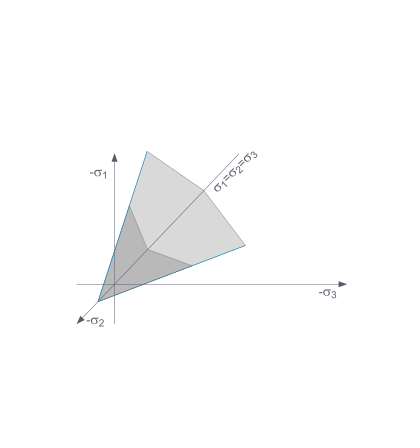
A modification of the model with triaxial conditions from the technical article on determining material properties shows this relatively clearly. Here, in addition to the original isotropic initial stress state of 300 kPa, two further states of 100 kPa and 500 kPa were applied.
A forced displacement was then applied to these three initial states, resulting in a compression of 150 ‰ and an elongation of 75 ‰. The modified model and the technical article mentioned can be accessed at the following links.
- FAQ 5726 | Single Element Test – Triaxial Conditions – Modified Hardening Soil Material Model
- KB 1976 | Adjustment of Material Parameters to Experimental Data
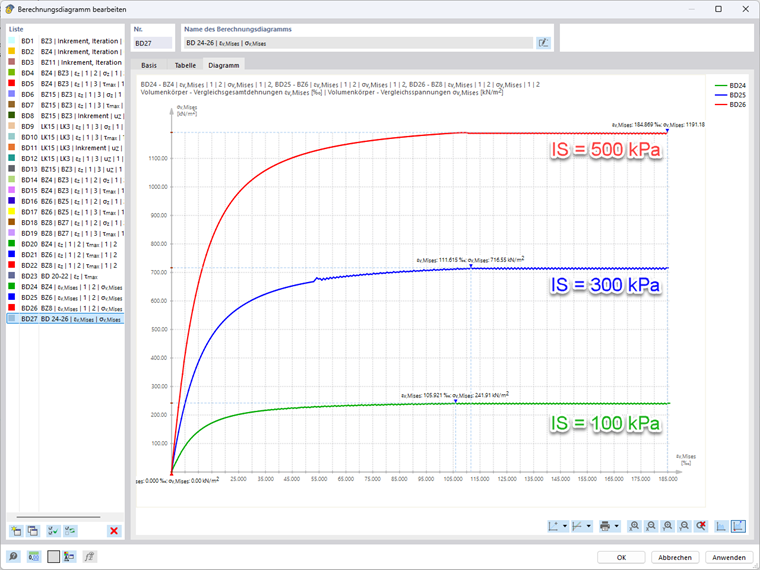
The following image shows the final states of the axial compression, with the Von Mises equivalent stress and strain compared. As can be seen here, the initial slope (stiffness) increases with higher pressure on all sides in the initial state. This also applies to the plateau stress.
For the axial elongation of the element, the following group of calculation diagrams shows the maximum shear stress versus the first plastic principal normal strain. Here, too, the same behavior can be seen for the initial stiffnesses and the reaching of the stress plateau.