A major problem in the use of nonlinear material models is often the material parameters required for this purpose. This also applies to the modified hardening soil material model used in this article. This technical article discusses the iterative adjustment of these parameters by comparing published measurement data with the results of FE simulation. This analysis is based on the publication by Bower et al. [1, which in turn refers to the publication of the description of the original hardening soil material model by Schanz et al. [2.
However, instead of using the actual test specimen geometry as in the publication by Bower et al. [1], a single cubic element with an edge length of one meter was used here. This greatly reduces the calculation time. Since the material models are applied at the element level, reliable material parameters should be determinable when the real test conditions are modeled correctly. In these single-element tests, the support was applied at the corner points and the load was applied by means of imposed line deformations. The Construction Stages add-on was used to correctly account for the previous states. In the first three construction stages, the equilibrium for the undeformed structure is determined to initialize the test conditions. In both models, the first construction stage includes the activation of the geometry and boundary conditions with linearized material properties. This is followed by the activation of the nonlinear material properties. If necessary, the isotropic load is then applied, followed by the entry of the test loads for which the forced-deformation line supports are activated.
- Online Manual Geotechnical Analysis for RFEM 6
- Online Manual Analysis of Construction Stages (CSA) for RFEM 6
- Online Manuals Static Analysis Settings
- RFEM 6 Manual | Structure | Special Objects | Structure Modifications
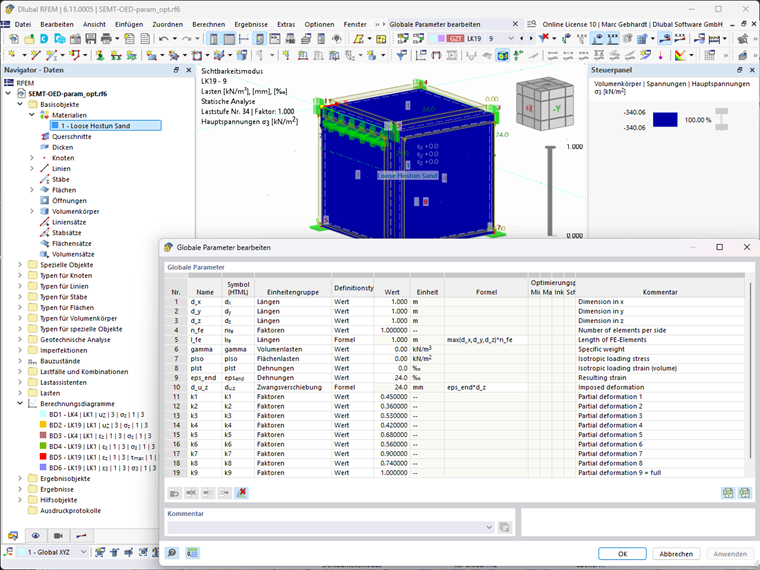
The simulation of the material test under oedometric conditions consists of a fixed support of the nodes on the bottom side and a support of the nodes on the top side fixed in the vertical direction. Only a minimal self-weight and no isotropic load was applied. The deformation-controlled load application was carried out in nine stages of alternating loading and unloading up to a maximum deformation of 24 mm (corresponds to 24.0 ‰). This cyclic load application was achieved by means of load combinations using parameterized multiplication factors in the structural analysis settings. The following image shows a view of this model with the associated global parameters:
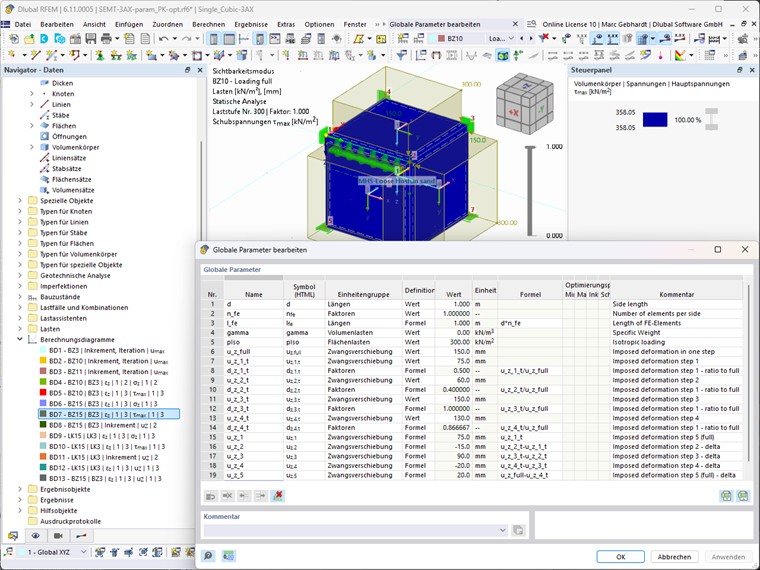
The recalculation of the triaxial material test was structured similarly. The nodal support was provided without constraints and with torsional restraint. Furthermore, an isotropic load of 300 kN/m² was applied to correspond to the test conditions. The test load was applied by means of an imposed displacement of the upper side, without cyclic loading and unloading, up to a maximum vertical displacement of 150 mm. The image below shows the model described.
The associated models can be downloaded at the following links:
- KB 1976 | Single Element Test – Oedometer Conditions – Modified Hardening Soil Material Model
- KB 1976 | Single Element Test – Triaxial Conditions – Modified Hardening Soil Material Model
The most problematic aspect here is the adjustment to two test curves. For numerical stability, a higher minimum cohesion of 1.0 kPa was therefore used for the simulation of the triaxial conditions. The following image shows the material parameters determined for the oedometer conditions for the modified hardening soil material model:

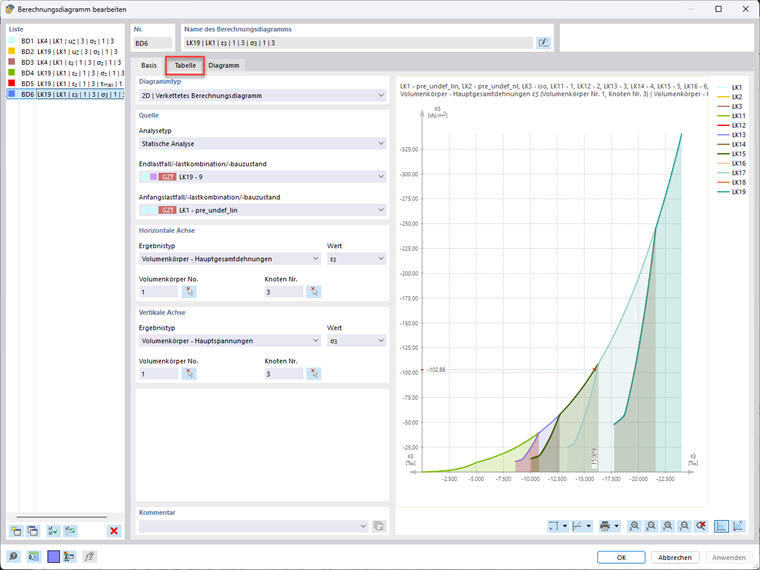
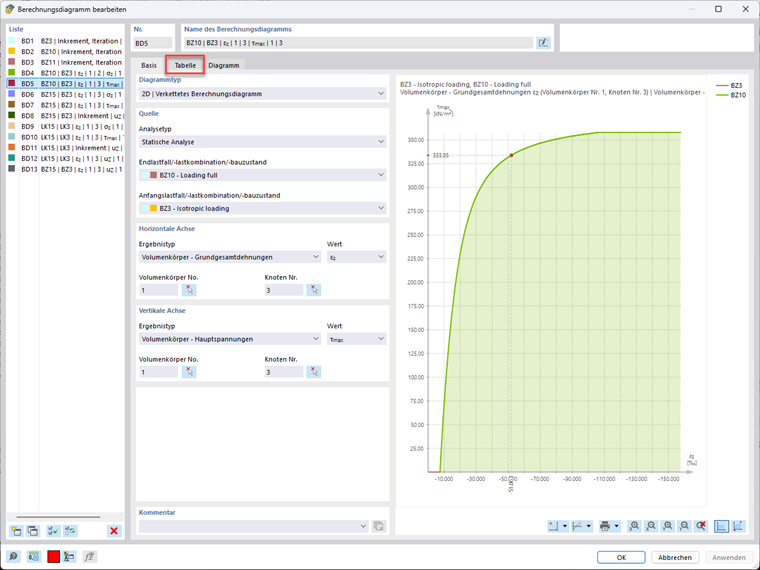
As mentioned above, a comparison of the published test curves with the equivalent simulation results was performed to determine these values. The linked calculation diagram monitors implemented in RFEM 6 were used for this purpose. In addition to providing a good overview of the development of individual results, these can also be exported to Excel in the “Table” tab. The following images show the calculation diagrams determined in this analysis for the recalculation of the oedometer and triaxial material tests.
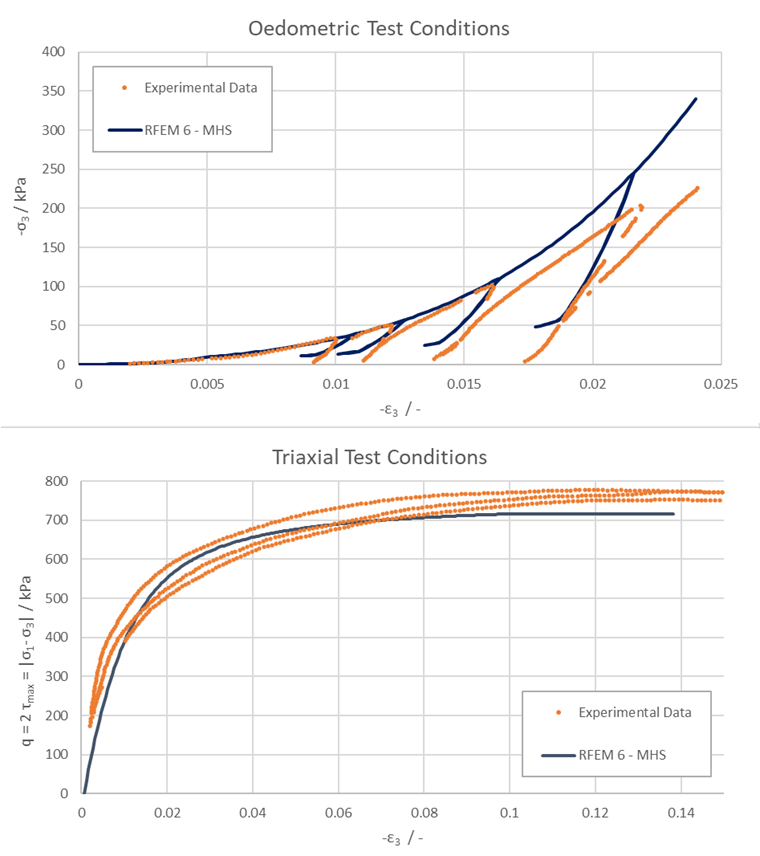
The deviation between the simulation results and the material test curves can now be determined visually or using statistical methods. The following image shows the results obtained here in comparison with the published data determined experimentally. As can be seen, the agreement of the oedometer conditions is very good up to a medium stress level (around 100 kPa), while the behavior is then too stiff. The loading and unloading modules are too low in the first two cycles, whereas they are too high in the last cycle. When compared with the tri-axial test repeated three times, it is noticeable that the initial stiffness is too low, followed by excessive curvature. This indicates that the shear hardening (CSH) value is too low. Finally, the constant stress level is reached too early and remains lower than in the experimental curves (~715 kPa/760 kPa ~ 94.1%). The Pearson correlation coefficient, which can be seen as a measure of the dependence of the measurement and simulation curves, is 0.90 or 0.94 for the oedometer conditions and 0.88 or 0.91 for the triaxial test, depending on the interpolation method used for the assignment of measured values.