


Introduction
The accurate prediction of wind-induced forces on antenna structures is a critical aspect of structural and telecommunications engineering, particularly for high-frequency, slender devices like the Kathrein 80010804 antenna. In this study, a comprehensive validation of CFD-based wind simulations is carried out for the antenna’s cross-section in collaboration with RWTH Aachen University. The goal is to assess the reliability of numerical results generated by RWIND Simulation software by comparing them with wind tunnel measurements, including both in-house tests and reference data published in the Master's thesis from RWTH Aachen University [1] and technical Kathrein Catalog (Images 1 and 2).
One of the key challenges in the validation process is the sensitivity of aerodynamic behavior to the Reynolds number, particularly at low wind attack angles (e.g., 0° and 180°), where flow separation and reattachment phenomena dominate. The aerodynamic performance at these orientations is highly dependent on the flow regime, surface roughness, and the scale of the physical model, leading to discrepancies between CFD results and experimental findings.
This validation study not only serves to benchmark RWIND but also contributes to refining best practices for simulating complex antenna geometries under wind loading. The findings underline the importance of accounting for Reynolds effects, boundary conditions, and geometrical fidelity to achieve meaningful agreement with experimental data.

![CFD Simulations for Wind Load Analysis of Antenna Structures: Validation Through Wind Tunnel Testing [1]](/en/webimage/057701/4702092/Image.png?mw=760&hash=ec9a55cdca40d30b4481aa04757df3b01dc1fa64)
Description
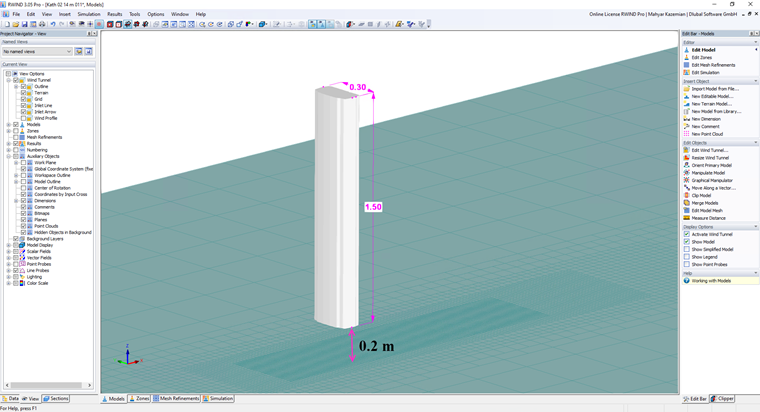
In the current validation example, the force coefficient for both the CFD simulation in RWIND and the experimental study [1] from RWTH Aachen University is investigated. The model represents Kathrein Antenna Cross-Section 80010804 in RWIND, positioned above a grid surface that serves as the ground plane or wind tunnel floor. The model includes several dimensional labels, indicating specific measurements in Image 3. The total height of the antenna is 1.50 m and the width (b) is 0.3 m; its base is elevated 0.20 m from the ground as shown in Image 3. It is important to note that the reference area is assumed to remain constant across all wind directions, as defined by the following formula:
Input Data and Assumptions
The required assumption of the wind simulation is illustrated in the following table:
| Table 1: Dimensional Ratio and Input Data | |||
| Wind Velocity | V | 14 - 41 | m/s |
| Height | H | 1.5 | m |
| Bottom Gap | Gap | 0.20 | m |
| Air Density - RWIND | ρ | 1.25 | kg/m3 |
| Wind Directions | θwind | 0o to 360o with step 30o | Degree |
| Turbulence Model - RWIND | Steady RANS k-ω SST | - | - |
| Kinematic Viscosity - RWIND | ν | 1.5*10-5 | m2/s |
| Scheme Order - RWIND | Second | - | - |
| Residual Target Value - RWIND | 10-4 | - | - |
| Residual Type - RWIND | Pressure | - | - |
| Minimum Number of Iterations - RWIND | 800 | - | - |
| Boundary Layer - RWIND | NL | 10 | - |
| Type of Wall Function - RWIND | Enhanced / Blended | - | - |
| Turbulence Intensity | I | 5% | - |
Computational Mesh Study
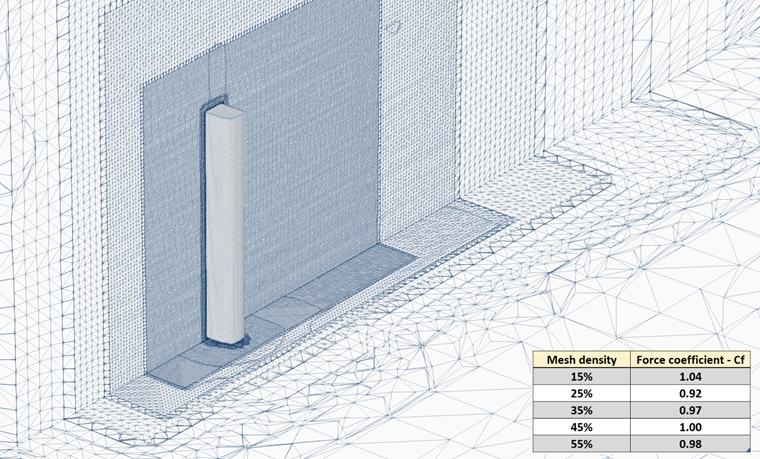
A computational mesh study is essential in CFD analysis because it directly affects the accuracy and reliability of the results. While a well-refined mesh improves precision, excessive refinement increases computational cost without much benefit. Therefore, mesh sensitivity studies help find the optimal balance between accuracy and efficiency, enabling better decision-making with practical use of resources. The table displayed in the lower right corner compares various mesh densities ranging from 15% to 55% and their corresponding force coefficients (Cf) as shown in Image 4.
For more info about computational mesh study:
Results and Discussion
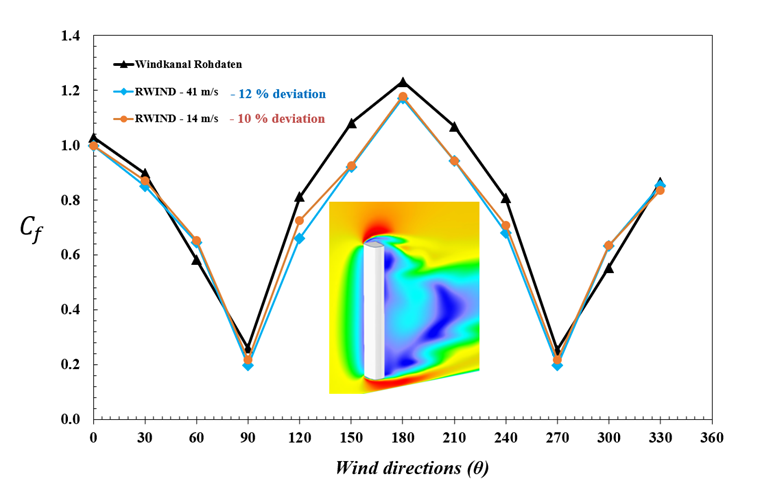
Image 5 compares the force coefficient Cf across the antenna model, based on wind tunnel measurements and RWIND results at wind speeds of 14 m/s and 41 m/s. Both simulations (14 m/s and 41 m/s) follow the experimental trend, which confirms correct flow orientation sensitivity but slightly underpredicts peak values, with deviations of 10% and 12%, respectively. The minimum Cf occurs at 90∘ and 270∘, and the maximum at 180∘, reflecting wind exposure. The inset CFD visualization illustrates flow separation, supporting the results. The Reynolds number influences flow separation, turbulence, and vortex shedding. Even small differences in Re between CFD (at 14 m/s and 41 m/s) and the wind tunnel may cause changes in pressure distribution, especially at round corner sections. RWIND may not fully reproduce the Reynolds effects due to the physics complexity. The comparison highlights reasonable agreement, with minor deviations due to Reynolds number effects.
For more info about how to calculate the wind force coefficient in RWIND:
Conclusion
Overall, the present study validates the numerical wind simulation for the Kathrein antenna cross-section 80010804 by comparing RWIND results with experimental data provided in collaboration with RWTH Aachen University. The comparison confirms that RWIND reliably captures the aerodynamic force coefficient of the rounded-cornered antenna across all wind directions, demonstrating its capability to simulate wind loads on slender, curved geometries. The reasonable agreement between simulated and measured force coefficients underlines the accuracy of the model.
In addition, here is the example from RWTH Aachen University that illustrates the single and three sharp-edge antenna models:
