


Introduction
In Computational Fluid Dynamics (CFD), boundary conditions (BC) play a crucial role in defining the behavior of flow domains. When dealing with transient time-varying simulations, the definition of the inlet boundary condition becomes significantly more complex compared to steady-state simulations (Image 1). This is because transient inlet BCs involve not only spatial variation (two dimensions at the inlet surface), but also time dependency, which leads to inherently large amounts of data. In particular, when turbulence needs to be characterized at the inlet, a very fine resolution is required to properly capture the fluctuations. This feature allows engineers to introduce realistic gusts, turbulence, and transient inflow fluctuations into wind simulations. Unlike steady-state methods, which only capture mean wind effects, TVIBC reproduces the rapid changes in velocity and turbulence intensity observed during storms, hurricanes, and extreme wind events.
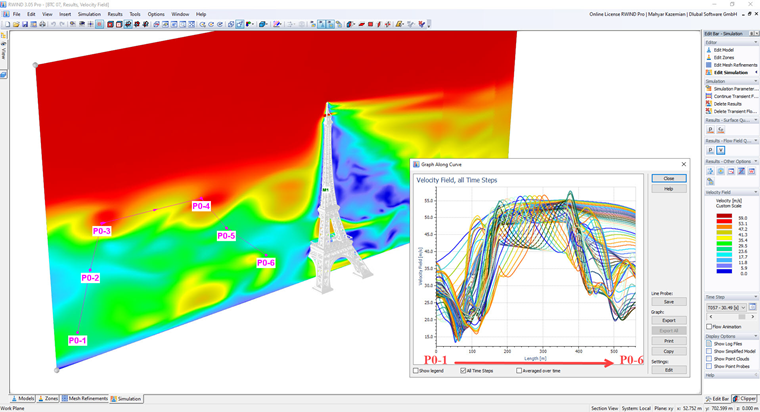
Concept of Time-Varying Inlet Boundary Condition
In a TVIBC approach, the inlet velocity is not simply prescribed as a mean wind profile. Instead, it is modeled as:
|
Ū(z) |
Mean velocity profile as a function of height z |
|
u'(t,z) |
Fluctuating component |
This temporal variation ensures that the incoming flow carries realistic turbulence structures, coherent gusts, and energy spectra similar to those observed in atmospheric boundary layers (ABL).
Sources for Time-Varying Boundary Condition Data
Several methods can be employed to obtain data for defining transient inlet boundary conditions:
- Experimental Measurements
Directly importing measured data from wind tunnel tests or field campaigns provides highly realistic inflow conditions. However, this method is resource-intensive and limited by experimental availability.
- Synthetic Turbulence Generators
Numerical turbulence generators can produce inflow conditions with prescribed statistical characteristics. This approach is flexible but may not perfectly replicate real turbulence spectra.
- Reuse of Transient Simulation Results (Periodic BC)
Results from a separate transient simulation can be recycled as inflow conditions for another CFD model. This periodic approach is particularly efficient and ensures the statistical consistency of turbulent structures.
More info and implementation:
Advantages of Using Time-Varying Inlet Boundary Conditions over Steady-State Inlet Conditions
✅ Realistic Representation of Turbulence
- Captures transient gusts, eddies, and turbulence spectra that directly affect pressure fluctuations on structural surfaces.
- Essential for high-rise buildings, slender towers, bridges, and lightweight roofs that are sensitive to dynamic wind actions.
✅ Improved Load Predictions
- Time-varying inflows allow direct estimation of gust factors, dynamic amplification, and peak pressures, rather than relying on empirical correction factors.
- Reduces uncertainty in critical design values such as base shear, overturning moments, and support reactions.
✅ Validation with Experimental Data
- Many wind tunnel studies demonstrate that structures experience non-stationary loads.
- TVIBC simulations show better agreement with wind tunnel experiments and field measurements compared to steady inflow methods.
✅ Compatibility with Standards and Guidelines
- Modern codes (e.g., Eurocode EN 1991-1-4, ASCE 7-22, WTG-Merkblatt) emphasize the role of gust effects and turbulence.
- TVIBC provides a direct computational pathway to include these effects, aiding compliance with approval engineers’ expectations.
Conclusion
The Time-Varying Inlet Boundary Condition represents a significant step forward in computational wind engineering. By moving beyond steady-state assumptions, it allows engineers to capture the full dynamic nature of atmospheric turbulence and its effects on structures. Although computationally more expensive, the improved accuracy and stronger alignment with experimental data make TVIBC an essential tool for critical projects where safety, serviceability, and approval acceptance depend on realistic wind load predictions.
 Knowledge Base