Activation
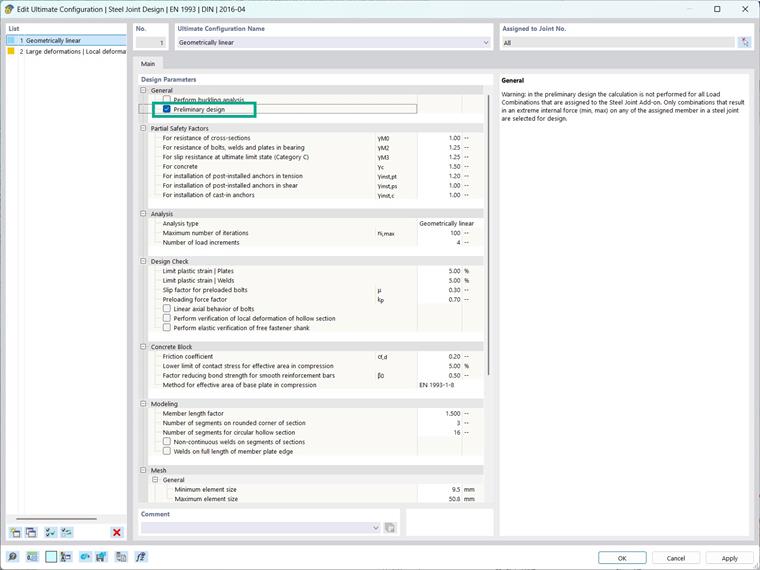
Activation of the preliminary design is carried out in the ultimate configuration. The corresponding check box can be found in the "General" section. A preliminary design is performed for all joints to which an ultimate configuration with activated preliminary design is assigned.
Reduction of the load combinations
The calculation effort is reduced by decreasing the number of load combinations to be designed. A complete design requires that all load positions from the acting load combinations are analyzed at all nodes of the joint. However, the number of the probably governing load positions can be limited to a significantly smaller number, applying the following assumptions:
- The load combinations causing the greatest internal force components in the connected member ends are also governing for the joint.
- For internal forces acting in the same direction, the loads with the greatest absolute values are governing.
- If an extreme internal force component (with a tolerance of 0.1 % of the value) occurs under two load positions, both are to be assumed as governing.
- Internal forces in the order of +/- 1 N or 1 Nm are negligible.
- Only member ends that are not supported in the submodel are included.
In most cases, the load combinations identified under these assumptions actually contain all governing ones. However, it cannot be ruled out that individual significant combinations are neglected due to an unusual load position. Therefore, the method is only suitable for preliminary design.
Application Example
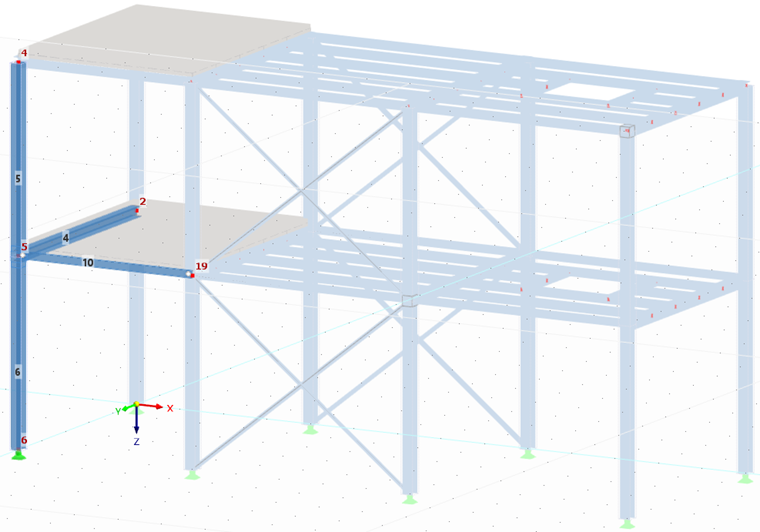
This simple example of a two-sided column joint illustrates the effectiveness and mode of operation. The imposed, wind, and snow loads acting on a steel frame structure in 21 load combinations result in the following internal forces at the examined joint node.
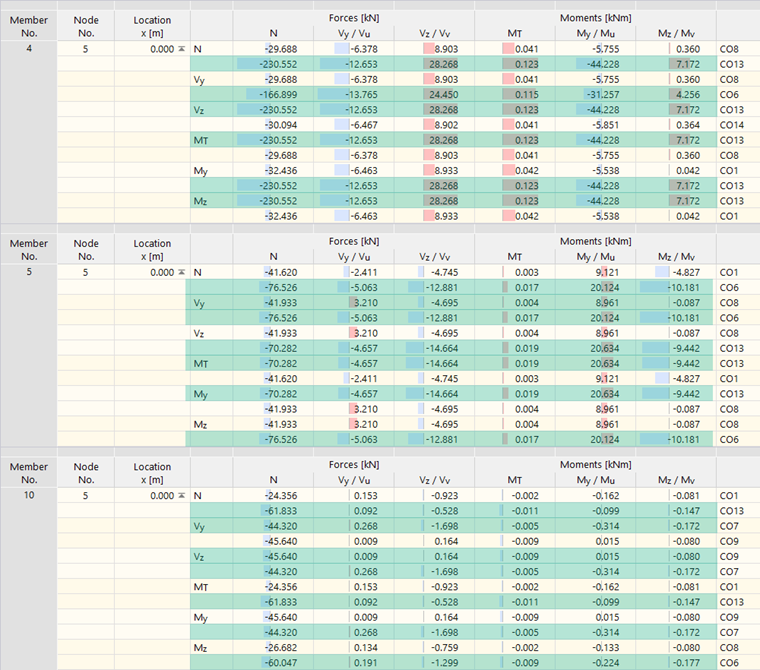
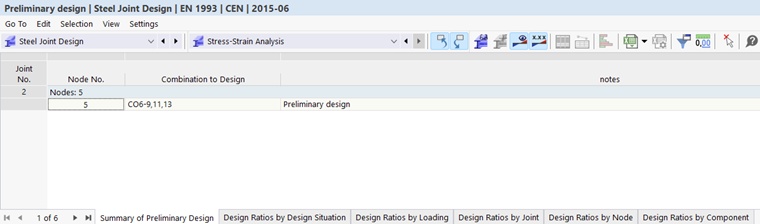
In the table, all lines determined as governing load combinations according to the assumptions explained above are marked. The column base is assumed to be supported, so the loads in the lower part of the column are not considered. Additionally, there is the case that LC 11 in member 4 causes a maximum shear force in z of 28.243 kN, which is within the 0.1% tolerance limit around the maximum shear force in z of the design situation in LC 13 (28.268 kN). This results in the reduced, probably governing load combinations 6, 7, 8, 9, 11, and 13, which are also stated in the 'Preliminary Design Summary' table. Thus, the combinations to be analyzed are reduced from 21 to 6.
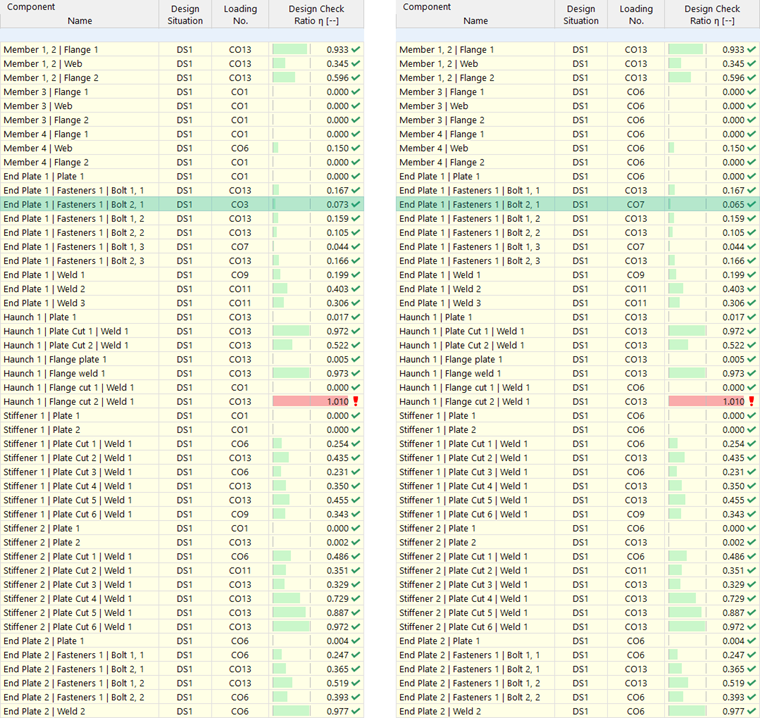
A comparison of the utilizations of the joint components with the complete design shows that the actually critically stressed components can already be correctly dimensioned based on the preliminary design. The utilization of a bolt of the end-plate connection, however, is underestimated by 0.8 %. The governing load combination here, LC 3, was not identified by the preliminary design. This illustrates the method's sensitivity to special load positions, although the error in this case, as in most other typical applications, is negligible.
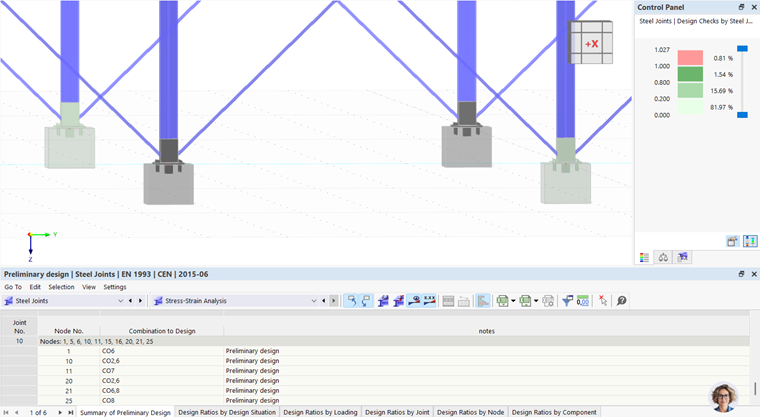
Since the determination of the probably governing load cases takes place on the substitute FE model, it often occurs for joints defined at multiple nodes that no load combinations are identified for a node at all. Consequently, there are also no results available for this node, leading to a missing graphical output. The corresponding nodes are then displayed in gray. The summary table of the preliminary design also lists which nodes have been designed.