


1. Introduction
Accurate assessment of wind actions on structures depends not only on the applied load model, but fundamentally on how the incoming atmospheric boundary layer (ABL) is represented. In practical engineering design, wind is a highly unsteady, turbulent, and spatially correlated phenomenon. However, most code-based approaches, including the standard Eurocode wind model, reduce this complexity to equivalent static quantities in order to ensure simplicity, robustness, and conservative safety margins.
In Computational Fluid Dynamics (CFD)–based wind simulations, the definition of the inlet boundary condition is a decisive factor for the accuracy of predicted surface pressures, peak loads, and dynamic effects.
The method documented here implements a random, spatially-correlated turbulent inflow generator on a vertical inlet plane (YZ plane) and is intended for:
- Transient CFD wind simulations
- Load-relevant pressure and force evaluation
- Validation against wind-tunnel–like inflow conditions
- Advanced applications beyond the conservative scope of the Eurocode
This approach goes significantly beyond the standard Eurocode (EC) wind model, which is primarily designed for static design load derivation, not for time-resolved flow physics.
2. Overview of the Implemented Method
The inflow generation consists of five coupled components:
2.1 Spatially Discretized Inlet Plane
- Inlet defined on a YZ plane at constant 𝑥=𝑥0
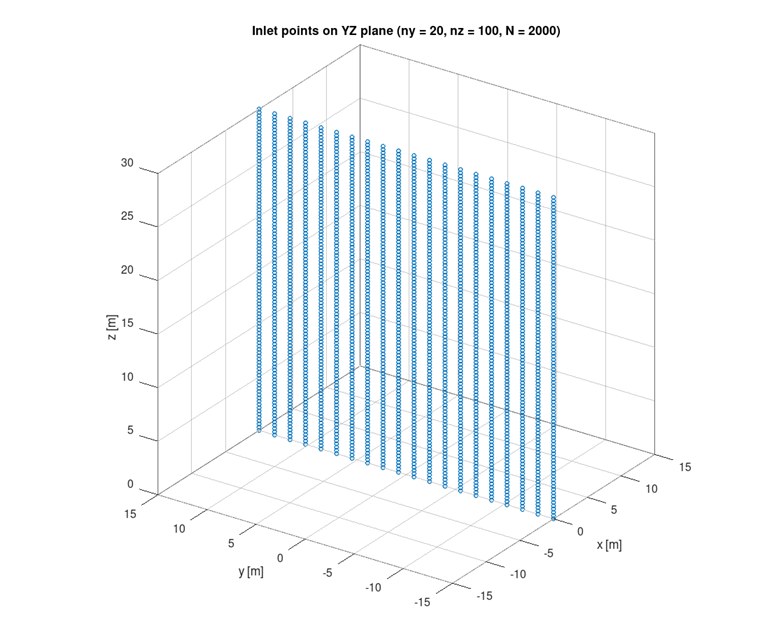
- Regular grid: 𝑛𝑦 × 𝑛𝑧 points (e.g. 20 × 100 → 2,000 probes)
- Each grid point represents a time-dependent velocity signal
- No spanwise averaging is applied (important for preserving fluctuations)
This allows vertical and lateral coherence effects to be physically represented.
2.2 Mean Wind Profile (Power-Law, Physically Enforced)
The mean wind profile is defined using a power-law formulation, an empirical engineering approximation that represents the increase of wind speed with height within the atmospheric boundary layer. The model relates velocity to a reference wind condition and terrain-dependent exponent. Although simpler than the logarithmic boundary layer formulation derived from the similarity theory, the power-law approach provides a practical and widely used inflow definition for engineering applications. The formulation ensures a consistent vertical velocity distribution referenced to a specified height.
|
U(z) |
Mean wind speed at height z above ground level |
|
Uref |
Reference wind speed |
|
z |
Height above ground |
|
𝑧ref |
Reference height |
|
α |
Power-law exponent (terrain exponent) |
2.3 Turbulence Model: Kaimal Spectrum
Turbulence at each inlet point is generated using the Kaimal spectrum, which represents atmospheric boundary-layer behavior and defines how turbulent energy is distributed across frequencies. This approach captures realistic frequency-dependent characteristics of wind fluctuations rather than assuming constant behavior. The model reflects turbulence intensity and characteristic length scales to describe the structure of velocity variations. As a result, the generated turbulence includes physically consistent energy content that varies with frequency. At each inlet point, turbulence is generated using the Kaimal autospectrum, consistent with atmospheric boundary-layer theory [1]:
|
Su(f) |
Longitudinal velocity power spectral density at frequency |
|
σu |
Standard deviation of the longitudinal velocity fluctuations |
|
𝐼𝑢 |
Turbulence intensity |
|
Lu |
Longitudinal integral length scale |
This produces frequency-dependent energy content, which is absent in the Eurocode static approach.
2.4 Spatial Coherence and Cross-Spectral Matrix
A spatial coherence model is applied to ensure a physically realistic correlation between inlet points by describing how turbulence similarity decreases with distance and frequency. This coherence function is used to define the relationship between signals at different locations, reflecting spatially correlated wind fluctuations. Based on this coherence, a full cross-spectral density matrix is constructed, combining individual spectra with their spatial correlation. The resulting matrix represents both the energy distribution and the spatial coupling of velocity fluctuations across the inlet. To ensure a physically realistic correlation between inlet points, a distance-dependent coherence model is applied:
|
γij(f) |
Frequency-dependent coherence function between inlet points i , j and |
|
f |
Frequency |
|
dij |
Euclidean distance between inlet points |
|
𝐶coh |
Coherence decay coefficient |
This results in a full cross-spectral density matrix:
|
Sij(f) |
Cross-spectral density between velocity signals at inlet points i and j |
|
Sii(f), Sjj(f) |
Auto-spectral densities at points i and j |
Key characteristics:
- Fully spatially correlated turbulence
- Frequency-dependent correlation decay
- Captures realistic gust structures across the inlet
2.5 Robust Cholesky Decomposition (Numerical Stability)
A robust Cholesky decomposition is applied to maintain numerical stability when the cross-spectral matrix becomes ill-conditioned, especially near the ground. The matrix is first symmetrized to ensure consistency, followed by adaptive diagonal loading to improve stability. An automatic retry strategy with increasing regularization is used if needed, ensuring positive definiteness. This approach enables stable and reliable generation of correlated time-series data. Because the cross-spectral matrix can become ill-conditioned (especially near the ground), a robust Cholesky factorization is used:
- Hermitian enforcement:
- Adaptive diagonal loading
- Automatic retry strategy with increasing regularization
This guarantees positive definiteness and stable time-series generation.
2.6 Time-Series Construction (Inverse FFT)
Random phases are introduced to represent turbulence within the signal, while the spectrum is scaled and structured to ensure a physically realistic real-valued result. An inverse FFT is then applied to transform the frequency-domain information into a time-dependent velocity signal. The final outcome is a velocity field composed of a mean flow combined with fluctuating components.
- Random phases applied per frequency
- One-sided spectrum scaled by sqrt(2Δ𝑓)
- Hermitian symmetry enforced
- Inverse FFT → time-resolved velocity signal at every inlet point
Result:
3. Visualization and Diagnostics
The method enables:
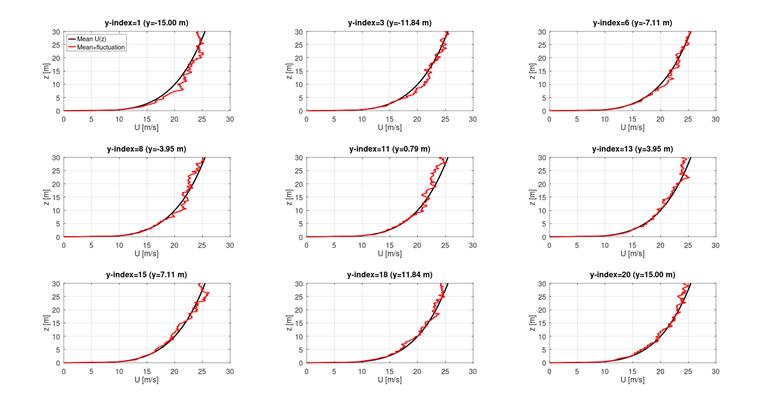
- Instantaneous vertical profiles 𝑈(𝑧,𝑡o)
- Multiple probe-line comparisons (no averaging artifacts)
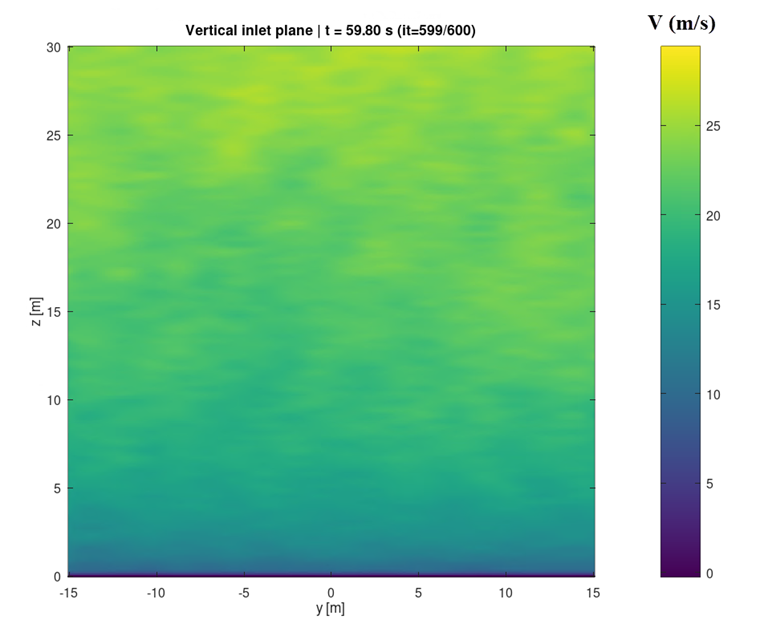
- Full inlet-plane contour animations 𝑈(𝑦,𝑧,𝑡)
This makes flow physics directly observable, unlike EC-based static profiles.
4. Comparison with the Standard Eurocode Wind Model
Table 1 summarizes the fundamental conceptual and methodological differences between the standard Eurocode (EC) wind model and the current random CFD inflow generation method. While both approaches aim to represent wind effects on structures, they are based on different modeling philosophies and serve different engineering purposes.
Table 1: Comparison with the Standard Eurocode Wind Model
| Aspect | Eurocode (EC) | Current CFD Inflow Method |
|---|---|---|
| Nature | Static / quasi-static | Fully transient |
| Turbulence | Implicit via factors | Explicit time-series |
| Spatial correlation | Not resolved | Fully resolved |
| Frequency content | Not present | Kaimal spectrum |
| Gust structure | Equivalent static gust | Physically evolving |
| Pressure peaks | Empirical factors | Emergent from flow |
| Load paths | Conservative envelope | Physics-based |
| Suitability | Code compliance | Advanced analysis & validation |
5. Key Differences in Interpretation
The Eurocode approach is primarily intended to ensure safe design loads by incorporating turbulence effects through partial safety factors, but it does not provide detailed insight into the timing or mechanisms of load development. In contrast, the current method enables deeper physical understanding by resolving when, where, and why peak pressures occur, including gust penetration, separation-induced pressure peaks, and spatially correlated loading effects. This makes it particularly valuable for lightweight structures, facade and cladding elements, membrane systems, roof-mounted equipment, and studies involving dynamic structural response:
📘Eurocode
- Designed to produce safe design loads
- Turbulence effects embedded in partial safety factors
- No information about when or how loads occur
🌬️Current Method
- Resolves when, where, and why peak pressures form
- Gust penetration
- Separation-induced pressure peaks
- Correlated loading over large areas
⭐Particularly important for:
- Lightweight structures
- Cladding and facade elements
- Membranes and roof equipment
- Dynamic response studies
6. Engineering Implications
The proposed method does not aim to replace the Eurocode for regulatory design; instead, it should be understood as a complementary approach that provides additional physical insight beyond the assumptions typically embedded in Eurocode procedures. It is particularly suitable for sensitivity studies, research and validation purposes, optimization processes, and for explaining discrepancies that may arise between Eurocode-based results and CFD simulations. In practical engineering applications, this approach often helps clarify why CFD-derived pressure values differ from Eurocode predictions, especially regarding local peak pressures and transient flow effects, without necessarily indicating an error in either methodology.
7. Summary
The presented inflow generation method introduces physically consistent turbulence modeling combined with spatial coherence and time-resolved wind field representation, supported by a robust numerical implementation. Compared to the standard Eurocode approach, the method shifts the analytical perspective from conservative load envelopes toward a physics-driven understanding of flow behavior, thereby enabling deeper insight and more advanced wind engineering analyses.