


In reality, singularities—or the resulting stress concentrations—do not occur to the same extent as they do in the model. Generally speaking, analyzing results in the vicinity of singularity points is not meaningful. However, examining and investigating these singularities is definitely worthwhile, as they can indicate problems in the actual model. A practical example in concrete design would be, for instance, examining the risk of punching shear in the vicinity of singularity points.
In concrete design in RFEM, singularities often result in non-designable situations.
Where can singularities occur?
- Point supports or load introduction
- Reentrant corners or corners of openings
- Changes in stiffness (for example, a change in plate thickness)
- The start and end of ribs
- The start and end of line supports or walls
Identifying Singularities
In FEM, singularities can be identified by refining the mesh at the corresponding location in the model using an FE mesh refinement. If the stress-dependent result value increases in the considered area, but the area in which it acts decreases, then it is very likely a singularity.
Counteracting Singularities
In RFEM 6, singularities and the associated non-designable situations can be counteracted in various ways.
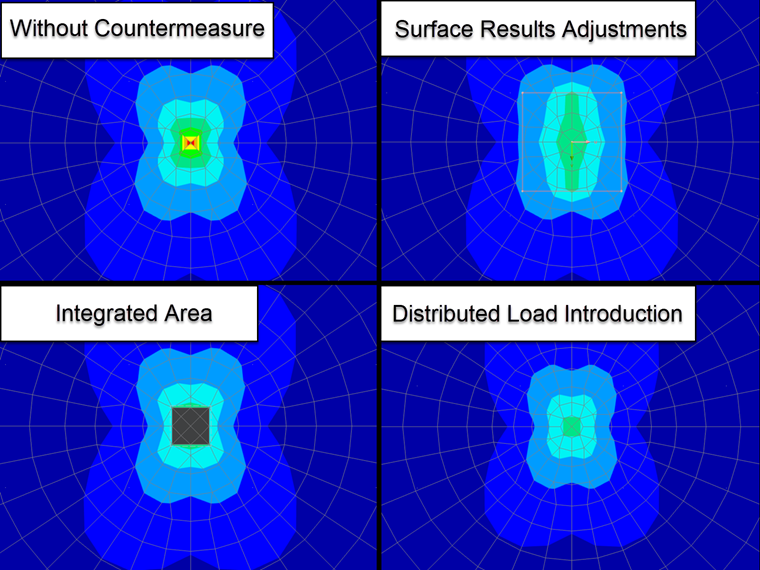
Surface Results Adjustments
RFEM 6 provides surface results adjustments that can be used to smooth out peaks in the results. The results within the specified area are displayed as mean values instead of the actual distribution. “Surface Results Adjustments” can be accessed under “Special Objects” in the Navigator. When performing a surface results adjustment, the underlying area must be specified based on engineering principles.
Integrated Surface
As an alternative to surface results adjustments based on the dimensions of the column cross-section, surfaces can be modeled and integrated into the existing surface. These surfaces must then be excluded from the design.
Distributed Load Introduction
To avoid singularity effects, concentrated loads or line loads can be converted into surface loads. A possible approach using “Free Rectangular Loads” is shown below. In the “Edit Global Parameters” menu, t represents the thickness of the concrete slab, F is the nodal load, and phi is the load distribution angle.
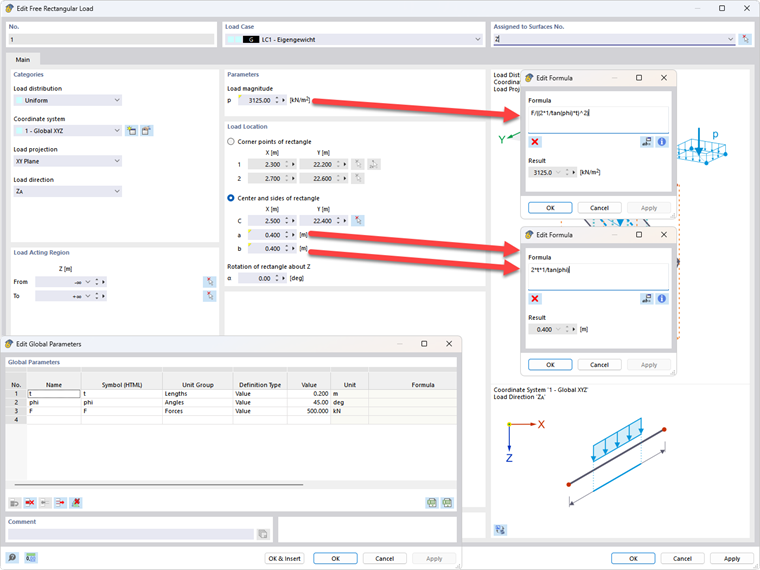
The two methods listed (surface results adjustments and integrated surface) can be applied to both columns and reentrant corners. In general, surface results adjustments are sufficient. However, for nonlinear calculations, surface results adjustments do not have the desired effect, as internal forces may redistribute during the calculation, potentially leading to new singularity effects.
Design Method for Slabs
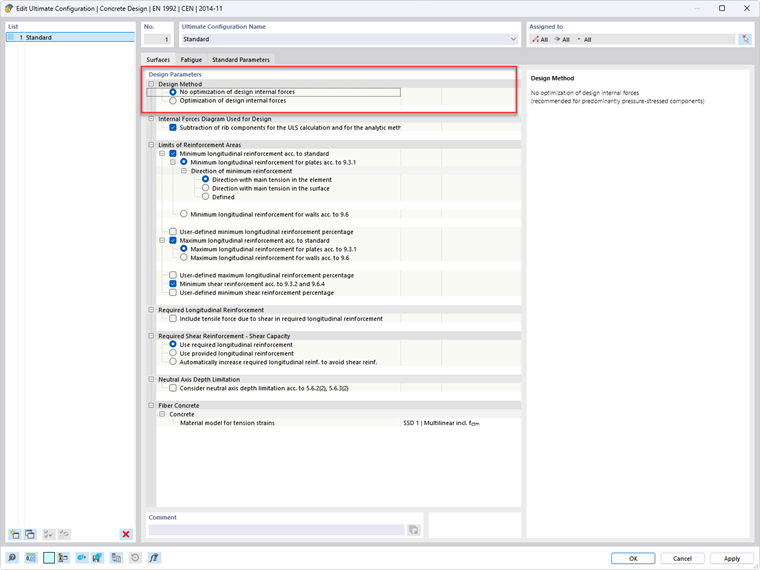
In slab design, singularities can occur due to high axial forces, for example, as a result of point supports. Additionally, the design method can have an amplifying effect on singularity effects or non-designable situations. For slabs, it is therefore recommended to deactivate the optimization of design internal forces (in the Navigator) under: “Concrete Design,” “Ultimate Configurations,” “Surfaces.”
Avoiding Nodal and Line Loads
To avoid singularity effects, it is recommended to use surface loads instead of nodal or line loads.
Rounding Reentrant Corners
For both reentrant corners and corners at openings, a corner can be rounded or chamfered using the “Round or Angled Corner” function, if necessary. Both functions can be accessed via “Tools” > “Modify Lines” in the menu bar. In general, however, many singularity effects can be sufficiently counteracted by using smoothing areas.
Supports
Avoiding singularities at nodal and line supports is explained in this technical article: