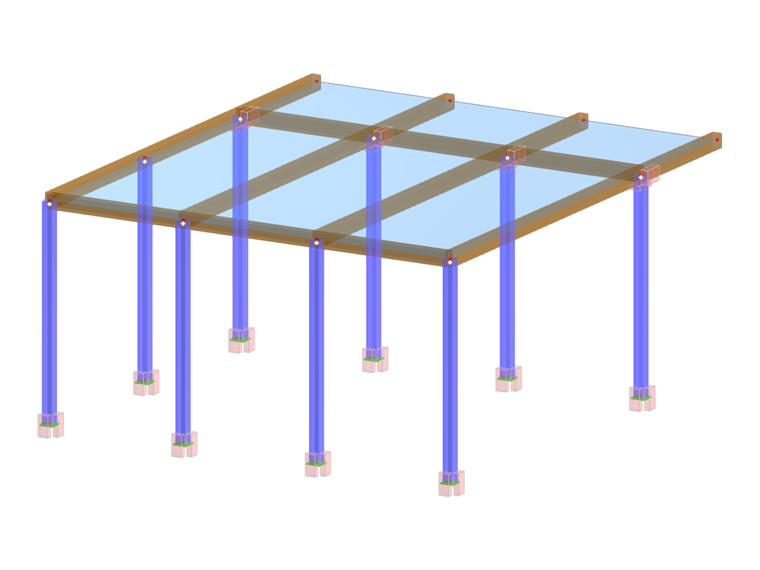
In the serviceability limit state, deformations are primarily analyzed and compared with the allowable limit deformations. To ensure compliance with the allowable limit deformations, it is necessary to dimension the member cross-sections accordingly. For this purpose, RFEM 6 and RSTAB 9 provide an automated cross-section optimization feature, which is explained in this article.
Application Areas
Cross-section optimization in the serviceability limit state is available as a feature for the following add-ons:
- Steel Design
- Timber Design
- Aluminum Design
All design standards available in the program are supported.
Input in Program
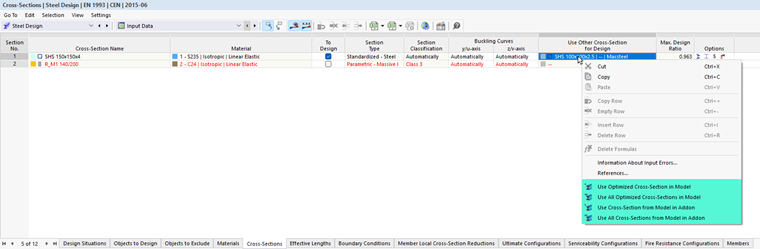
In the table, switch to the Input Data → Cross-Sections tab of the respective design add-on.
In the Use Other Section for Design column, select the Optimize option for all cross-sections you want to optimize.

You can now start the design process. The program automatically determines the most effective cross-section. Once the design is complete, you can review the optimized cross-sections and transfer them directly to the model, if desired.
Functionality
Cross-section optimization in SLS is performed iteratively, just as it is for ULS. The design checks are performed using the existing internal forces and deflections from the structural analysis. If any design limits are exceeded, the cross-section is enlarged. On the other hand, if all design limits are not met, the cross-section is reduced. The internal forces and deflections are not recalculated in this process; therefore, this method—particularly for nonlinear structural systems—represents an approximate solution, which is generally sufficient for predimensioning, however.
A distinctive feature of the SLS is that the cross-section properties are not included in the design check formulas, since only existing deflections are compared with allowable deflections.
To solve this problem, a factor α is introduced into the design check formulas, which represents the moment of inertia ratio of the optimized cross-section to the moment of inertia of the original cross-section. This factor is ultimately used to multiply the design ratio.
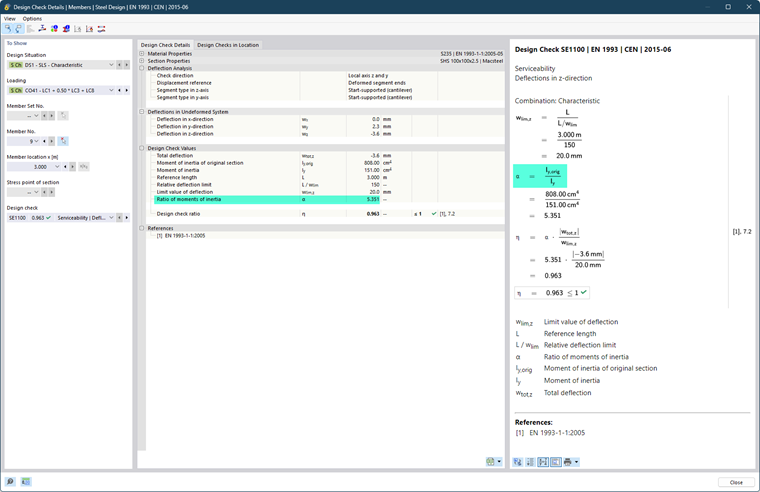
The alpha factor is calculated as follows for the general case (deformation analysis in the resulting axis).
For deformation analysis in the local axis direction, the expression simplifies to:
Special Considerations
Cross-section optimization in SLS is based on two prerequisites. If one of these prerequisites is not fulfilled, no optimization is performed for the relevant members or design checks. The prerequisites are as follows:
- Deformation reference “Deformed segment ends” selected
The deformation reference “Undeformed structural system” is not accepted for cross-section optimization. The reason for this is that, for example, in multi-story buildings, the total deformation of a member is primarily determined by the global building sway. The enlargement of a single cross-section has a minor influence on this deformation, which is why optimization in this case would often lead to nonsense results.
- No cross-section precamber
Members with a defined precamber are excluded from the cross-section optimization.