


Analytical Model
This study adopts the design criteria specified in EN 1993-1-8 for evaluating bolt resistance (shear and tension) and plate resistance (bearing and punching shear), utilizing the limit state formulations provided in Table 3.4.
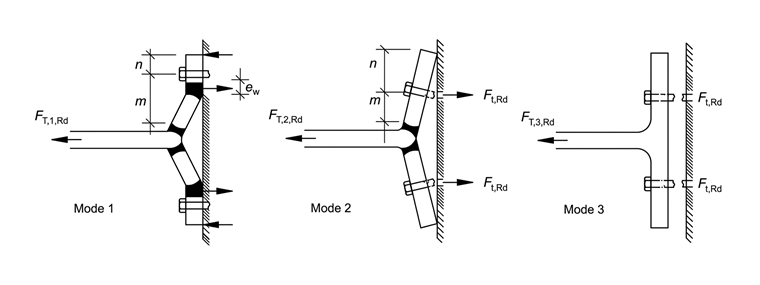
The design resistance of the equivalent T-stub is evaluated independently for the endplate and the column flange components. For each component, the governing design resistance, FT,Rd is defined as the minimum value derived from three potential failure mechanisms.
The individual resistance for each mode is calculated based on the plastic moment capacity of the flange (Mpl,1Rd and Mpl,2,Rd) and the tension resistance of the bolt group(∑Ft,Rd). These modes account for complete flange yielding (Mode 1), bolt failure coupled with flange yielding (Mode 2), and pure bolt fracture (Mode 3).
- Failure Modes:
- Plastic Resistance Moments:
Geometric Details of Beam-to-Column Connection
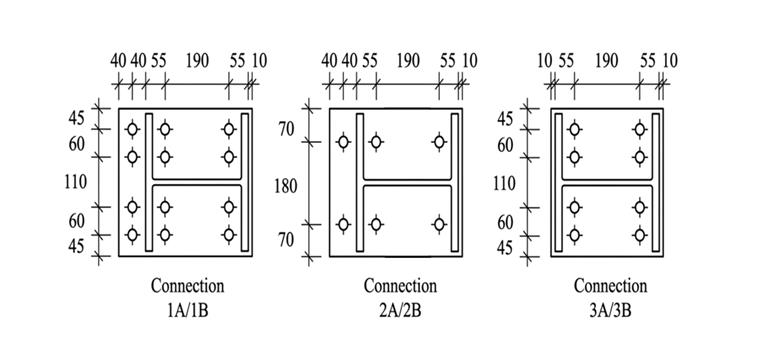
Consistent with standard construction practice, all beam and column members were fabricated from S235 steel, while the endplates utilized higher-strength S355 steel. The geometric configurations, including endplate and bolt group arrangements, are detailed in Image 2, with the corresponding experimental test matrix and measured material properties provided in Tables 1, respectively.
As defined in the test matrix, Group A (specimens 1A–3A) utilized an HEA 300 column section (tw = 8.5mm; tf = 14mm), while Group B incorporated the heavier HEB 300 section (tw = 11mm; tf = 19mm). To evaluate the performance of a weak-column strong-beam hierarchy, a uniform HEB 300 beam section and 30 mm thick endplates were maintained across all specimens, ensuring the Group A configurations were column-critical.
- Table 1: Geometric Configuration of Tested Specimens
| Specimens | Column Section | Beam Section | No. of Bolts | Length of Column | Length of Beam |
|---|---|---|---|---|---|
| T1A | HEA 300 | HEB 300 | 12 | 2 | 1.5 |
| T2A | HEA 300 | HEB 300 | 6 | 2 | 1.5 |
| T3A | HEA 300 | HEB 300 | 8 | 2 | 1.5 |
| T1B | HEB 300 | HEB 300 | 12 | 2 | 1.5 |
| T2B | HEB 300 | HEB 300 | 6 | 2 | 1.5 |
| T3B | HEB 300 | HEB 300 | 8 | 2 | 1.5 |
Discussion
Steel Joints for RFEM Solution
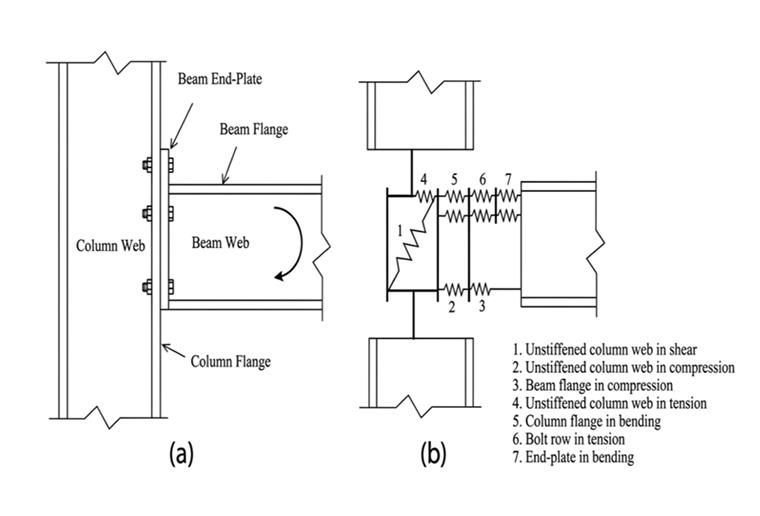
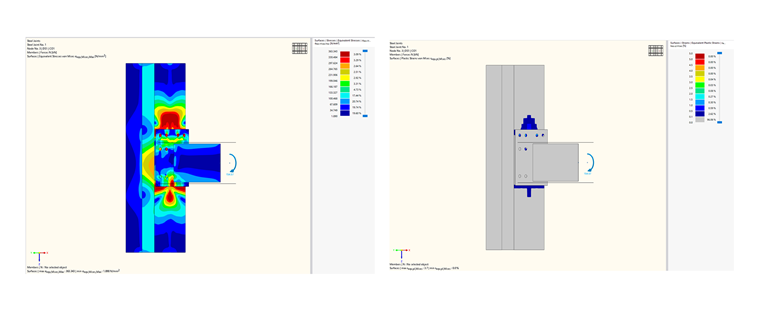
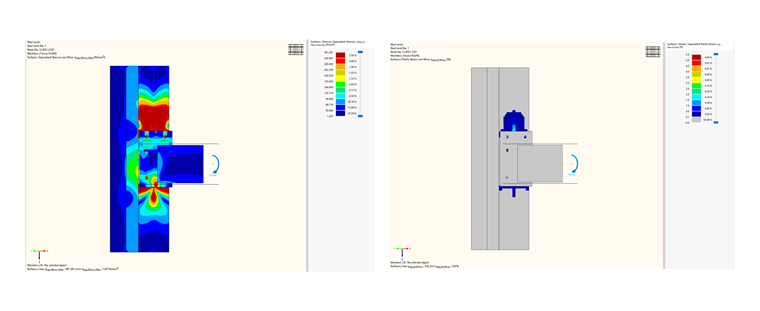
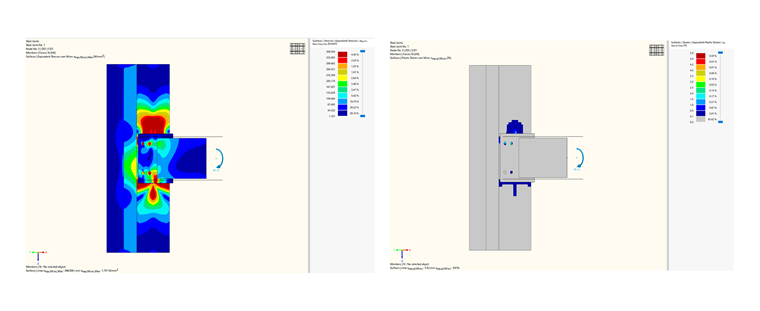
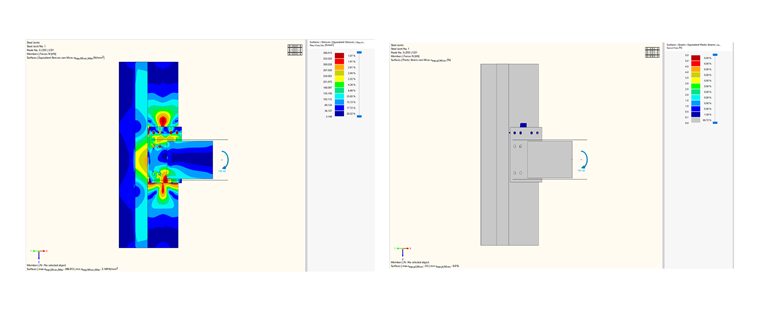
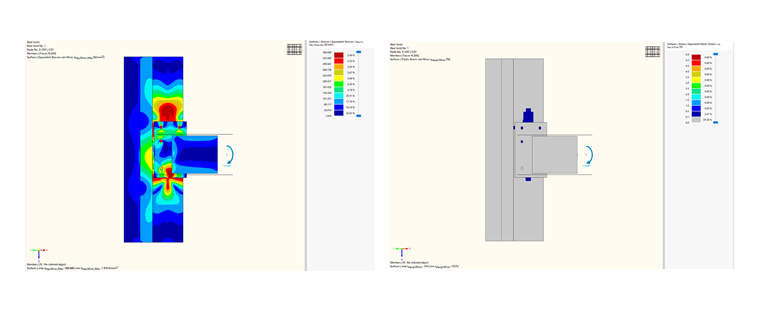
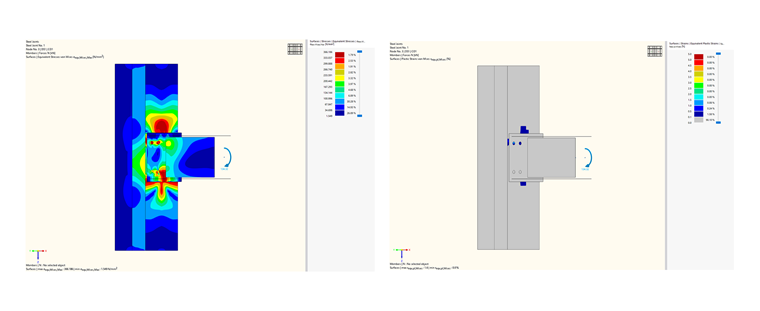
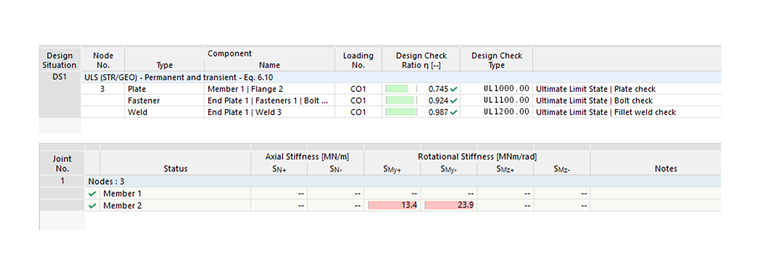
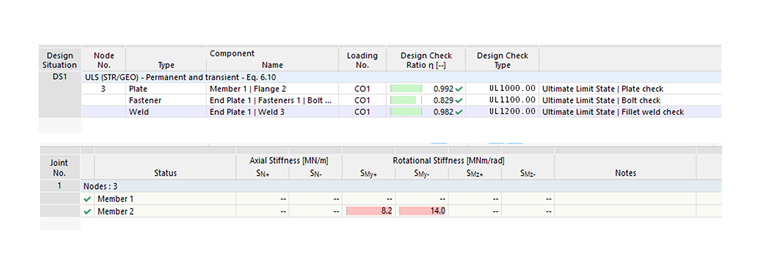
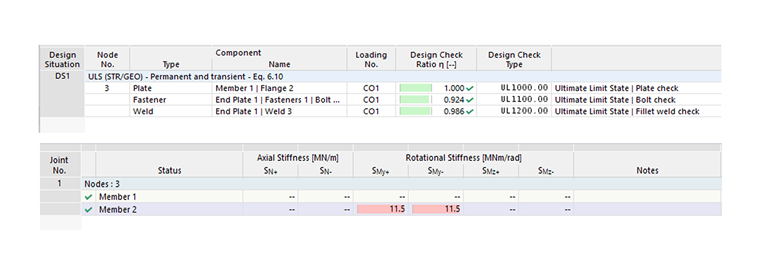
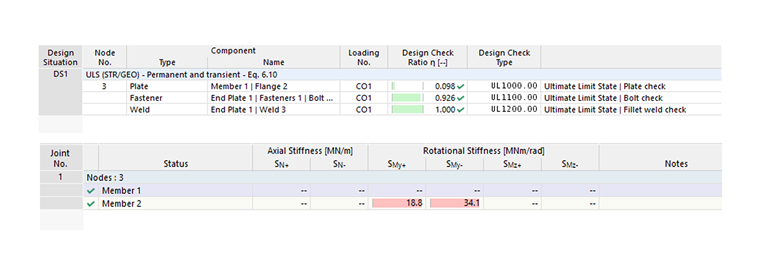
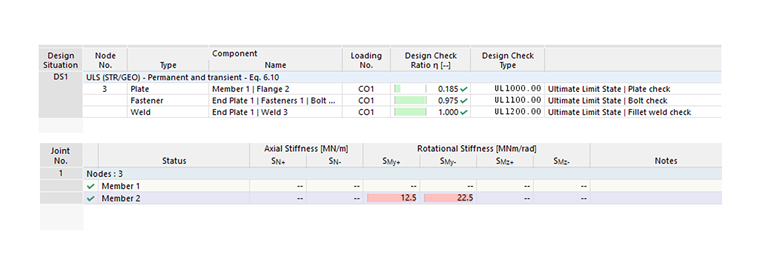
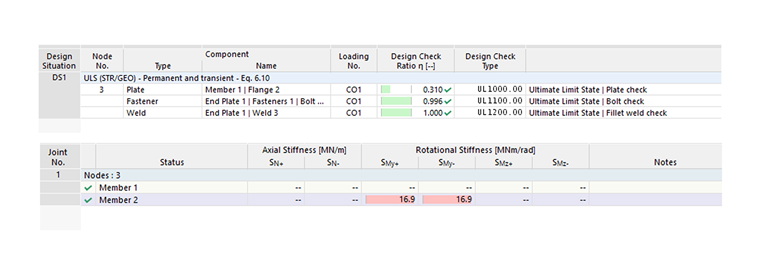
Utilizing the FE-based Steel Joints add-on for RFEM 6, the connection design process was fully integrated into the primary structural model. This study presents an experimental and numerical investigation into the structural performance of six extended thick end-plate beam-to-column connections, with a specific emphasis on the influence of non-conventional bolting patterns involving multiple bolts per row. To isolate the inherent rotational stiffness of the nodal zone, all specimens were configured without supplemental column web stiffeners. The experimental matrix interrogated two distinct failure hierarchies: (1) a weak-column/strong-beam configuration (HEA300 column; HEB300 beam) and (2) a balanced-stiffness configuration (HEB300 column and beam).
These investigations were augmented by targeted T-stub characterization and high-fidelity finite element (FE) analysis. Upon validation against experimental data and verification via Eurocode 3 (EC3) frameworks, the FE models were employed to extract granular insights into localized deformation mechanics. Image 4&5 and Table 2&3 illustrate the comparison of moment resistance and stiffness-Experimental, ROFEM, Steel Joints in RFEM to EC3. And Table-4 illustrates the failure modes.
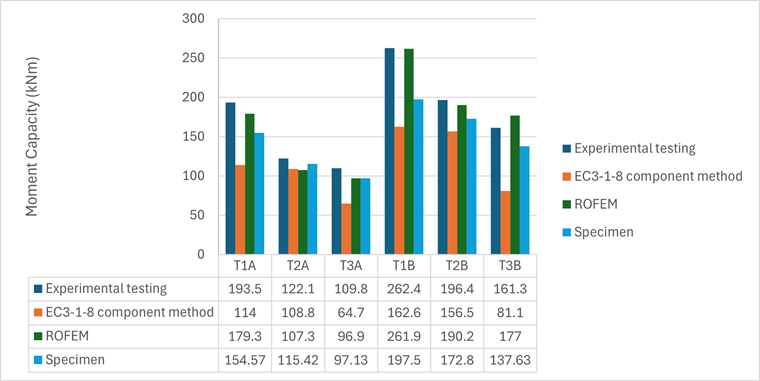
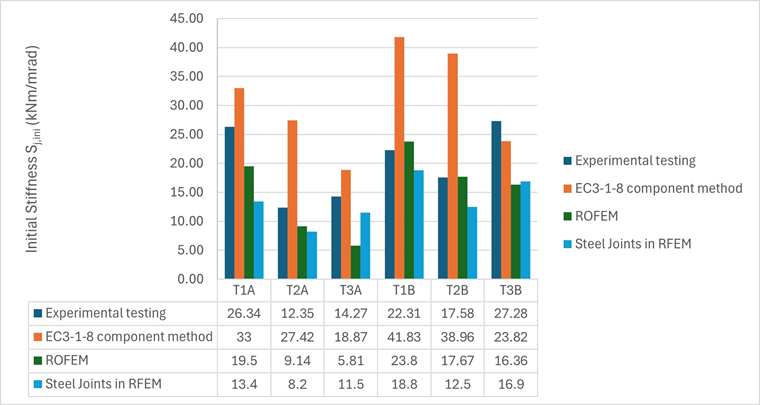
- Table 2: Comparison of Moment Resistance, Stiffness – Experimental, ROFEM, Steel Joints in RFEM & EC-3-1-8
| Specimen | No. of Bolts | Moment kN m, Mj.R | Initial Stiffness Sj,ini (MNm/rad) |
|---|---|---|---|
| T1A | 12 | 193.5 | 26.34 |
| T2A | 6 | 122.1 | 12.35 |
| T3A | 8 | 109.8 | 14.27 |
| T1B | 12 | 262.4 | 22.31 |
| T2B | 6 | 196.4 | 17.58 |
| T3B | 8 | 161.3 | 27.28 |
| Specimen | No. of Bolts | Moment kN m, Mj.R | Initial Stiffness Sj,ini (MNm/rad) |
|---|---|---|---|
| T1A | 12 | 114 | 33 |
| T2A | 6 | 108.8 | 27.42 |
| T3A | 8 | 64.7 | 18.87 |
| T1B | 12 | 162.6 | 41.83 |
| T2B | 6 | 156.5 | 38.96 |
| T3B | 8 | 81.1 | 23.82 |
| Specimen | No. of Bolts | Moment kN m, Mj.R | Initial Stiffness Sj,ini (MNm/rad) |
|---|---|---|---|
| T1A | 12 | 179.3 | 19.5 |
| T2A | 6 | 107.3 | 9.14 |
| T3A | 8 | 96.9 | 5.81 |
| T1B | 12 | 261.9 | 23.8 |
| T2B | 6 | 190.2 | 17.67 |
| T3B | 8 | 177 | 16.36 |
| Specimen | No.of bolts | Moment kN m, Mj.R | EC3/RFEM |
|---|---|---|---|
| T1A | 12 | 154.57 | 0.74 |
| T2A | 6 | 115.42 | 0.94 |
| T3A | 8 | 97.13 | 0.67 |
| T1B | 12 | 197.5 | 0.82 |
| T2B | 6 | 172.8 | 0.91 |
| T3B | 8 | 137.63 | 0.59 |
- Table 3: Stiffness Comparison
| Specimen | No. of Bolts | Initial Stiffness Sj,ini (MNm/rad) | EC3/RFEM |
|---|---|---|---|
| T1A | 12 | 13.4 | 2.46 |
| T2A | 6 | 8.2 | 3.34 |
| T3A | 8 | 11.5 | 1.64 |
| T1B | 12 | 18.8 | 2.23 |
| T2B | 6 | 12.5 | 3.12 |
| T3B | 8 | 16.9 | 1.41 |
- Table 4: Failure Modes
| Specimen | EC3 | Steel Joints in RFEM | Experiments |
|---|---|---|---|
| T1A | Column flange bending | Column flange bending | Column flange bending |
| T2A | Column flange bending | Column flange bending | Column flange bending |
| T3A | Column flange bending | Column flange bending | Column flange bending |
| T1B | Column flange bending | Column flange bending | Column flange bending |
| T2B | Column flange bending | Column flange bending | Column flange bending |
| T3B | Column flange bending | Column flange bending | Column flange bending |
Conclusion
Preliminary experimental data were used to assess the applicability of EN 1993-1-8 provisions to Steel Joints. In line with findings reported for conventional carbon steel members, the Eurocode stiffness model was found to overestimate the initial rotational stiffness, with the analytical predictions demonstrating considerable scatter relative to the measured values.
The experimental results confirm that both moment resistance and initial stiffness increase with bolt number, with 12-bolt specimens (T1A, T1B) consistently outperforming 6 and 8 bolt counterparts. The EC3-1-8 component method generally underestimates moment capacity while overestimating initial stiffness most notably for T1B (41.83 vs. 22.31 MNm/rad) consistent with the overestimation trend observed under EN 1993-1-8.
The EC3/RFEM ratios ranging from 0.59 to 0.94 indicate conservative moment resistance predictions from the Eurocode component method, with the low ratio for T3B (0.59) suggesting significant underestimation for certain connection geometries.