Modeling Combined Reinforcement in Steel-Fiber-Reinforced Concrete Foundation Slabs
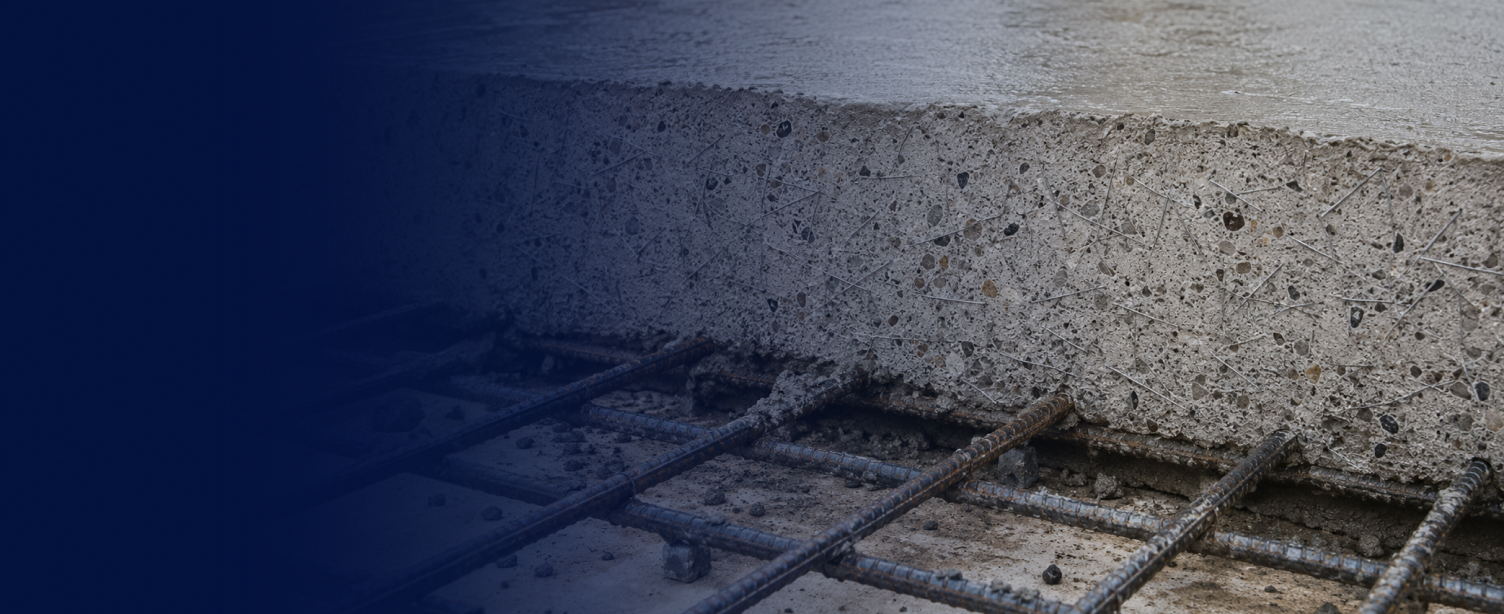
Industrial foundation slabs made of steel fiber-reinforced concrete, combined with reinforcing steel, present a unique structural challenge: The structural behavior results from the interaction of concrete, steel fibers, and conventional steel reinforcement, which is described by nonlinear material laws. Older software solutions were unable to perform modeling of this composite behavior in a single model. For projects such as a 400-meter-long battery cell factory, the enormous scale of the structure—with varying loads and highly stressed areas along its entire length—required a modeling approach that could provide precise analysis of both settlement differences and nonlinear deformation responses. The Excel calculations could cover only a portion of the required design checks, making a powerful FE solution indispensable.
Nonlinear RFEM 6 Workflow for Steel Fiber-Reinforced Concrete and Soil-Structure Interaction
RFEM 6 provides the engineering office Müller & Lobisch the ability to model steel fiber-reinforced concrete foundation slabs entirely within a single FE environment. Frank Lobisch defines user-defined stress-strain diagrams for steel fiber-reinforced concrete and ordinary concrete directly in RFEM 6—including the declining branch of the material curve, which he incorporated into the software in close collaboration with the Dlubal development team. The nonlinear material model for steel fiber-reinforced concrete is seamlessly linked to nonlinear soil models, resulting in an expanded margin of safety for the governing limit states. The majority of the required design checks are performed in RFEM 6; supplementary design checks are carried out as needed using custom Excel calculations.
Advantages of Using Dlubal Software
- Combined reinforcement in a single model — RFEM 6 integrates nonlinear material models for steel fiber-reinforced concrete with conventional steel bar reinforcement in a single environment, allowing for precise composite design.
- Maximum modeling flexibility — From individual connections to industrial floor slabs up to 400 meters long, RFEM 6 consistently and comprehensively models every scale.
- Nonlinear soil-structure interaction — The direct coupling of nonlinear material models with nonlinear soil models opens up new possibilities for foundation design and settlement analyses.
- Efficient design workflow — the vast majority of the required structural design checks are performed within RFEM 6, which reduces manual effort and ensures consistent, transparent calculations.