


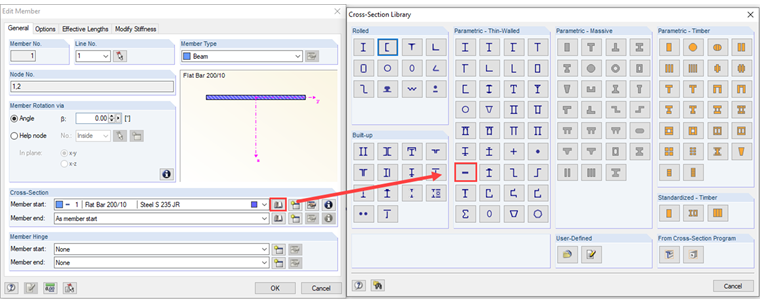
Most likely, the error is in the selection of the cross-section:
For steel design, a thin-walled flat bar cross-section should be selected instead of a rectangular solid cross-section.
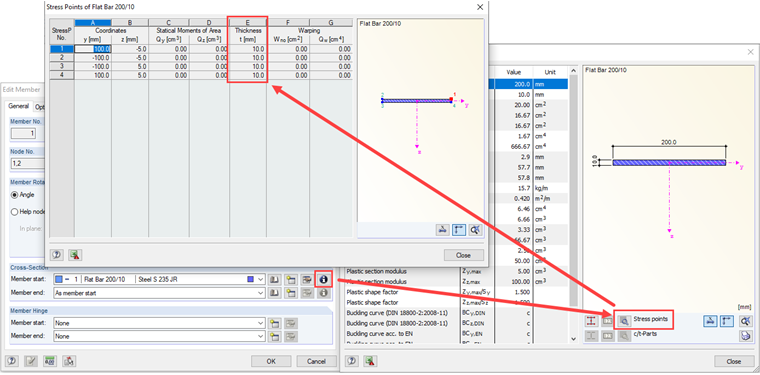
The high shear stress of a solid cross-section is due to the existing stress points of the cross-section, or the corresponding thickness of this stress point.
In the case of a thin-walled flat bar cross-section, there are four stress points at the corner points of the cross-section with the corresponding thickness t = 10 mm.
For a solid cross-section, however, there is another stress point in the center, where the maximum of height h or width b is assumed as the thickness t for this cross-section type. In this case, the width b is 200 mm.
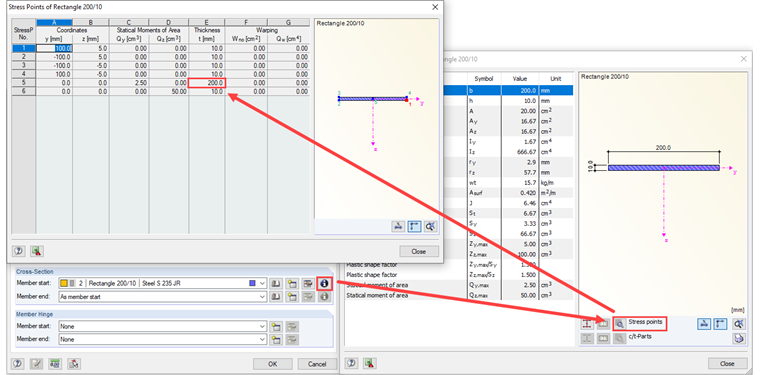
This results in a small torsional section modulus Wt and the correspondingly high shear stress.
The solution is, as described above, to select a flat bar in the main program.